This post is based on my reading of the section on the Cauchy problem in Arnold’s ODE.

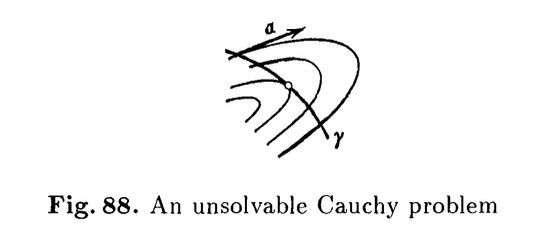
Definition: Given a vector field \alpha, the Cauchy problem for L_{\alpha} u = 0 is the problem of determining a function u from its values on a given hyper-surface, \gamma.

The first question we can ask ourselves is: when does the Cauchy problem not have a solution?

Recall that the first integral u is constant on any characteristic. Thus, if \gamma intersects a characteristic at 2 distinct points and the initial values assigned to these 2 points are different, then no such first integral solution exists.
Problem 1: Solve the Cauchy problem u|_{x=0} = sin(y) for the equation \frac{\partial u}{\partial x} - y \frac{\partial u}{\partial y} = 0.

The corresponding vector field is:

\dot{x} = 1

\dot{y} = -y

and the corresponding characteristics are y = Ce^{-x}.

The first integrals are functions that are constant on y = Ce^{-x}. Notice that one such function would be u_0(x, y) = ye^x. As mentioned in the previous post, all first integrals are functions of ye^x.

To satisfy the initial conditions, we also need u(0, y) = sin(y).

The function that we are looking for is:

u(x, y) = sin(ye^x).

Problem 2: Which points of the line x = 1 are non-characteristic for the equation y\frac{\partial u}{\partial y} - x \frac{\partial u}{\partial y} = 0?

The corresponding vector field is:

\dot{x} = y

\dot{y} = -x

and the characteristics are the family of circles centred at the origin.
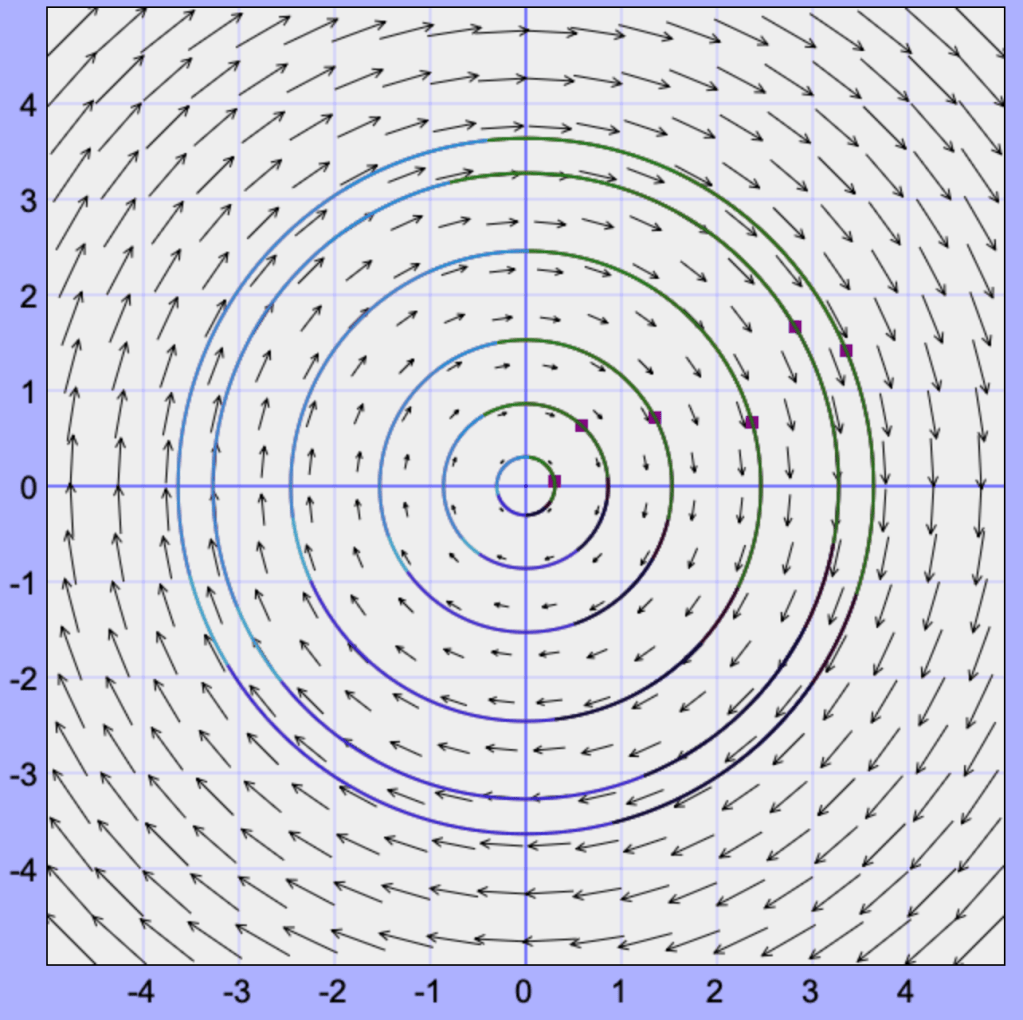
Notice: the characteristic x^2 + y^2 = 1 is tangent to our initial surface x = 0 at the point (1, 0). All circles with radius greater than 1 intersect x = 0 at two points.

Functions of u_0(x, y) = x^2 + y^2 are first integrals (can we say the converse holds as well?).

We also need u(x, y) = y^2.

Since u(1, 0) = 0, this tells us that u is equal to 0 on the unit circle.

One possible function is u(x, y) = x^2 + y^2 - 1.

Are there any other first integrals that might work?

Yes, let’s consider things in terms of the polar coordinates. Then, notice that we only require:

u(r, \theta) = r^2 - 1 for all r \geq 1.

We can smoothly extend u(r, \theta) to $latexx 0 < r < 1$ in a way that u(r, \theta) \neq r^2 - 1 in this interval. So more that one possible answer exists.

Why does not uniqueness not hold in this case? x = 1 is NOT a Cauchy surface. The set of characteristics with r < 1 does not intersect with x = 1. Hence, the initial conditions imposed does not determine the values on them.

Cauchy Problem for Inhomogeneous Linear Equations

Instead of studying equations of the form L_{\alpha} u = 0, we now study equations where the LHS is a function of x_1, ..., x_n, i.e. L_{\alpha} u = b(x_1, ..., x_n).

Theorem: In some sufficiently small neighbourhood of any non-characteristic point of the initial surface, the solution exists and is unique.

Key observation: Suppose u(x_1, ..., x_n) to be a solution and \phi(t) to be a phase flow. Then, \frac{d}{dt} u \circ \phi = b. Why?

\frac{d}{dt} u \circ \phi = \begin{bmatrix} \frac{\partial u}{\partial x_1} \\ . \\ . \\ . \\ \frac{\partial u}{\partial x_n} \end{bmatrix} \dot{\phi} (*)

By definition, \dot{\phi}|_{p} = (a_1(p), ..., a_n(p)) =: \alpha(p) is the vector belonging to the vector field \alpha at point p.

Hence,

(*) = a_1 \frac{\partial u}{\partial x_1} + ... + a_n \frac{\partial u}{\partial x_n}

= b(x_1, ..., x_n) (by definition).

What does \frac{d}{dt} u \circ \phi = b tell us?

Physically, this implies that the increment of u along a segment of \phi is equal to the integral of b with respect to the time of motion along this segment, i.e.

u \circ \phi(t) - p = \int_0^t \frac{d}{dt} u \circ \phi dt = \int_0^t b(\phi(t))dt.

We can simplify the RHS by supposing that within the neighbourhood of p, a_1 \neq 0 (otherwise, we can just relabel. We know that at least one of the a_i‘s is not zero since p is not a characteristic point.).

Then, instead of considering the vector field (\dot{x}_1, ..., \dot{x}_n) = \alpha = (a_1, a_2, ..., a_n), we consider its scaled version:

(\dot{x}_1, ..., \dot{x}_n) = \tilde{\alpha} = (1, \frac{a_2}{a_1}, ..., \frac{a_n}{a_1}).

The 2 vector fields share the same phase curves.

Notice that \dot{x}_1 = 1 (x_1 has unit velocity), this means that dx_1 = dt, and so:

\int_0^t \frac{d}{dt} u \circ \phi dt = \int_0^{x_1} \frac{b}{a_1} dx_1.

We have in turn found the unique expression for the solution near p.

Let’s better understand the above by working through an example.

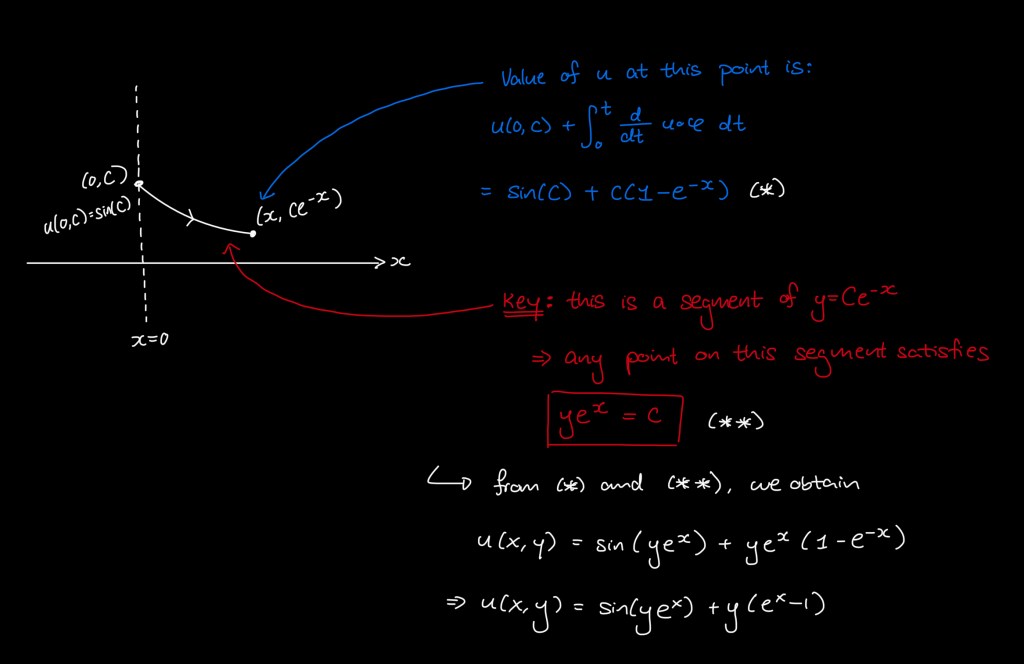
Problem 3: Solve the Cauchy problem u|_{x=0} = sin(y) for the equation \frac{\partial u}{\partial x} - y \frac{\partial u}{\partial y} = y.

Recall from above that the characteristics are y = Ce^{-x}.

We know that for a given phase flow \phi(t) (corresponding to the characteristic y = C_0 e^{-x}):

\frac{d}{dt} u \circ \phi = y = C_0e^{-x}.

Geometrically, this means that the value of u on a characteristic y = C_0 e^{-x} varies with velocity C_0 e^{-x}.

Thus,

u \circ \phi(t) - u \circ \phi(0) = \int_0^t \frac{d}{dt} u \circ \phi dt = \int_0^x C_0 e^{-x} dx = C_0(1 - e^{-x}).

Leave a Reply

Is this your new site? Log in to activate admin features and dismiss this message
Log In