This post is based upon my reading of a section of Chapter 2 of Arnold’s ODE.

Recall: given a vector field V on M, it is uniquely associated with the differential operator L_{V}, i.e. the operator that differentiates a function f: M \rightarrow \mathbb{R} along V.

Definition: we say that u: M \rightarrow \mathbb{R} is a first integral of \dot{x} = V(x) if L_{V} u = 0.

It is obvious that the first integrals of \dot{x} = V(x) are solutions of the corresponding PDE L_V u = 0 and vice versa.

Notice that there are 2 relatively obvious, yet geometrically important, properties that can be taken as equivalent definitions for first integrals:

  1. u is constant along the characteristics (i.e. the phase curves) of V.
  2. Each characteristic belongs to one and only one of the level sets of u>

Example: Let’s look at the vector field on \mathbb{R}^2 given by:

\dot{x}_1 = x_1

\dot{x}_2 = x_2

This corresponding differential operator is given by x_1 \frac{\partial}{\partial x_1} + x_2 \frac{\partial}{\partial x_2} = 0.

The phase curves are the set of rays emanating from the origin and the origin itself:
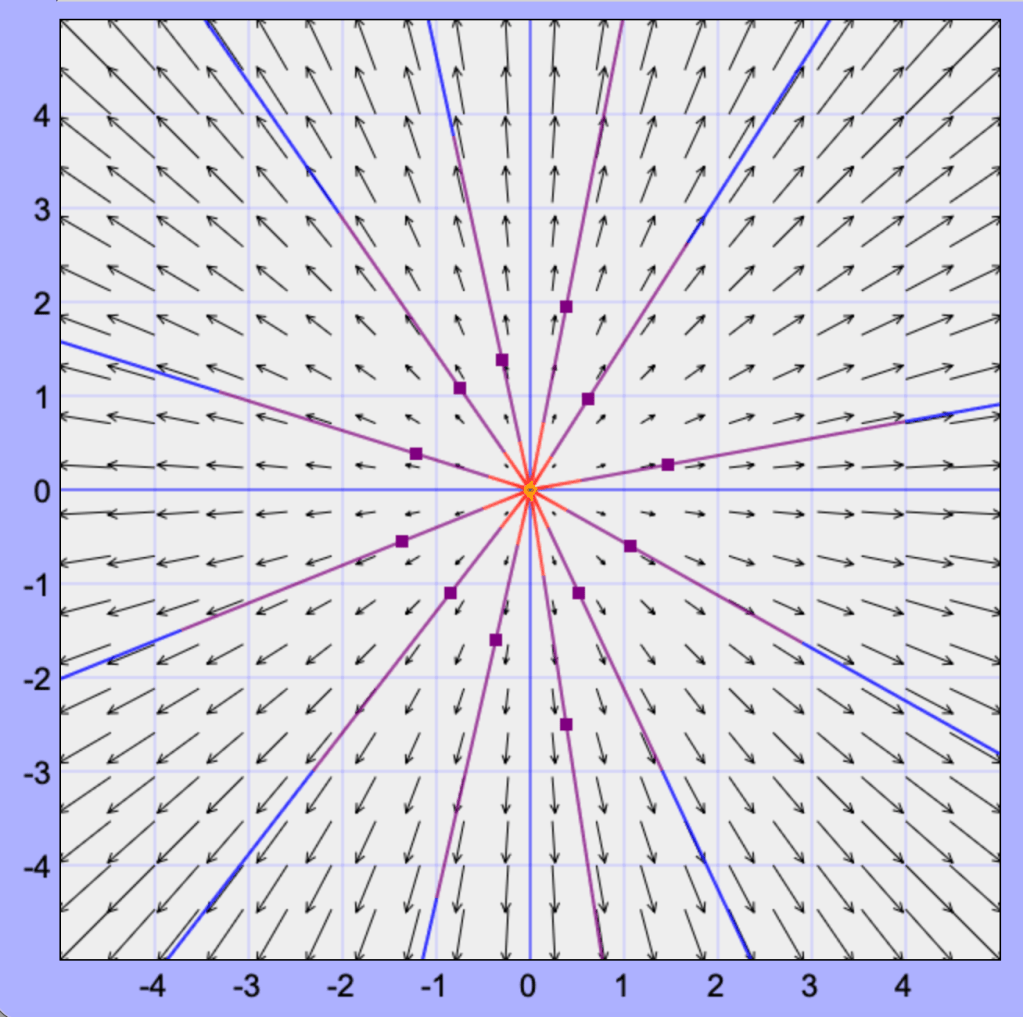
The first integrals of this vector field are constant along each ray and continuous on \mathbb{R}^2. This means that all the first integrals are constant on \mathbb{R}^2, i.e. the set of solutions for the PDE x_1 \frac{\partial u}{\partial x_1} + x_2 \frac{\partial u}{\partial x_2} = 0 is the set of constant functions.

Note: we can apply similar argument to show that in a neighbourhood of a limit cycle, all first integrals are constant. This is because a phase curve passing through a point in a small neighbourhood of a limit cycle converges to the cycle as t \rightarrow \infty. Since a first integral must be constant on the phase curves and is continuous on \mathbb{R}^2, the value of the first integral on any of the phase curves close enough to the cycle must be the same as the value of the first integral on the limit cycle.

Problem: For which k does the system of equations \dot{x}_1 = x_1, \dot{x}_2 = kx_2 on \mathbb{R}^2 have a non-constant first integral?

The phase curves for this vector field are given by:

x_1(t) = x_1(0) e^t

x_2(t) =x_2(0) e^{kt}

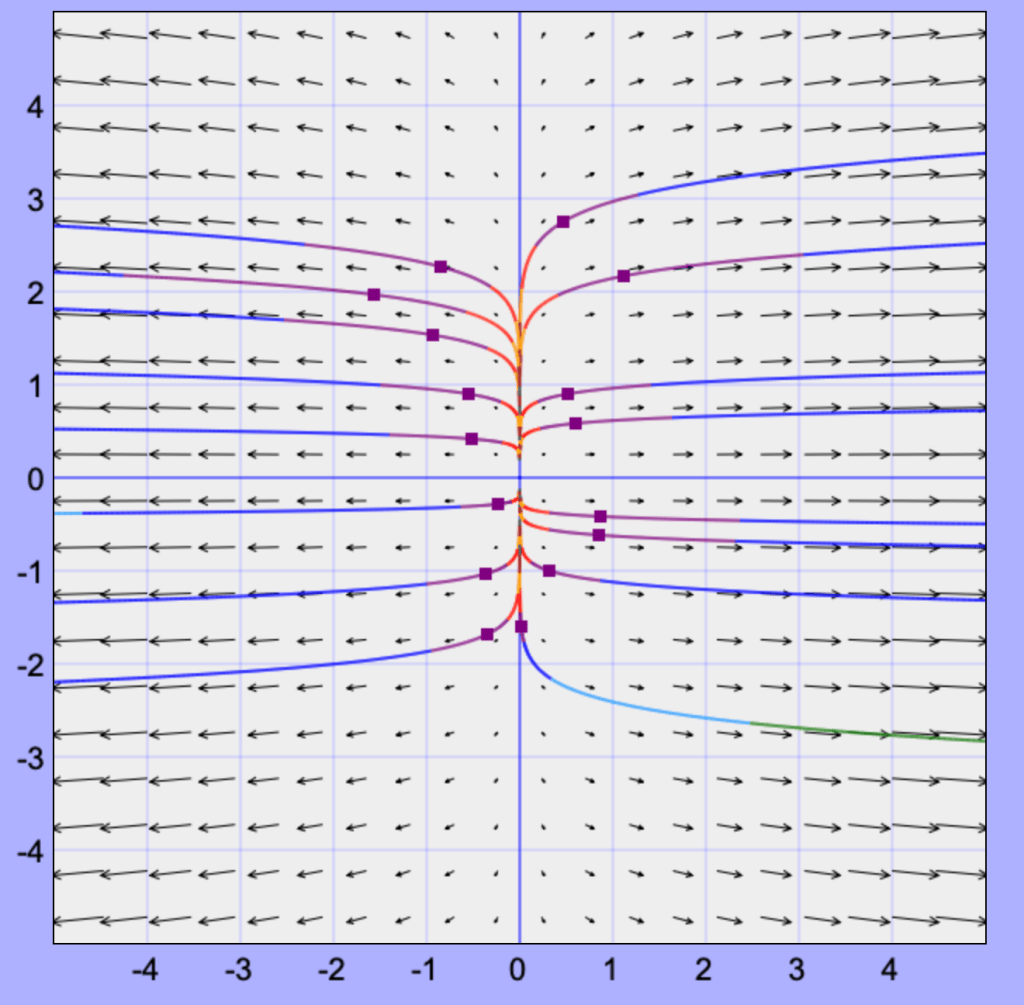
When k > 0, the phase curves consist a set of ‘curvilinear’ rays emanating from the origin and the origin itself. Again, we can argue by continuity that the first integrals must be constant.

Phase curves for when k = 0.1

When k = 0, the phase curves are the set of rays parallel to the x_1 axis. The function f(x_1, x_2) = x_2 is a non-constant first integral of this vector field.

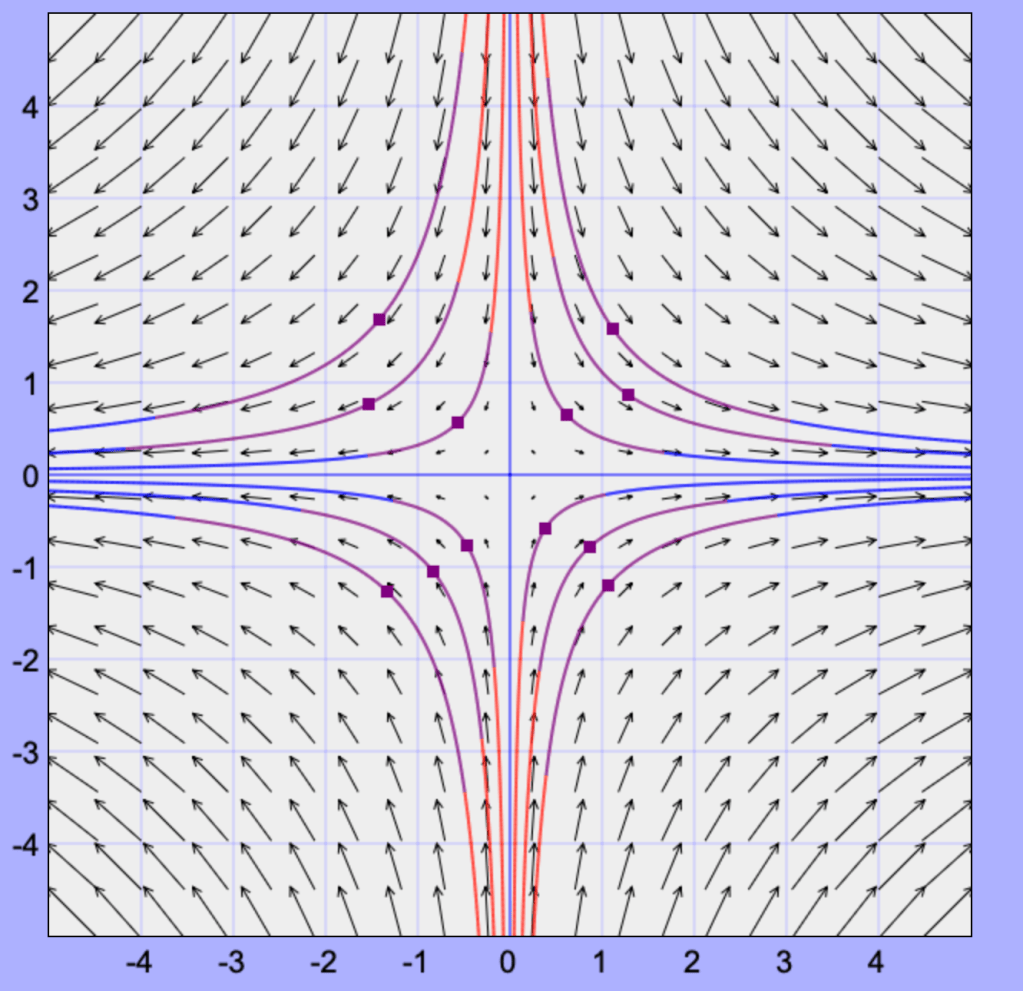
When k < 0, the phase curves are no longer rays emanating from the origin. In fact, most of them reach infinity within finite time.

Phase curves for when k = -1.

For k = -1, the curves are the branches of the hyperbolas y = \frac{C}{x} and x = \frac{C}{y}, where C \in \mathbb{R}, and the origin. A non-constant first integral would be f(x_1, x_2) = x_1 x_2.

In fact, for all k < 0, there exists non-constant first integrals. How do we find a solution for a general k < 0 value?

The better question would be: given the phase curves, how do we find the first integrals? i.e. how are the first integrals of \dot{x} = v(x) related to the solutions for \dot{x} = v(x)?

Example: Given \frac{\partial u}{\partial x} - y \frac{\partial u}{\partial y} = 0.

The corresponding vector field is:

\dot{x} = 1

\dot{y} = -y

And the phase curves are given by y = Ce^{-x}.

What are the first integrals u(x, y)?

Key observation: If u(x, y) is a first integral, then u(x, Ce^{-x}) = \text{constant} for all C \in \mathbb{R}. It is easy to see that one such function is u_0(x, y) = y e^{x}. And all functions of u_0 also satisfy.

Theorem (I will write the proof in the following post):

There exists a neighbourhood of V of x_0 (where x_0 is a non-singular point) such that in V, \dot{x} = V(x) has n-1 functionally independent first integrals: f_1, ..., f_n and any first integral of the equation is a function of f_1, ..., f_{n-1}

Since the vector field V(x, y) = (1, y) does not have any singular points, it follows that the set of functions of u_0(x, y) = y e^{x} is the set of solutions to the PDE.

What about when the vector field has a singular point?

For instance, are all the first integrals of \dot{x} = x, \dot{y} = -y on \mathbb{R}^2 functions of xy?

No. Arnold claimed that there exists a solution for which u(1, 1) \neq u(-1, -1). How can we find such a solution?

Leave a Reply

Is this your new site? Log in to activate admin features and dismiss this message
Log In