This post is based upon my interpretation of the first part of the 3rd chapter of Arnold’s PDE Huygen’s Principle in the Theory of Wave Propagation.
We all be considering manifolds living inside the space-time , where is the physical space and . For simplicity, let’s call and .
At each point (where and ), there is a cone of possible velocities of motion.
Example (field of Lorentz quadratic cones):
Suppose that is a Riemannian manifold.
We look at the graphs of all possible motions with unit velocity. By definition, at each point on , the graphs would be tangent to the quadratic cone (defined by the Riemannian metric). Thus, at each point with , we have a cone of motions of unit velocity. We can extend this construction to all . Thus, is endowed with a field of Lorentz quadratic cones.
Projectivization of the tangent space to M
Consider . Since , and . Then, the projectivization of is the space of lines passing through in . By definition, this is isomorphic to . The key point is that we are no longer tracking the magnitude of the tangent vectors, we are only concerned with the directions of these vectors. That is, if we interpret this physically, we are only considering the directions that we can move away from p while keeping us tangent to M.
If we instead consider the space of rays passing through p in , this would be isomorphic to .
The space of lines passing through is dual to the space of hyperplanes passing through (each hyperplane corresponds uniquely to the line orthogonal to it). We can assign orientation to the tangent plane by assigning one of the two rays orthogonal to the plane. This space can be better understood as the spherization of the cotangent space of . Recall, the contangent space (or the space of 1-forms) is isomorphic to the actual tangent space, i.e. each tangent vector corresponds uniquely to a 1-form. A hyperplane is the null set of a 1-form. The spherization of the space of 1-forms is to identify the 1-forms up to a positive scaling, i.e. we consider the set of all 1-forms corresponding to the vectors lying on a ray to be the same 1-form; this 1-form corresponds to a unique hyperplane. We say that these hyperplanes are co-oriented, i.e. their orientation is given by the orientation of their corresponding 1-form.
Contact elements
Contact elements are the non-co-oriented hyperplanes in the tangent space (and the ones that are co-oriented are called co-oriented contact elements.
Example: the set contact elements for is .
Fresnel hypersurface
Recall the field of cones of possible velocities we defined above. We now consider the set of hyperplanes tangent to the cone at each point on M. Since each cone is of dimension n, it follows that the set of tangent hyperplanes is a hyper surface in the manifold of contact elements. This hyper surface is called the Fresnel hyper surface.
Constructing the Tautological Field
The tautological field is the field of hyperplanes in the tangent spaces of the manifold of contact elements that is invariantly determined by (this is the bundle of the manifold of contact elements over M).
How do we see ? How do we see its tangent space?
Example: suppose
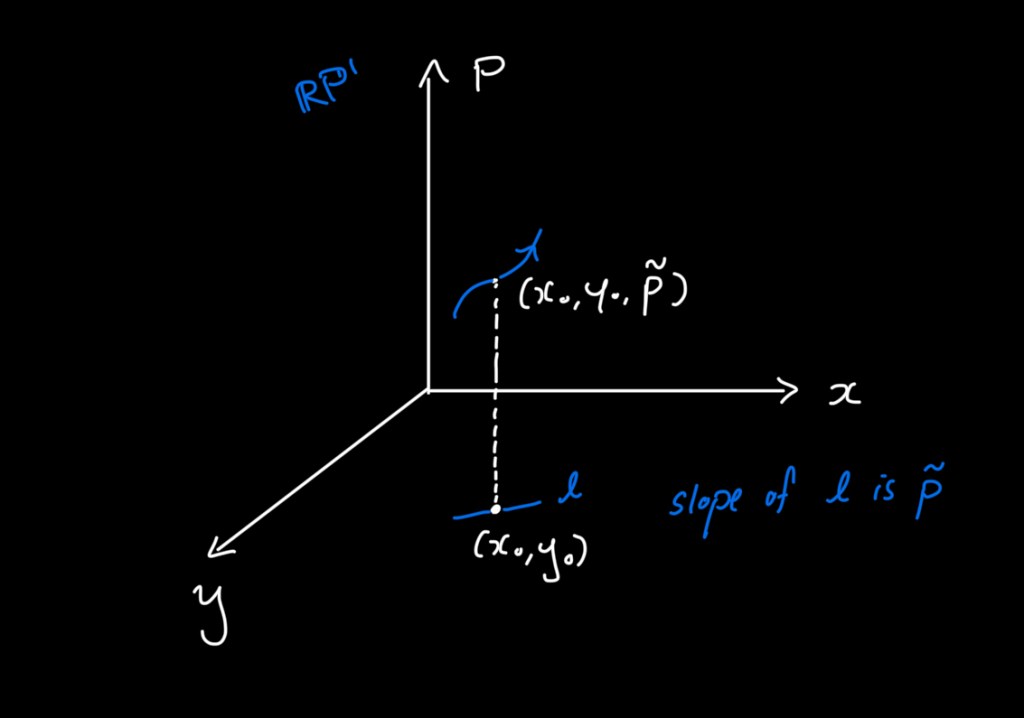
Consider the space of ‘1-jets’ of curves in (NOT functions). This would be the space (because an infinite slope is now possible). Then this space is . For a given ; tells us the location of the contact element on and tells us the slope of the line (which in this case is the hyperplane) passing through . The tangent space of the space of contact elements at a point lives inside this space of 1-jets; it is the space of all motions (to be precise, it would be the space of equivalence class of motions) in passing through a point such that the projection of this motion onto the (x, y)-plane in a neighbourhood of is the line with slope passing through .
The tangent space of the space of contact elements is of dimension 3. The hyperplane corresponding to a contact element, , is the set of all motions passing through , whose projection onto the (x,y)-plane near is the line of slope passing through . This set of motions gives us the hyperplane in whose projection onto the (x, y)-plane is ; it is given by:
.
Looks familiar? This is the standard contact structure that Arnold has defined in the previous 2 lectures.
We can extend this construction of tautological field to a general manifold M. Each contact element on M corresponds to a hyper-plane in the tangent space of M. The hyperplane that we are looking for is the pre-image of this hyperplane under the projection , given by mapping the space of contact elements at each point to . More precisely, the pre-image is given the image of the hyperplane, which can be identified as an element of , under the inverse of .




Leave a Reply