This post is based upon the reading of the first part of the chapter: Manifolds of n dimensions of Penrose’s The Road to Reality. We will examine the configuration space of an ordinary rigid body in the 3-dimensional Euclidean space. Claim: this is a non-Euclidean 6-manifold.
Where does the 6 dimensions come from?
Position of the centre of gravity: this is a point in the 3-dimensional Euclidean space.
Rotational orientation: this is determined by an axis of rotation (i.e. a line passing through the origin of 

The 3-dimensional sub-manifold corresponding to the position of the centre of gravity is just
How do we see that it is non-Euclidean?
One way would be to find closed loops on this manifold that cannot be shrunk to a point, i.e. we show this manifold is not simply connected.
What is a closed loop in our configuration space?
Given an initial point on this 6-manifold, i.e. a given centre of gravity and rotational orientation. Then, a loop beginning and ending at this point is a continuous motion of translations of the centre of gravity and rotations that returns back to the original centre of gravity and rotational orientation at the end.
Let’s consider the following loop.
Given a book (with an initial position and rotational orientation) connected to the wall by a belt. Rotate the book around the axis in the direction normal to the wall by 
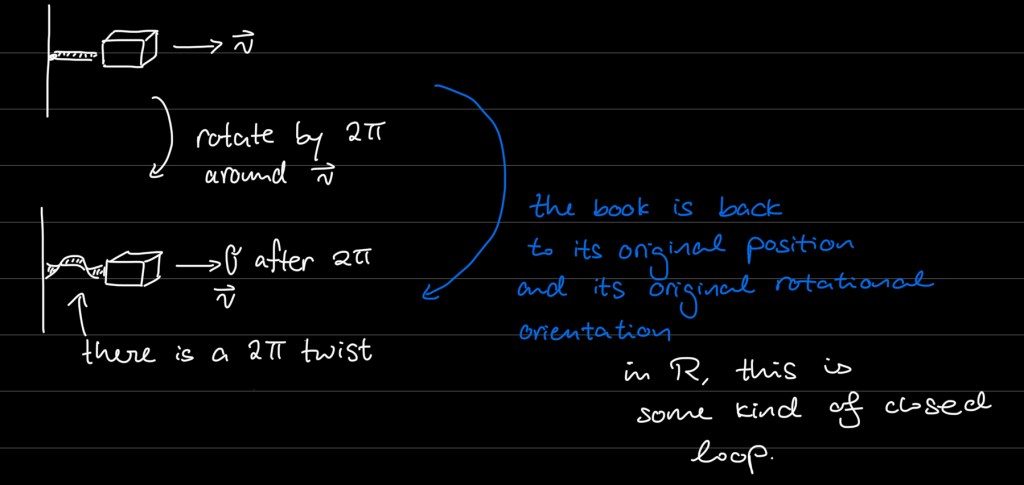
So, can we deform the
A deformation of a loop in this space is a continuous belt motion that leaves the book unmoved in its initial position. This makes sense since the initial state of the book is the base point of our loop in the space. If the book is moved (either changes position or changes rotation), then the entire loop would have moved.
But as we can easily see, no motion of the belt alone will untwist the
What is more interesting is that should we rotate the book by another


Leave a Reply