The eikonal equation in \mathbb{R}^2 is given by

(u_x)^2 + (u_y)^2 = 1.

In his first lecture, Arnold mentioned that the solutions to the above equation are functions that are (at least locally) the sum of a constant and the distance to some curve.

Given the initial value problem:

(u_x)^2 + (u_y)^2 = 1

u(x, \phi(x)) = 0,

the unique solution would be the distance of each point to the curve y = \phi(x).

Let’s take a look at a few examples.

Example 1: Let C be the unit square centered at the origin in \mathbb{R}^2. Consider the IVP

(u_x)^2 + (u_y)^2 = 1

u(x, y) = 0 where (x, y) \in C

The graph of the unique solution defined on the domain inside C is the square-based pyramid with height 1/2:
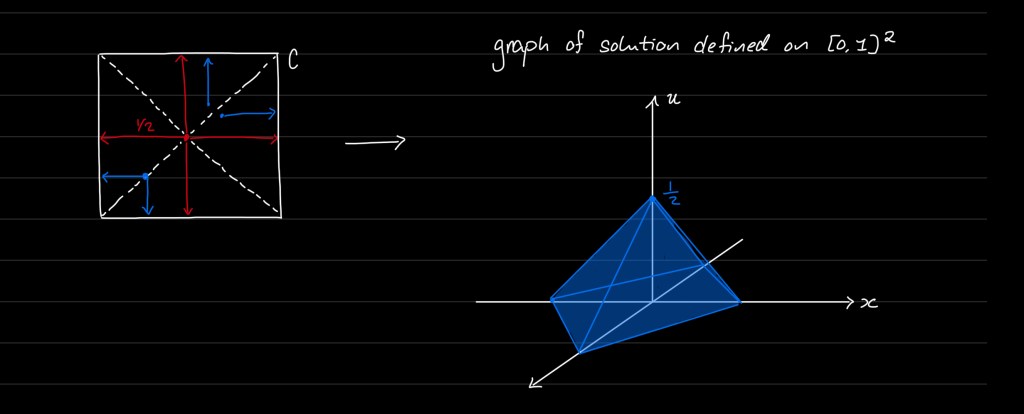
Notice, the solution is not smooth along the diagonals of the square. The projection of the characteristic field onto the (x,y)-plane is just the field of vectors such that the length of the vector at each point is the distance from the point to the square and the direction of each vector is along the line of shortest distance from the point to the square.

Similarly, if we use the unit circle as the zero set for u in the initial value problem, the graph solution defined on the unit disk would be the cone centered at the origin of height 1/2. The unique solution is given by $latex u(x, y) = |\sqrt{x^2 + y^2} – 1|.

Let’s now derive this using the characteristic vector field.

(u_x)^2 + (u_y)^2 = 1 describes a surface in J^1 \cong \mathbb{R}^5.

Let p_x = u_x, p_y = u_y. The coordinates in J^1 are given by x, y, u, p_x, p_y.

If we write the PDE as a Hamilton-Jacobi equation, we have:

H(x, y, u, p_x, p_y) = 1/2[(p_x)^2 + (p_y)^2 - 1] = 0

(the 1/2 coefficient at the front does not affect the solutions; it is simply used to make the computations later slightly more simple)

From lecture 2 of Arnold’s PDE, the characteristic vector field is given by:

\dot{x} = H_{p_x} = p_x

\dot{y} = H_{p_y} = p_y

\dot{p_x} = -H_{x} = 0

\dot{p_y} = -H_{y} = 0

\dot{u} = (\dot{x}, \dot{y}) \cdot (p_x, p_y)^{T} = (p_x)^2 + (q_x)^2

Since \dot{p_x} = \dot{p_y} = 0, it follows that $p_x, p_y$ are constants, say \tilde{p_x}, \tilde{p_y}, along each characteristic (i.e. each phase curve of the characteristic vector field).

Hence, the projection of each characteristic onto the (x,y)-plane is:

(x(t), y(t)) = (x_0, y_0) + t(\tilde{p_x}, \tilde{p_y}), where x_0, y_0 are initial values at t = 0.

Since (p_x)^2 + (p_y)^2 = 1, it follows that u(t) = u_0 + t, where u_0 is the initial value at t = 0.

Goal: find the value of \tilde{p_x}, \tilde{p_y} for each characteristic.

Parameterizing the unit circle by s \in [0, 2\pi):

s \mapsto (cos(s), sin(s))

We also want u(cos(s), sin(s)) = 0.

Key: (\tilde{p_x}, \tilde{p_y} is the gradient of u(x, y) at (x, y). We now know that a level curve of u(x, y) is given by the unit circle (cos(s), sin(s)). The gradient is orthogonal to the tangent of the level curve. Thus at x = cos(s), y = sin(s), the corresponding (\tilde{p_x}, \tilde{p_y}) must be a multiple of the normal vector of the unit circle n(s) = (cos(s), sin(s)). Since (\tilde{p_x}^2 + (\tilde{p_y})^2 = 1, (\tilde{p_x}, \tilde{p_y}) = +/- (cos(s), sin(s)).

Hence, for a characteristic corresponding to parameter s, we have:

(x(t), y(t)) = (1 + t)(cos(s), sin(s))

u(t) = t (when t = 0, we are on the unit circle)

Notice that \sqrt{x(t)^2 + y(t)^2} = |1-t|.

It follows that u(x, y) = |\sqrt{x^2 + y^2} - 1|, which is what we want.

Leave a Reply

Is this your new site? Log in to activate admin features and dismiss this message
Log In