Given a smooth manifold M, we can endow it with a Lorentzian structure by a smooth assignment of a Lorentzian inner product (bilinear non-degenerate form of signature (-, +, …, +)) to the tangent space 


Definition of Time-Orientation:
Let (M, g) be a Lorentzian manifold. For any 


A time-orientation on M is a smooth assignment of a positive time-cone 
for any 


We say 
Lemma (to be proven in a following post):
An example of a time-orientable manifold is the Minkowski space; we can take the time-like vector field to be 
Now, we can ask: does time-orientability have anything to do with topological-orientability?
Answer: these two concepts are independent!
We will show this independence by constructing two examples: the Mobius band with two different Lorenztian metrics — one making it time-orientable and the other, not time-orientable.
Constructing the Mobius band as the quotient of a group action on 
Define the action of 

This group of actions is generated by 
The quotient space, 
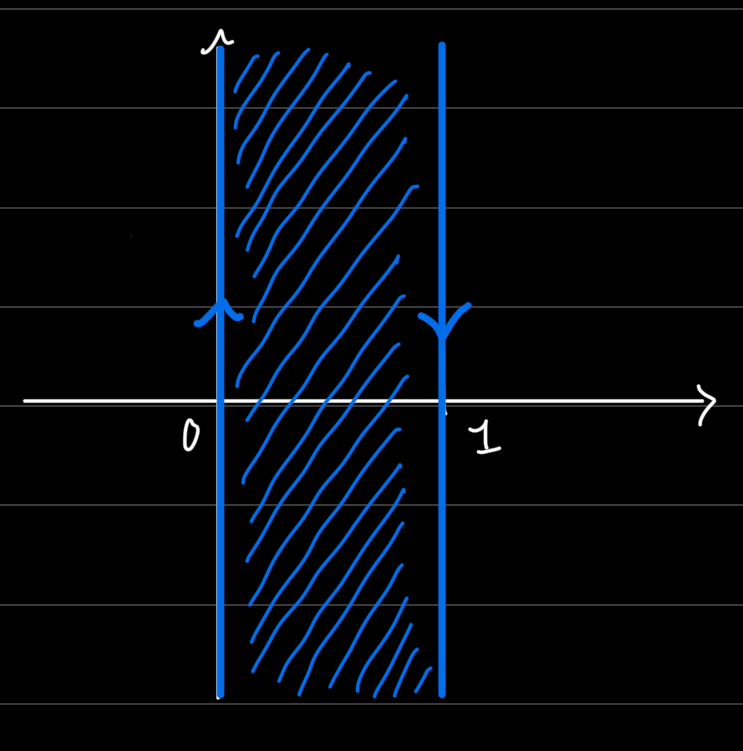
Let 

Notice also that for any 

Let the Lorentzian metric on the tangent spaces of 
Now, how do we extend this Lorentzian metric to one on 
Let 


For each 

or

We define the corresponding Lorentzian metric on
for 

where 

Let’s check if this definition makes sense!
First, since 


But what about the corresponding 
Suppose 
If 

We can similarly that this also follows for 
Hence, the Lorentzian metric on 
Choose 


Suppose we had chosen the metric 
Using the same method as above, we can see that the corresponding Lorentzian metric on

Take
Suppose that there exists a smooth time-like vector field $Y$ on the tangent bundle of 
Then at each 


Since ](https://s0.wp.com/latex.php?latex=T_%5Bp%5D%28%5Cmathbb%7BR%7D%5E2%2F%5Cmathbb%7BZ%7D%29&bg=ffffff&fg=000&s=0&c=20201002)
](https://s0.wp.com/latex.php?latex=%5Ctext%7Bspan%7D%5C%7BY_%5Bp%5D%2C+X_%5Bp%5D+%5C%7D+%3DT_%5Bp%5D%28%5Cmathbb%7BR%7D%5E2%2F%5Cmathbb%7BZ%7D%29&bg=ffffff&fg=000&s=0&c=20201002)


Leave a Reply