This post is based upon a question that I have encountered in Arnold’s ODE a while ago:
How many connected components does have in ?
Today, we will address the specific case of when c = 0, i.e.:
(*).
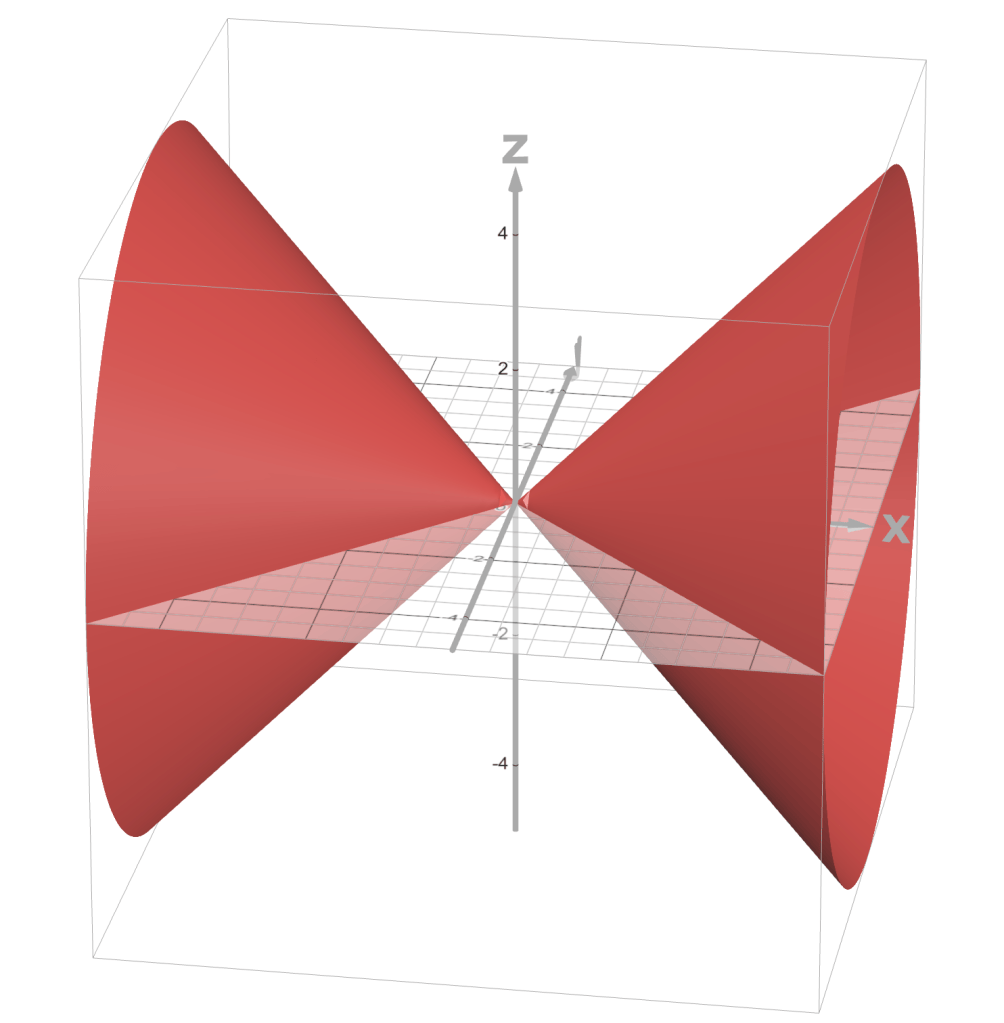
Let’s first consider this in . After learning a bit about Lorentzian geometry in my General Relativity course, it is now easy for me to see the geometric object defined by (*). This is the zero set (or the null cone) of the Minkowski inner product on . This surface in is a cone (more specifically, 2 cones) with its vertex at the origin. I will attach a picture of the null-cone of the 3-dimensional Minkowski space:
Screenshot taken from Desmos 3D Graphing Calculator
is the space of lines passing through the origin of . Geometrically, the curve for this equation in is given by the set of lines passing through the origin intersecting with the null-cone (including the points at infinity on the cone). So it seems intuitive (at least in ) that this curve will have only one connected component.
Let’s make this more rigorous.
Claim: the curve defined by (*) in is diffeomorphic to .
Let be a solution to (*). Equivalently, we can consider to be a vector (up to scaling) of the null-cone of the 4-dim. Minkowski space. We take for granted the following fact:
can be decomposed as where is a space-like vector and is a time-like vector and both are non-zero.
This decomposition is geometrically intuitive as the time-like vectors lie in the time-cones, which are inside the null-cones, and the space-like vectors like outside the null-cones. But it seems there are infinitely many ways to decompose, how do we define the most natural decomposition?
Since is defined up to scaling, are both defined up to scaling. Thus, we can normalize the 2 vectors; we denote the two new vectors to be , respectively. The dimension of the time-like subspace is 1 and the dimension of the space-like subspace is 3 because the Minkowski product has signature (1, 3), and so:
and
It follows that .
is 2 disjoint copies of .
Notice that we identify (u, w) and (-u, -w) as the same point. Hence, we are really dealing with the space:
, which is what we want.
It is not difficult to see that the map that arises from this process is a diffeomorphism.
Since the curve is diffeomorphic to , which is connected, the curve is connected.




Leave a Reply