This post is a continuation of the previous post. We left off having defined a symplectic structure on the contact planes of dimension 2n in J^1.

The symplectic structure is given by the 2-form d\alpha|_{\alpha = 0}; we have shown that it is defined up to a scalar multiple on each contact plane.

Claim: the skew-orthogonal complement of a hyperplane is a 1-dimensional subspace, a line.

Step 1: Show that there exists a basis \xi_1, ..., \xi_n, \zeta_1, ..., \zeta_n for the symplectic space such that:

d\alpha(\xi_i, \xi_j) = 0 = d\alpha(\zeta_i, \zeta_j)

and d\alpha(\xi_i, \zeta_j) = \delta_{i,j}

Let v_1, ..., v_{n}, v_{2n} be a basis for the symplectic space.

We know from the previous post that d\alpha is not degenerate. Hence, if we let \xi_1 = v_1, there exists v_k such that d\alpha(\xi_1, v_k) \neq 0. Notice that d\alpha(\xi_1, \xi_1) = 0. WLOG, let v_k = v_2.

Then, let \zeta_1 = \frac{v_2}{d\alpha(\xi_1, v_2)}.

Key step: just like in the Gram-Schmidt process where we apply projection onto the orthogonal complement of a subspace to obtain a vector orthogonal to all our previous vectors, here we apply symplectic projection.

Set \xi_2 := v_3 - d\alpha(v_3, \zeta_1)\xi_1 + d\alpha(v_3, \xi_1)\zeta_1.

Then, d\alpha(\xi_2, \xi_2) = 0 (we can check this simply by plugging it into the algebraic expression. It also intuitively makes sense because integrating \alpha forward and backward along the vector self-cancels.

d\alpha(\xi_2, \zeta_1) = d\alpha[v_3 - d\alpha(v_3, \zeta_1)\xi_1 + d\alpha(v_3, \xi_1)\zeta_1, \zeta_2]

= d\alpha[v_3, \zeta_1) - d\alpha(v_3, \zeta_1) d\alpha(\xi_1, \zeta_1) + d\alpha(v_3, \xi_1) d\alpha(\zeta_1, \zeta_1]

= d\alpha(v_3, \zeta_2)(1 - d\alpha(\xi_1, \zeta_2))

= 0

and

d\alpha(\xi_3, \xi_1) = d\alpha[v_3 - d\alpha(v_3, \zeta_2)\xi_1 + d\alpha(v_3, \xi_1)\zeta_2, \xi_1]

= d\alpha(v_3, \xi_1) - d\alpha(v_3, \zeta_1) d\alpha(\xi_1, \xi_1) + d\alpha(v_3, \xi_1) d\alpha(\zeta_1, \xi_1)

= d\alpha(v_3, \xi_1)(1 + d\alpha(\zeta_2, \xi_1))

= 0

Thus, \xi_2 is in the orthogonal complement of \text{span}\{\xi_1, \zeta_1 \}. We can use the same method as before to find \zeta_2. Repeating the process, we will be able to find the n pairs of \xi_k‘s and \zeta_k‘s.

Now that we have found an orthonormal basis, the claim follows trivially.

Notice: since d\alpha(\xi, \xi) = 0, \xi lies inside its own skew-orthogonal complement.

This observation tells us that we can obtain a unique direction from each of the (2n-1)-dimension subspace obtained from the intersection of the contact plane and the tangent plane by taking its skew-orthogonal complement. Hence, we obtain a direction field in J^1.
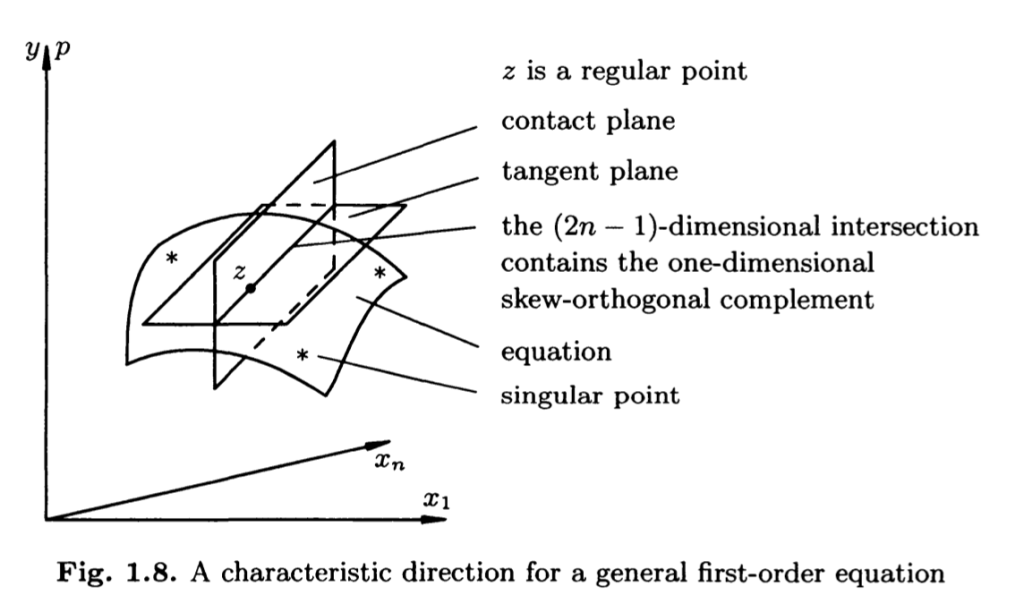
The next step: given a first-order PDE F(x, y, p) = 0, what are the expressions for this direction field?

Leave a Reply

Is this your new site? Log in to activate admin features and dismiss this message
Log In