Ok, this post might not be really math-related, but I really need to get this down and out of the way. Moving forward, I’m going to try and be more consistent with my posting — one post a day or every other day — to hold myself accountable to my learning and to my reading. I’m aiming to put more of my ‘own’ thoughts and questions on these posts and less of re-iterations of what I have learned. I found that in these past few weeks, I have been in such a rush to get ahead in Arnold’s PDE that I have not sat down to really make any of it mine. When I was looking over my notebook today, I found that I had hardly written down any of my own questions; 90% of the notes were just a copy-down of what Arnold has written. I had not given myself the chance to explore. So, I’ll make it my priority to slow-down my pace and look at each sentence he has written more carefully; afterall, this isn’t a race.
I’m going to start using these posts as a place to really be honest with myself, i.e. journaling my confusion, writing out my own questions (this might be the most difficult for me), and not pretending to know things that I really don’t know.
My goal for the foreseeable future is to set aside an hour or so to sit down and read Arnold’s PDE everyday. I’m not going to set a goal for the number of pages that I need to progress through (because honestly, the expectations I set have always been ridiculous). Rather, I’m going to focus on trying to really get one single thing each time, no matter how small and insignificant it may be. I’m going to try and challenge myself by asking at least 1 question that I actually am interested in and that I find not so easy to answer. I will write everything out as a post, and I will also make it a goal to at least write out one confusion that I have in each of these posts.
So, let’s get to some math 🙂
Part 1: Clarifying a proof I wrote for the claim “the angle subtended by an element of the curve is a harmonic function”.
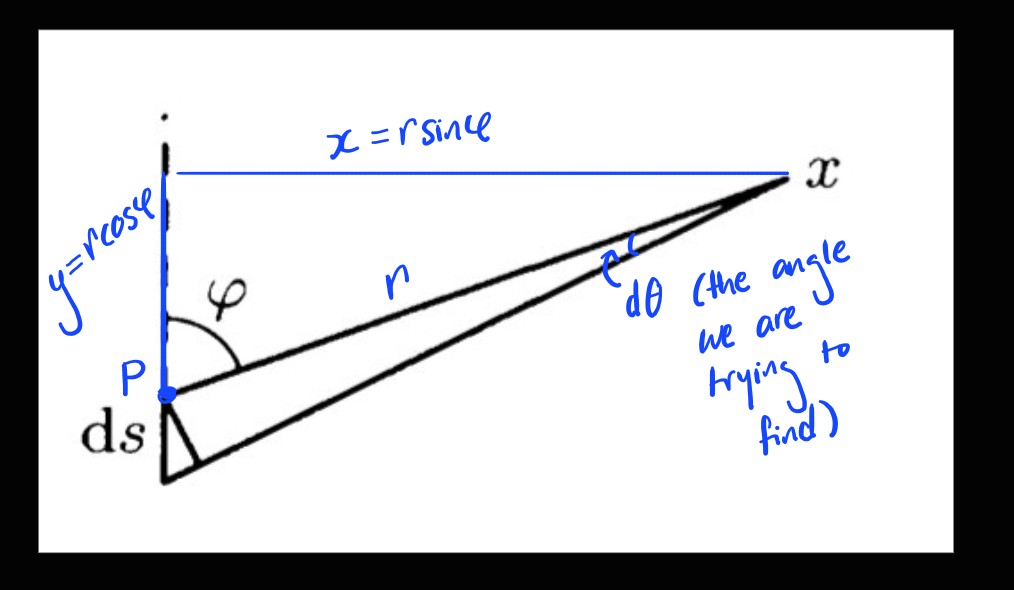
Confession: I avoided using the picture in Arnold’s PDE in my previous proof because it made me confused. Even now, I’m still confused, but ignoring it will not help with my confusion will it? So here is the picture:

First of all, which of the line is the curve? I had assumed that the line segment denoted by dS is a tangent line, but I’m not seeing anything that is tangent looking… But then, if I don’t take it as the tangent line, what is it?
Here is my interpretation:
For 

Why does (*) hold? There’s a nice geometric way we can visualize it:
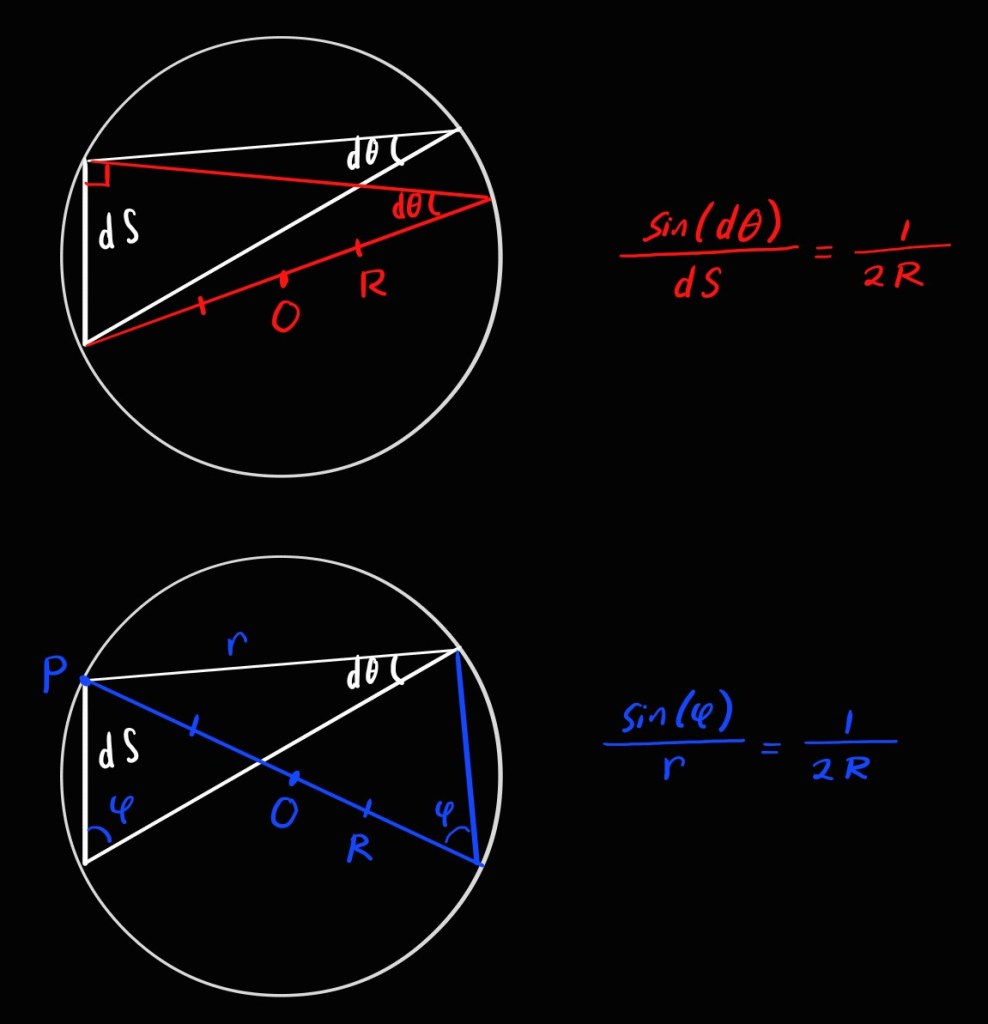
Thus, (*) is indeed true. For 

If we set the origin to be at P, 


Further exploration: Given 2 points on the plane, we can construct a harmonic function in the following way
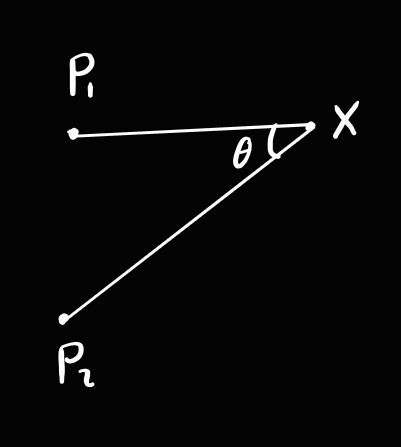
The value of 
Interesting: the corresponding level curves for this function are the two circles of fixed radius intersecting at the 2 given points. I have an example below:
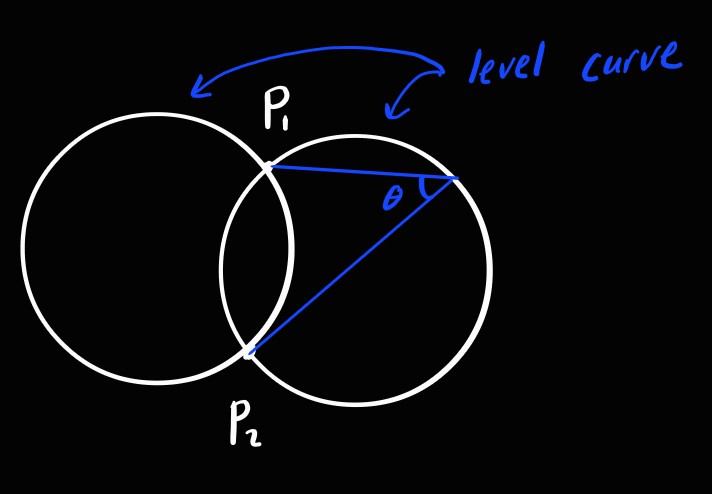
For now, I do not know whether this is meaningful. I only find it interesting; hence, the reason it is in this post. But I’m currently wondering if there is a potential connection between this and the dipole level curves that we discussed in a previous post.
Question: we can construct a harmonic function given two points on the plane, what about for 3 points?
Harmonic functions still seem so mysterious to me. There seems like no easy way to identify a function as harmonic without any computations. Constructing such functions is even more difficult.


Leave a Reply