This post is based upon Richard Borcherds’ video on Singularities. I will write out the key concepts that I have learned from this video in my own words (without referring to my notes) and some questions that I have.
We begin by looking at removable singularities. How do we understand such singularities? I like how Borcherds said these singularities arise from our own laziness to write the function properly (or maybe because we intentionally want to create such a phenomenon), i.e. the singularity can be easily corrected by representing the function in another way. I interpreted this type of singularities as ‘man-made’.
Example: 
It has a removable singularity at the origin. Key: we look at its taylor series. Notice some important properties about 

As 

Borcherds listed a criterion for functions with removable singularity:
If f is holomorphic for 
How do we prove this? We show that f can be rewritten in a nicer form.
Define 


Claim: 

In order for this to work, we would need to move C across the origin so that it encloses w. Since f is bounded in the neighbourhood around the origin, the integral of 
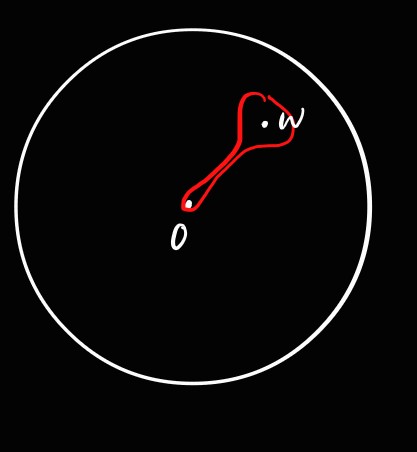
Hence, it follows that f can be expressed g, and g is defined at the origin.
Now, what happens when the value of f near a singularity becomes unbounded? i.e. as we approach the origin in any direction, the function tends towards infinity? We get a pole (if we look at the modulus of the function, we really see a pole). Borcherds said that poles are really quite nice, because if we look at 

Near a pole, 

So what happens if we have a pole-looking singularity at which f cannot be approximated by a 
Take for instance 
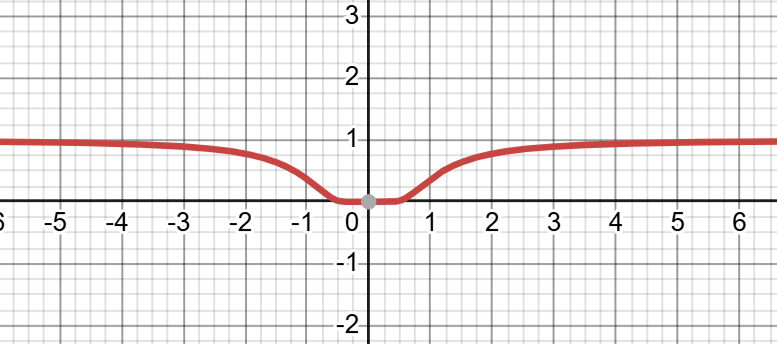
It is bounded and smooth near the origin. So we might think that the origin is a removable singularity. But no! If we approach the origin along the imaginary axis, we would be tending towards infinity.
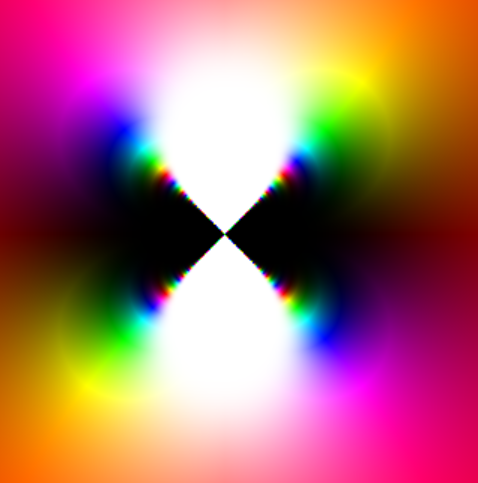
Notice that as we move towards the origin in various directions, any complex value would be achieved infinitely many times. This is true for any essential singularity (this is the difference between poles and this type of singularity). So suppose there exists 


This means that 


Key: we can split f into a holomorphic part and a not-so-nice part, i.e. 


Leave a Reply