This post will be my attempt at categorizing the isomorphism classes of elliptic curves (mainly filling in the gaps of the concepts I’ve learned in class).
Elliptic curves are identified as , where is a lattice. A point on the curve is thus .
Two curves, and , are isomorphic if there exists an isomorphism . We can assume because otherwise, if , we can do a translation by .
Key: we can lift this isomorphism to . This seems to make sense intuitively since has no holes, but how to make this argument rigorous? But how do we actually construct given ?
My idea: the most natural way to construct this would be , where is in the parallelogram spanned by and is a basis of the second lattice. This gives us a well-defined bijective map because every point has a unique representation of the form , but I’m not sure about the structure. If we define this way, would it be conformal?
Back on track: so suppose we can indeed lift f to , then it follows that and is a bijective homomorphism and has no poles at any finite value (once again, this seems very obvious but…). It follows that (since it must be a Mobius transform, the denominator must be a constant in order for there to be no poles, and the constant value must be 0 in order for 0 to be mapped to 0). When we restrict to the lattice , we get .
If , then we can construct an isomorphism as . It is not difficult to see that this will be well-defined (I won’t write out the proof in the post).
So from the above, we have shown that the isomorphisms of two elliptic curves are equivalent to showing the existence of such that , i.e. to study the isomorphisms of elliptic curves, it suffices to study the lattice structures on the plane (this is pretty cool!).
Given a lattice generated by , by the above, it is isomorphic to . Thus, WLOG, it suffices for us to study the lattices generated where .
Claim: and are isomorphic if and only if there exists such that .
Verification: Suppose such exists. Then,
is isomorphic to (*). We now show that (*) gives the same lattice as , i.e.
.
Suffices to show that for any , there exists such that:
.
Hence, the two bases generate the same lattice.
Suppose now that and are isomorphic. We now show that there exists such that .
By the above, this means that there exists such that .
This is equivalent to:
and
.
Similarly,
and
.
Since , it follows that , which is what we want.
Hence, the space of isomorphism of the lattice structures can be identified by , i.e. it suffices for us to find the fundamental domain of .
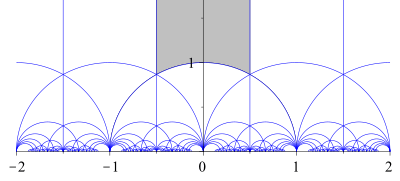
Fundamental Domain of
Taken from Wikipedia
To show that the shaded region is indeed a fundamental region, we take for granted the fact that is generated by:
and . The corresponding actions on are given by:
and .
Notice that T’ translates the upper half plane and S’ inverts the plane across the upper half of the unit circle. Hence, the plane can be generated by the region bounded between -1/2 and 1/2 and lying above the unit circle (with the two sides of the boundaries symmetric across the imaginary axis identified). That is, an inversion will send the region into a region inside a unit circle; a translation will move the region into a parallel region. We can take a sequence (might need to be an infinite sequence) to get the entire plane.




Leave a Reply