In our previous proof for the ‘jump’ of the potential on the surface of a single-layer being equal to the charge density (up to sign and a coefficient), we made the assumption that the flux of the gradient of the potential across the lateral surface is small given that the area is small. Note: the magnitude of the gradient of the potential is equal to the magnitude of the electrostatic field. The assumption is equivalent to assuming that the magnitude of the electrostatic field near the surface is bounded.

Is this obvious?

Not really. |E| \propto \frac{1}{r^2} for a point charge. Notice that as we near the point charge, the field is no longer bounded.

The goal of this post will be to show that the electrostatic field corresponding to a smooth single layer charge distribution is indeed bounded everywhere.

Let the surface of the single layer charge be S. Notice that the magnitude of the field that is of distance r>0 or more away is going to be bounded by \frac{ \text{Area of S} \{magnitude of maximum charge density}}{r^2}. Hence, it suffices to consider the field that is within a distance of r away from the surface.

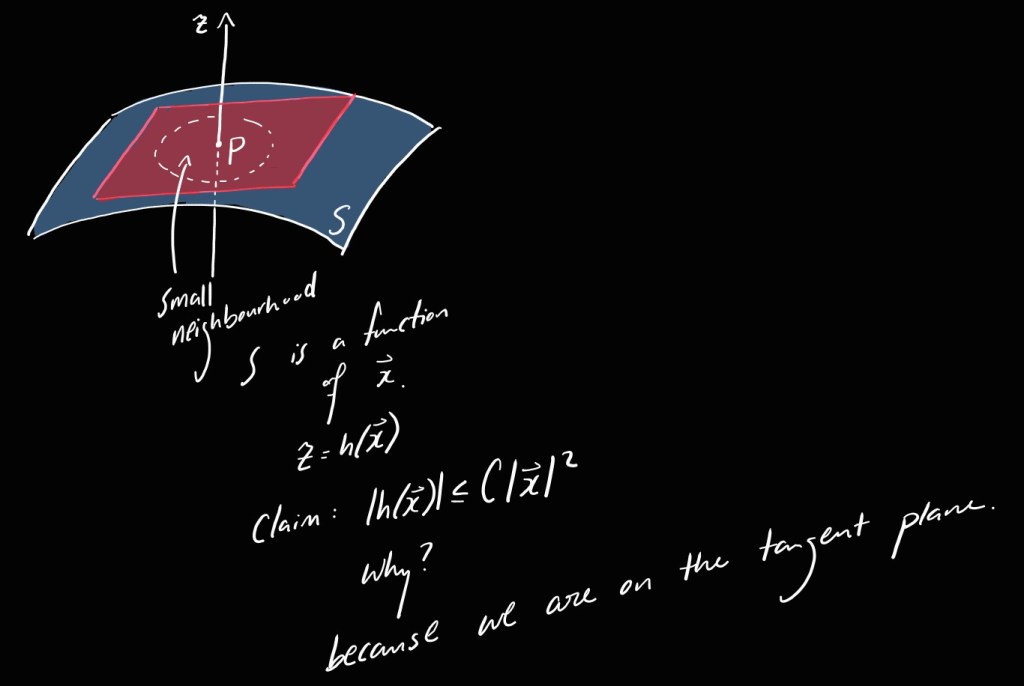
It suffices to study the r-neighbourhood of an arbitrary point P \in S, in particular, it suffices to examine the electric field lying on the line passing through P that is normal to the surface. By the argument in the previous paragraph, it suffice to study the electric field generated by charges within the neighbourhood and not of those charges outside.

For the sake of computations, we will assign local coordinate at the point P. Let P be the origin, the line passing through P and normal to the surface be the z-axis. And denote the tangent plane to S at point P be given by the coordinate vector \vec{x}.

We start by considering a case of when the layer coincides with our tangent plane and the charge density is 1. Then for at any point on the z-axis, the horizontal component of the field at the pont cancels out (due to symmetry) and we are left with only the vertical component.
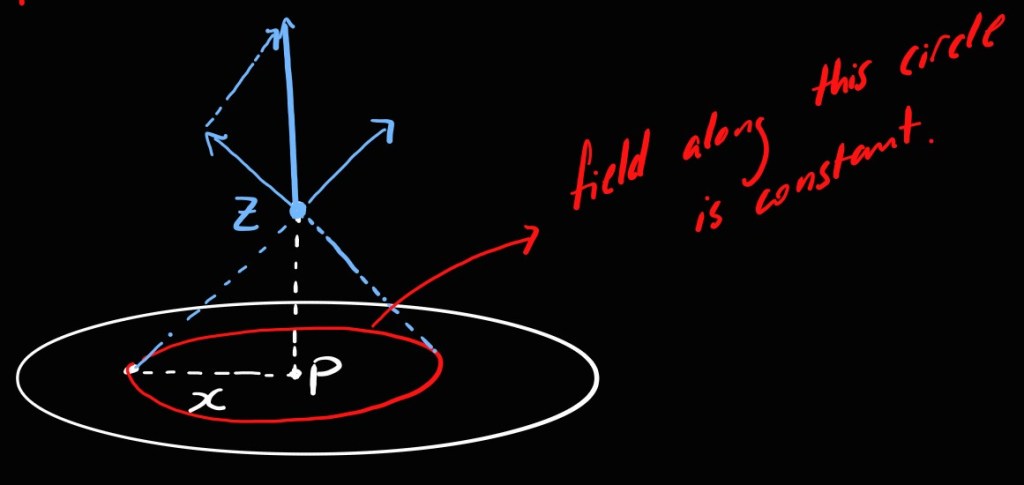
Notice that the field at point Z on the z-axis corresponding to a charge located on the surface only depends on the radial distance of the charge. Thus, for a circle o fixed radius x, we have:

Vertical component of field corresponding to each point on the circle is \frac{Z}{(x^2+Z^2)^{1/2}} \frac{1}{x^2 + Z^2}.

And so, the total vertical component of the field corresponding to the circle of charge is \frac{Z}{(x^2+Z^2)^{3/2}} 2\pi x.

It follows that the corresponding vertical component of the field for the disk of radius r centered at P is:

\int_{0}^{r} \frac{Z}{(x^2+Z^2)^{3/2}} 2\pi x dx

= 2\pi \int_0^{r} \frac{(\frac{x}{Z})Z^2}{((\frac{x}{Z})^2 + 1)^{3/2} Z^3} dx

= 2\pi \int_0^{r} \frac{\frac{x}{Z}}{((\frac{x}{Z})^2 + 1)^{3/2}} d\frac{x}{Z}

= 2\pi \int_0^{\frac{r}{Z}} \frac{\frac{1}{2}}{(\zeta^2 + 1)^{3/2}}d\zeta^2

= 2\pi(1 - \frac{1}{(\zeta^2 + 1)^{1/2}}|_{\zeta = \frac{r}{2\Z}}

= 2\pi(1 - \frac{Z}{(r^2 + Z^2)^{1/2}}) (*)

Notice that (*) is always bounded by 2\pi. This concludes the proof for the simplest case.

Let’s consider the general case that involves h(\vec{x}) and \rho(h(\vec{x})).

Key: determinant of the Jacobian of h(\vec{x}) is the ratio of the area of the ‘approximating’ parallelogram on the graph of h(\vec{x}) to that of the area of the original rectangle given by x dx d\phi, where we take polar coordinates on the tangent plane.

It follows that the vertical component of the field is given by the integral of:

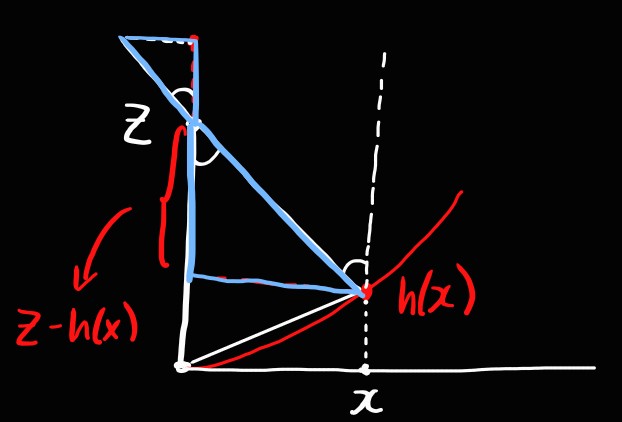
\frac{(Z - h) \rho(h(\vec{x})) J(\vec{x}) x dx d\phi}{(x^2 + (Z-h)^2)^{3/2}} (the book wrote Z+h instead, but I think this is a mistake. We can understand why by the diagram below):

We first show the denominator is bounded below.

x^2 + (Z-h)^2 = x^2 + Z^2 - 2Zh.

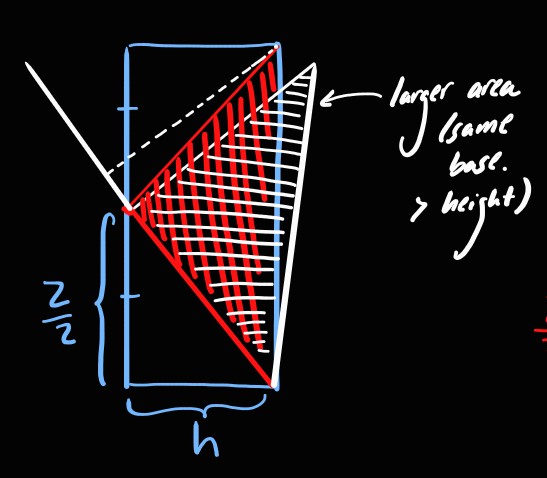
Notice that |Zh| \leq \frac{Z^2}{4} + h^2 by a very simple geometry argument

And |h| \leq Cx^2. Hence, it follows that:

x^2 + Z^2 - 2Zh \geq x^2 + Z^2 - 2(\frac{Z^2}{4} + h^2) + h^2 \geq (1-C) x^2 + \frac{Z^2}{2} (Arnold claimed that this is \geq \frac{1}{2}(x^2 + Z^2); I am not sure if the denominator is actually that nice, what if C \geq 1?)

So, let’s suppose for now that the denominator is indeed bounded below by \frac{1}{2}(x^2 + Z^2).

Since both \rho, h are smooth, it follows that they are bounded within the region.

Hence, \frac{Z \rho(h(\vec{x})) J(\vec{x}) x dx d\phi}{(x^2 + Z^2 - 2Zh)^{3/2}} \leq \frac{MZx dx d\phi}{(\frac{1}{2}(x^2 + Z^2))^{3/2}} is bounded by a constant (same argument as the simple case of the plane) and the second term is bounded above by C_2x^3 in the numerator and bounded below by C_2x^3 and so the entire term is also bounded by a constant.

It follows that the entire integrand is bounded.

Now, we show that the horizontal component given by \frac{\vec{x} \rho(h(\vec{x})) J(\vec{x}) x dx d\phi}{(x^2 + (Z-h)^2)^{3/2}} is bounded.

Key: It suffices to consider the case where \rho J = 1, since the two functions are smooth and therefore bounded by a multiple of their value at the origin. The integrand now becomes:

\frac{\vec{x} x dx d\phi} {(x^2 + (Z-h)^2)^{3/2}}.

Key: we compare the above integrand with that of when h = 0 (i.e. that of the horizontal plane). We know that in that case, the integral of the integrand on the disk is 0.

(Added section below. Completely forgot about doing it for the last few days!)

Goal: Show that \frac{1}{(x^2 + (Z-h)^2)^{3/2}} - \frac{1}{(x^2 + Z^2)^{3/2}} \leq \frac{C}{x^2}.

Suppose we’ve shown that the above is true. Then, since the numerator of the integrand is bounded by a multiple of x^2 and now, the denominator, it follows that the entire integrand is bounded by a constant, which is what we had been trying to show.

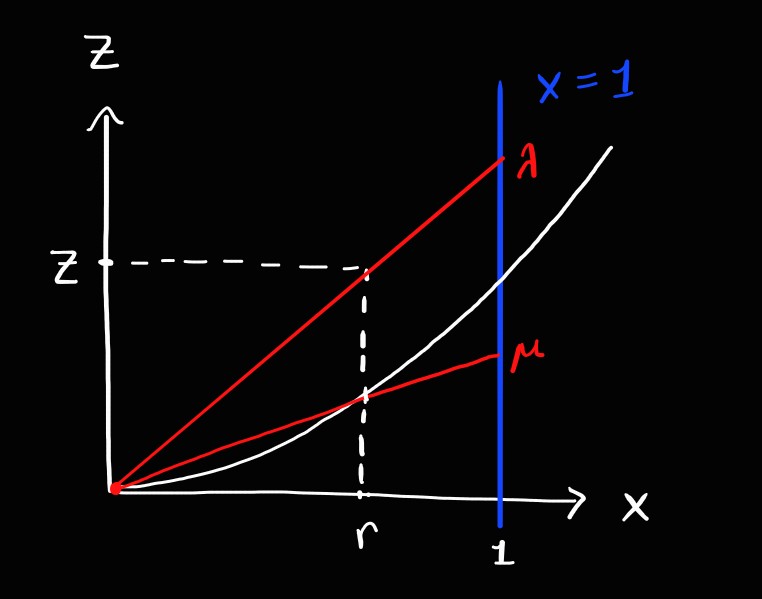
Key step in the proof: We apply a change of coordinate, Z = \lambda x and h = \mu x.

This change of coordinate transforms the LHS into a function of the slope parameter. We now have:

\frac{1}{x^3}(\frac{1}{(1 + \lambda^2)^{3/2}} - \frac{1}{(1 + (\lambda - \mu)^2)^{3/2}}) (*)

Since we are staying within a small region of the origin, the \lambda value is small. And so, \frac{1}{1 + \lambda^2)^{3/2}} is a smooth function, this means that within this neighbourhood, it can be approximated by a linear function. Thus,

\frac{1}{(1 + \lambda^2)^{3/2}} - \frac{1}{(1 + (\lambda - \mu)^2)^{3/2}} \leq C \mu.

This means (*) \leq \frac{C \mu}{x^3}. Since \mu = \frac{h}{x} \leq C x (since h is bounded by a quadratic function of x), it follows that (8) \leq \frac{C}{x^2}, we have what we want.

Leave a Reply

Is this your new site? Log in to activate admin features and dismiss this message
Log In