This post is a reflection made after watching Borcherds’ video: 3 Examples of Quotients. Hopefully this post will have a follow-up as I un-confuse myself and try answer some of the questions I have asked.
Cyclic Quotient Singularity (to be completely honest, I’m still very confused by what is going. I’ll try to explain focusing on the space ).
We have a correspondence between and ; this correspondence is made by examining the set of maximal ideals (?). By the Nullstellensatz Theorem, we know that all the maximal ideals in are of the form . Thus, each maximal ideal corresponds to a unique point , and vice versa.
Our goal is to study the space under the action of the group (and by doing so, we can also understand under the action of this group? Otherwise, why would Borcherds mention the correspondence between and at the beginning?).
Suppose is generated by of order n. Define the action of on to be:
and
, where .
A question we can ask ourselves: what is the subspace of that is fixed by ?
Key observation: if and only if .
So this means, if we fix , a basis of polynomials invariant under would be:
… (basically bases of space of homogeneous polynomials of degree that is multiple of 3).
Thought: it would be interesting to look at what kind of group the space of harmonic polynomials of n variables is fixed under. We know that the space of homogeneous (fixed degree) harmonic polynomials of 3 variables is an irreducible representation of SO(3) (fact I have yet to prove).
The subring of invariant under can then be generated by .
Note: Borcherds mentioned that these 4 generators are not independent, so we would need to quotient them out by the relations between the generators, i.e. , … This does not make too much sense to me. Why can’t we just leave it as ? What happens when we don’t quotient things out? Will we get more than one copy of certain elements? Also, why is it called cyclic quotient singularity? Where do we see the singularity?)
Parameter Space
Key takeaway: association of points with configurations (i.e. could be lines, polygons, conics, etc.)
Connections (off topic): this oddly reminds me of the pencils of quadrics that I talked about in previous post. In , each quadric is given by 5 points. (Aside: 2 points come from the foci. 3 more points on the curve of the quadric because if we only have 2 points on the curve, there corresponds exactly 2 orthogonal quadrics that satisfy this (follows from previous post and the fact that quadrics intersect at 2 points)). If we fix the 2 foci and move the 3 other points, we can generate all the quadrics in , but certain actions on the 3 points may result in the same quadric.
Borcherds gave a really nice real-life example by looking at the structure of cyclohexane. Goal: determine the dimension of the ‘configurations’ of cyclohexane (given that the distance between each two vertices is fixed and each angle is also fixed).
We know that each vertex of the cyclohexane lives in the . There are 6 vertices, hence the ‘point’ that is created by these 6 vertices lives inside .
Now, since edges and angles are constant, there would be 12 quadratics restricting the freedom of these 6 vertices. A lower bound for the dimension would be: 18 – 12 = 6.
Since a cyclohexane would still be itself if we translate it or rotate it, we would need to quotient this space by these Euclidean transformations. Translations and rotations in both have 3 dimensions. By this calculation, we would be getting 0 dimension for our configuration space, i.e. there is one unique cyclohexane. But this isn’t right because someone discovered two possible forms of cyclohexane. And one form has a degree of freedom as it could be ‘adjusted’.
Moduli Space = each point in this space corresponds to an isomorphism class
Example studied in the video: moduli space of elliptic curve
Goal: what kind of elliptic curves are actually different from each other?
An elliptic curve is given by , where .
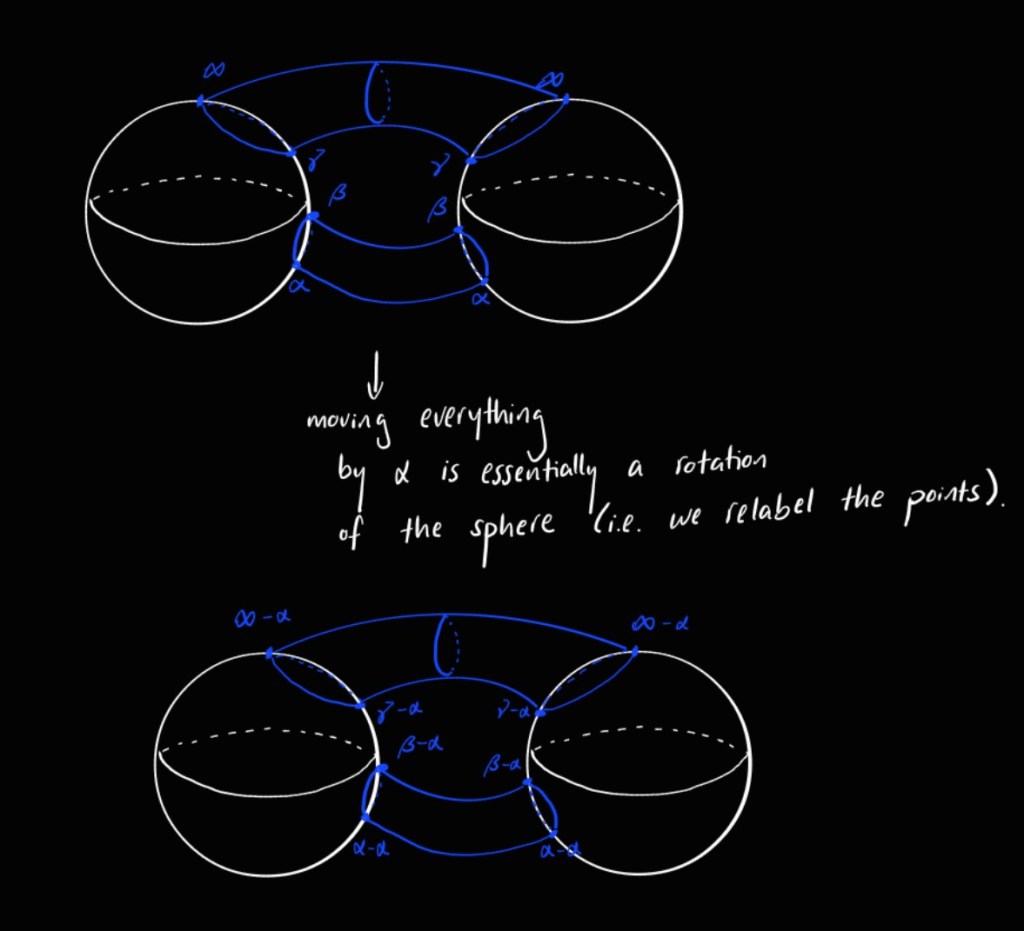
Step 1: translations do not affect elliptic curves. Thus, we can apply a change of variable to remove . My understanding via drawing:
So now, the equation becomes:
.
Step 2: Scale by so that we get . (The best way to explain why this does not change thing is probably to see this as a symmetry of the complex plane. Since stereographic projection is a conformal bijection between the complex plane and the sphere, it follows that this must also be a symmetry of the sphere. And so, this does not change our elliptic curve. Essentially, all the elliptic curves generated from the actions of the symmetries of the spheres are isomorphic…)
So now, an elliptic curve, after some transformations, is reduced to .
Does this mean uniquely determines an elliptic curve? Nope!
Turns out, sending to and , , , and all give us the same curve. Notice that the latter 4 are all compositions of the first 2. Essentially, the operation and generates this group of 6 transformations that is isomorphic . Key: We consider the two generating transformations as two reflections along different axis of a triangle.




Leave a Reply