We will examine, in detail (+ some of my interpretations), for the identity for the spherical laplacian, i.e. , where is a homogeneous polynomial of degree k in . For definitions of the spherical laplacian, please consult chapter 10 of Arnold’s PDE.
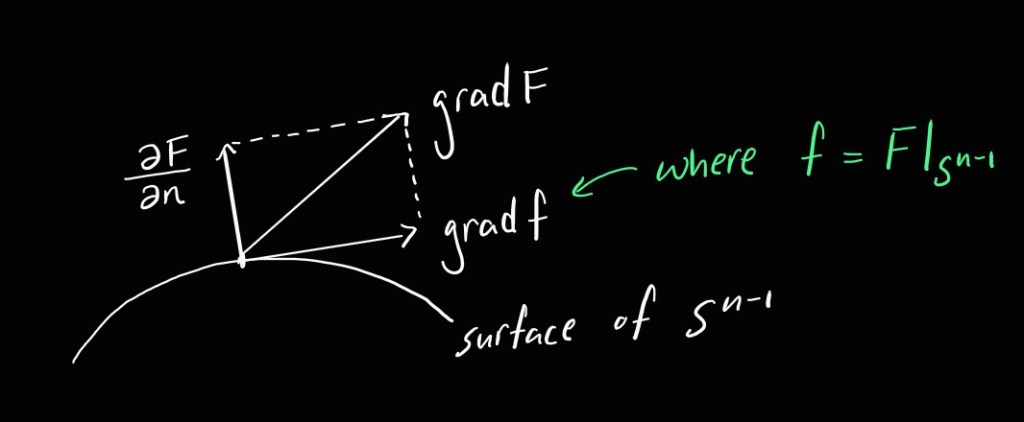
We begin by visualizing what is going on. Let be the restriction of to the sphere . Notice that can be decomposed into two orthogonal vectors, and . Key: since is homogeneous, the tangential component of to the sphere does not depend on the radius of the sphere, i.e. never changes when moving along a fixed ray coming from the origin.
The proof of the identity is similar to the proof for showing is harmonic in in the sense that we want to show a certain ‘property’ of the divergence of and show that it is true within any bounded region (away from the origin).
Since does not change on any sphere, and , it suffices to prove this property on the surface of the unit sphere.
To compute divergence within a region, it suffices to compute the flux across the surface of the region and then apply divergence theorem. Key: how do we pick the test region?
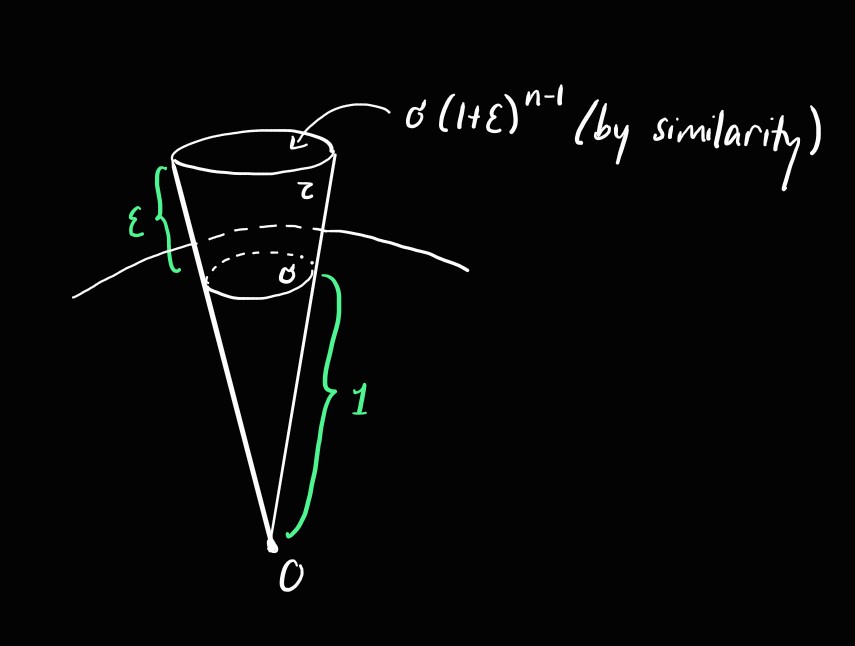
Note (this is where my solution may differ from that of Arnold’s): the region we pick should not be a prism if we want both the top surface and bottom surface to be on the surfaces of the spheres of radius and (which would allow us to more easily compute the flux) AND for the lateral surface to be orthogonal to the top and bottom surfaces. We would need to pick a region, G, that is:
If the area of the bottom surface is , then by similarity, the area of the top surface would be .
The flux of across the top and bottom surfaces would be the component of orthogonal to the surface of the sphere (i.e. radial direction); we know this would be . The flux across the lateral surface would be the component of tangent to the sphere, i.e. .
It follows that the total flux is:
.
For small enough, we can assume within the bottom and top surface to be constant. It follows that the
and
. (Note: the flux across the bottom is going into the bounded region whereas the flux across the top is coming out of the bounded region).
Hence,
(if we define the direction pointing out of the closed surface to be positive).
Now, we can use the binomial approximation to simplify, i.e. . It follows that we have:
.
By divergence theorem,
and
(because is tangential to the sphere and so has no flux coming out of the top and bottom surface.
Thus, the above equation becomes:
(*).
Notice: the volume of the is approximately
.
For small enough, the divergence at each point within the region is approximately constant. Hence, dividing (*) by the volume of the region gives:






Leave a Reply