In this post, we compare the process of resolving singularities for the two curves 

Curve 1:
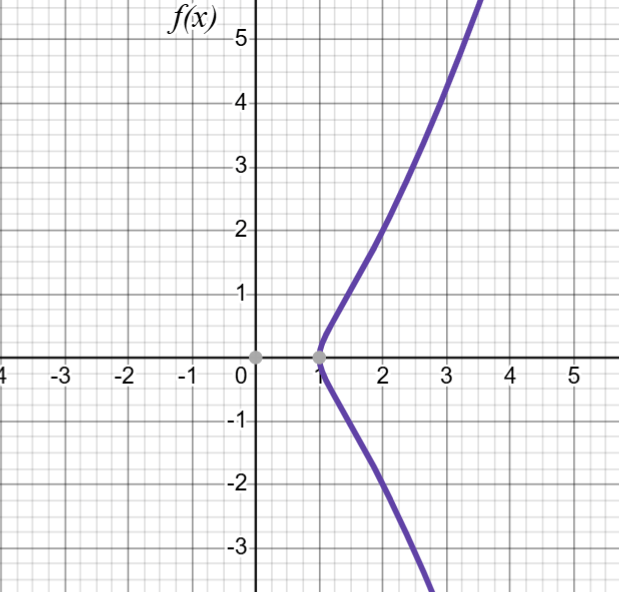
Notice that the singularity lies at the origin.
Key step: we put this curve into the blow up space of 


Putting C into 


When 


Substituting this into the equation for our curve gives:

This simplifies to:

and so 
Claim: 
What about the point at 

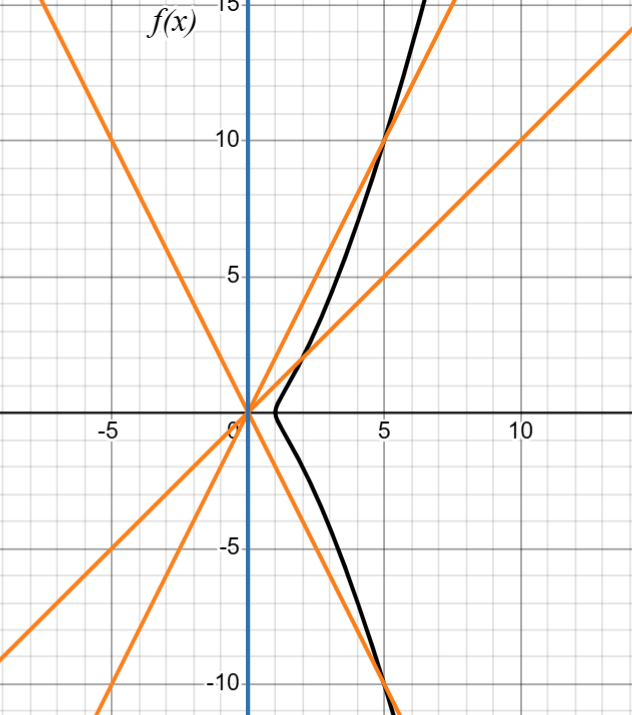
Physical interpretation: The parameterization describes our movement from line to line in our space of lines. Adding the vertical line allows us to move in a ‘complete’ and ‘smooth’ loop. As we move along our curve by going from line to line, we can now travel from the ‘top’ of our curve to the ‘bottom’ by transition through that vertical line.
It follows that we have a bijection from 
This parameterization also gives 
My observation: 


Key (don’t know if this is relevant):

Thus, adding $\latex t$ to $\latex \mathbb{R}[t^2 + 1, t^3 + t]$ is equivalent to adding
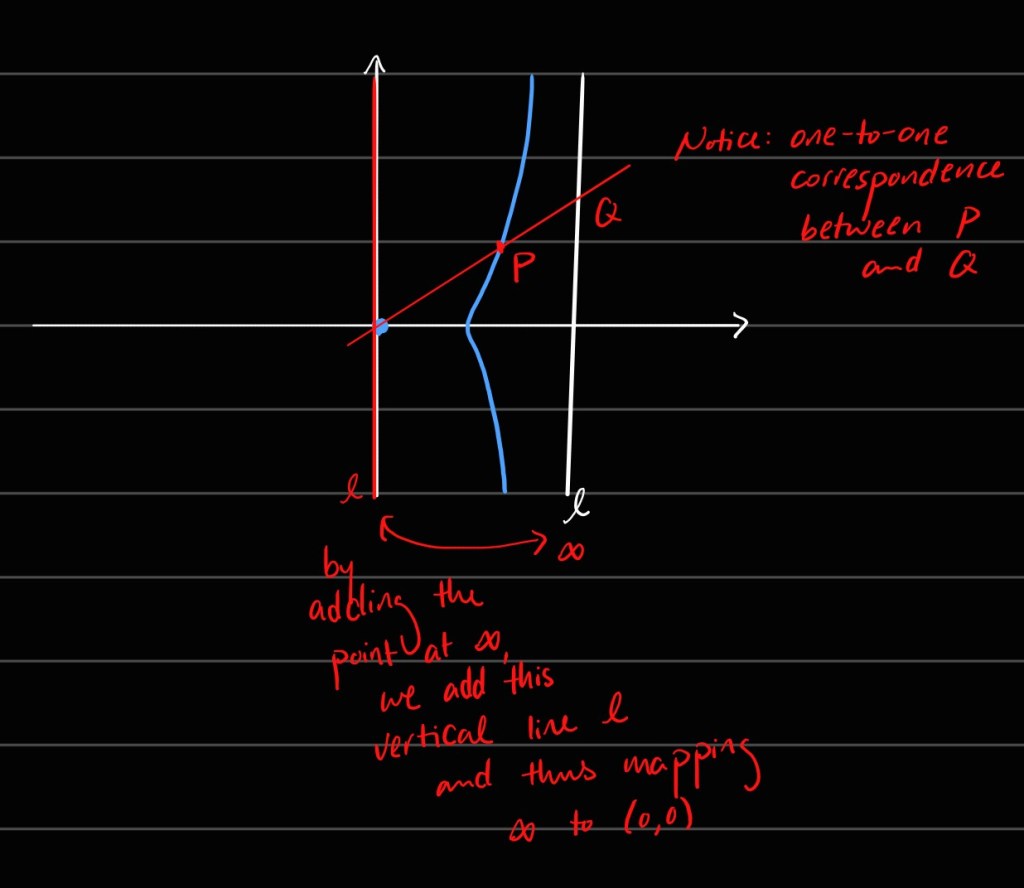
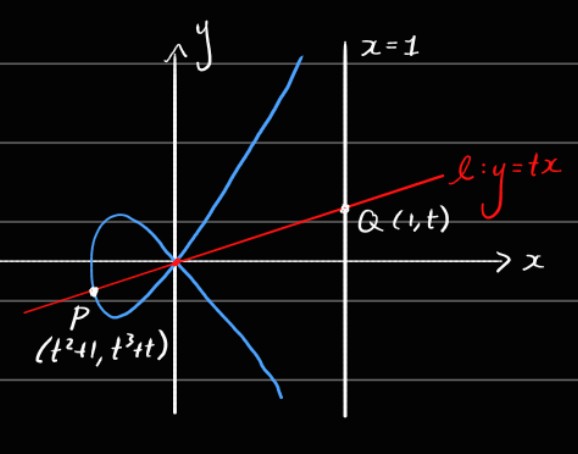
We can also geometrically see why the curve C is in bijection with a line through the following picture:
Now, let’s look at 
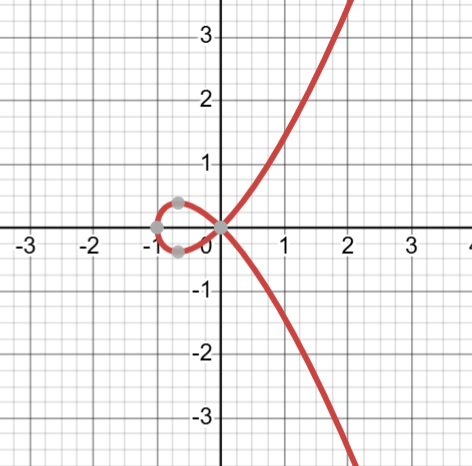
We again study the correspondence between points on the curve and the space of lines by putting this curve into
When
Substituting this into the equation for our curve gives:

We can simplify this to obtain:

and it follows that 
Claim: the map 
The claim is easy to verify, so I will give a proof by picture:
Notice that the origin corresponds to two points (1, 1) and (1, -1) on the line.
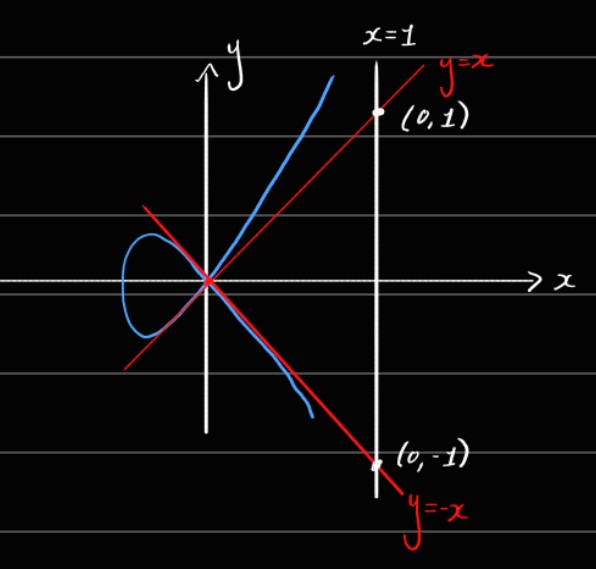
Thus, we have a birational map from the curve (removed one point) to the line


Leave a Reply