Goal: prove that at each point point in the n-dimensional Euclidean space, there passes precisely n confocal quadrics; they are mutually orthogonal.
Existence Proof:
We will prove this for n = 3; the proof can be generalized to any n.
Given a point 


To show that 3 distinct mutually confocal quadrics pass through 


Without loss of generality, suppose 


Key observation: 
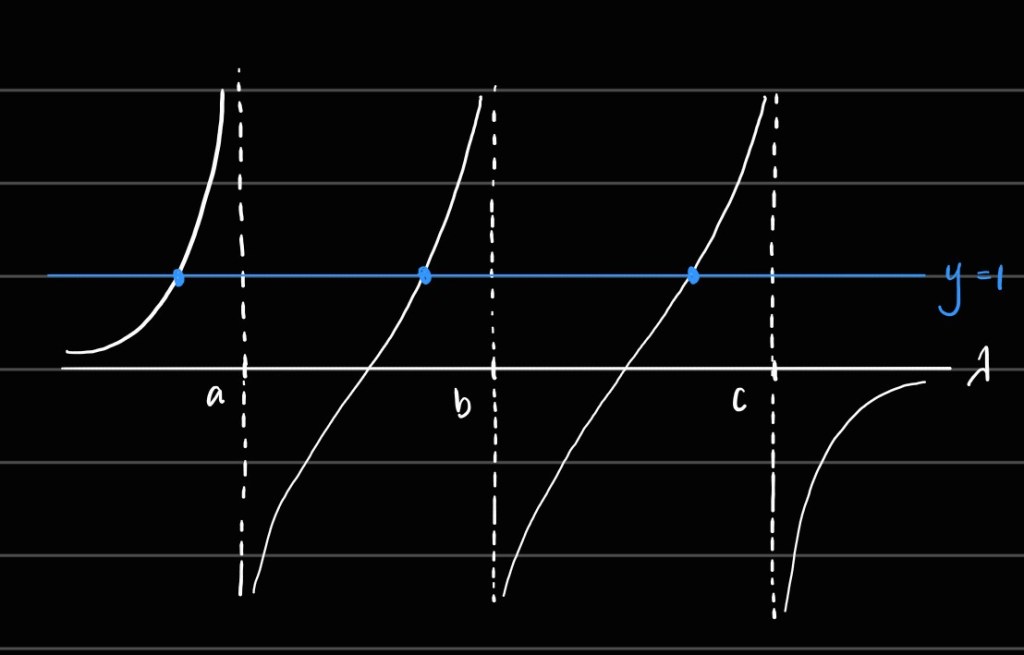
Done!
Orthogonality: The n mutually confocal quadrics intersecting at a point are orthogonal to each other.
Again, we prove this for n = 3; generalization to any 
Suppose
![\frac{x^2}{a - \lambda_1} + \frac{y^2]{b - \lambda_1} + \frac{z^2}{c - \lambda_1} = 1](https://s0.wp.com/latex.php?latex=%5Cfrac%7Bx%5E2%7D%7Ba+-+%5Clambda_1%7D+%2B+%5Cfrac%7By%5E2%5D%7Bb+-+%5Clambda_1%7D+%2B+%5Cfrac%7Bz%5E2%7D%7Bc+-+%5Clambda_1%7D+%3D+1&bg=ffffff&fg=000&s=0&c=20201002)
and
![\frac{x^2}{a - \lambda_2} + \frac{y^2]{b - \lambda_2} + \frac{z^2}{c - \lambda_2} = 1](https://s0.wp.com/latex.php?latex=%5Cfrac%7Bx%5E2%7D%7Ba+-+%5Clambda_2%7D+%2B+%5Cfrac%7By%5E2%5D%7Bb+-+%5Clambda_2%7D+%2B+%5Cfrac%7Bz%5E2%7D%7Bc+-+%5Clambda_2%7D+%3D+1&bg=ffffff&fg=000&s=0&c=20201002)
are 2 quadrics passing through the point
Note that (*) is a level curve of ![f(x, y, z) = \frac{x^2}{a - \lambda_1} + \frac{y^2]{b - \lambda_1} + \frac{z^2}{c - \lambda_1}](https://s0.wp.com/latex.php?latex=f%28x%2C+y%2C+z%29+%3D++%5Cfrac%7Bx%5E2%7D%7Ba+-+%5Clambda_1%7D+%2B+%5Cfrac%7By%5E2%5D%7Bb+-+%5Clambda_1%7D+%2B+%5Cfrac%7Bz%5E2%7D%7Bc+-+%5Clambda_1%7D&bg=ffffff&fg=000&s=0&c=20201002)
![g(x, y, z) = \frac{x^2}{a - \lambda_2} + \frac{y^2]{b - \lambda_2} + \frac{z^2}{c - \lambda_2}](https://s0.wp.com/latex.php?latex=g%28x%2C+y%2C+z%29+%3D+%5Cfrac%7Bx%5E2%7D%7Ba+-+%5Clambda_2%7D+%2B+%5Cfrac%7By%5E2%5D%7Bb+-+%5Clambda_2%7D+%2B+%5Cfrac%7Bz%5E2%7D%7Bc+-+%5Clambda_2%7D&bg=ffffff&fg=000&s=0&c=20201002)
It follows that 

Hence, to show that the two surfaces are orthogonal to each other, it suffices to show that the two corresponding gradient vectors are orthogonal.


Now, how do we show that 
Key:

![\Leftrightarrow (\frac{x_0^2}{a - \lambda_1} + \frac{y_0^2]{b - \lambda_1} + \frac{z_0^2}{c - \lambda_1}) - (\frac{x_0^2}{a - \lambda_2} + \frac{y_0^2]{b - \lambda_2} + \frac{z_0^2}{c - \lambda_2}) = 0](https://s0.wp.com/latex.php?latex=%5CLeftrightarrow+%28%5Cfrac%7Bx_0%5E2%7D%7Ba+-+%5Clambda_1%7D+%2B+%5Cfrac%7By_0%5E2%5D%7Bb+-+%5Clambda_1%7D+%2B+%5Cfrac%7Bz_0%5E2%7D%7Bc+-+%5Clambda_1%7D%29+-+%28%5Cfrac%7Bx_0%5E2%7D%7Ba+-+%5Clambda_2%7D+%2B+%5Cfrac%7By_0%5E2%5D%7Bb+-+%5Clambda_2%7D+%2B+%5Cfrac%7Bz_0%5E2%7D%7Bc+-+%5Clambda_2%7D%29+%3D+0&bg=ffffff&fg=000&s=0&c=20201002)

By (***),

This concludes the proof.
Something I’m currently thinking about: how do we construct these family of quadrics in the higher dimensions? For n = 2, given 2 foci, the ellipse and the hyperbola are formed by considering points for which the sum of the distances from the foci or the difference of such distances is a fixed value. What about for n = 3?


Leave a Reply