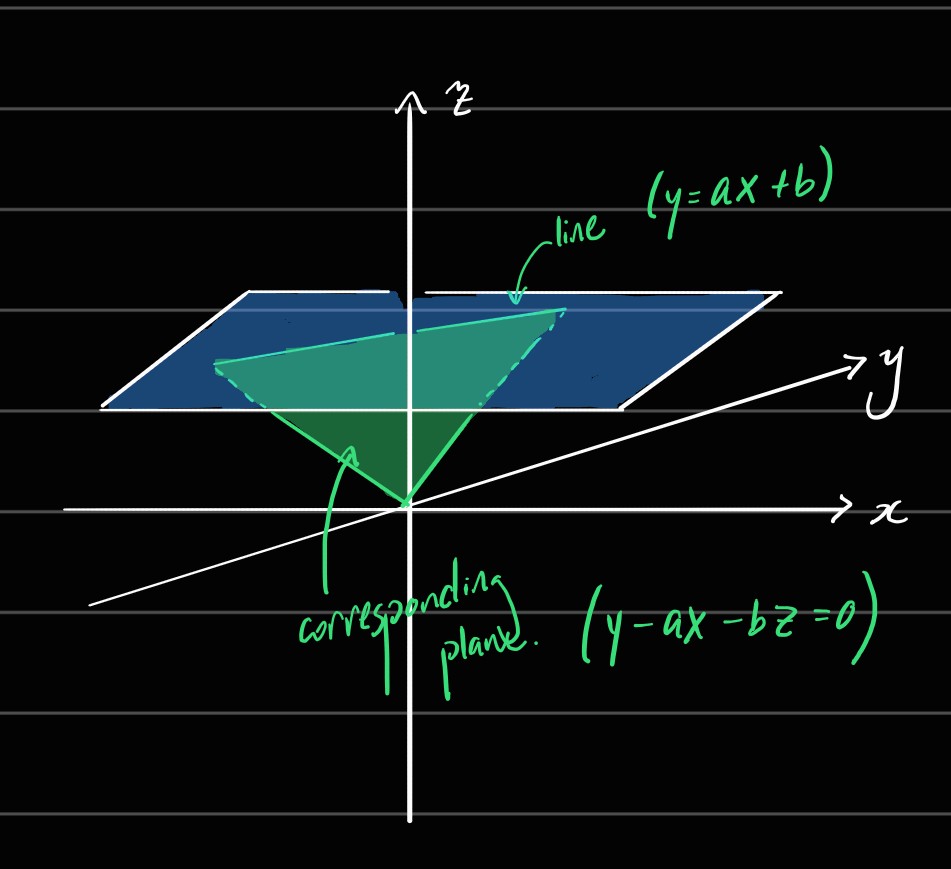
In the previous post: https://menagerieofmathematics.wordpress.com/2025/05/19/may-18th-a-question-from-last-time-single-layer-potential-part-2/?preview_id=750&preview_nonce=a771ef8129&preview=true,

I gave a proof of why a harmonic function defined on \mathbb{R}^2 bounded by log(x) must be a constant function. The proof was incomplete, I was only able to show that things would be ‘nice’ when x > 1, but did not know what would happen inside the unit disk.

Key point: Use the maximum principle for holomorphic functions. Once we have shown that the function is bounded by a constant outside of the unit disk, we show that the function can be smoothly extended to every point inside the unit disk.

Suppose u(x, y) is harmonic and well-defined on \mathbb{R}^2. Then, there exists a holomorphic function f(z) = u(z) + iv(z), where u is its real part.

Define the function g(z) = e^{f(z)} - e^{f(0)} (note the difference from the previous attempt where I defined g(z) = e^{f(z)}).

For z \geq 1,

|g(z)| \leq |e^{f(z)}| + |e^{f(0)}| \leq |z| + C \leq (C+1)|z|, where |e^f{(0)}| = C.

It follows that |g(z)/z| \leq C+1 for all z \geq 1.

What about inside the unit disk?

Here is where that change in the way I have defined g(z) comes in. Notice that g(0) = 0, and so, the Taylor series at the origin is of the form:

g(z) = a_1 z + a_2 z^2 + ....

This means:

\frac{g(z)}{z} = a_1 + a_2 z^2 + ... behaves nicely within the neighborhood around the origin and can be extended to the origin.

Hence, \frac{g(z)}{z} can also be extended to a holomorphic function inside the unit disk. Since at the boundary, the function is bounded by C+1, by the maximum principle, the function inside the unit disk is bounded by C+1.

Then, by Liouville’s Theorem, \frac{g(z)}{z} is constant on the entire plane.

Hence, e^{f(z)} - e^{f(0)} = \alpha z \Leftrightarrow e^{f(z)} = \alpha z + e^{f(0)}. Since |e^{f(z)}| > 0 for all z \in \mathbb{C}, \alpha = 0.

We now return to the topic of the Euclidean bundle and its projective dual. For simplicity, we will thoroughly study (2-\lambda)x_1^2 + (3-\lambda)x_2^2 = 1, and its supposed dual \frac{x_1^2}{2-\lambda} + \frac{x_2^2}{3-\lambda} = 1.

Admittedly, I had been too lazy in the last post to bother checking the duality. But I’ve now realized that it might not have been so trivial, so here is me making up for it in this post.
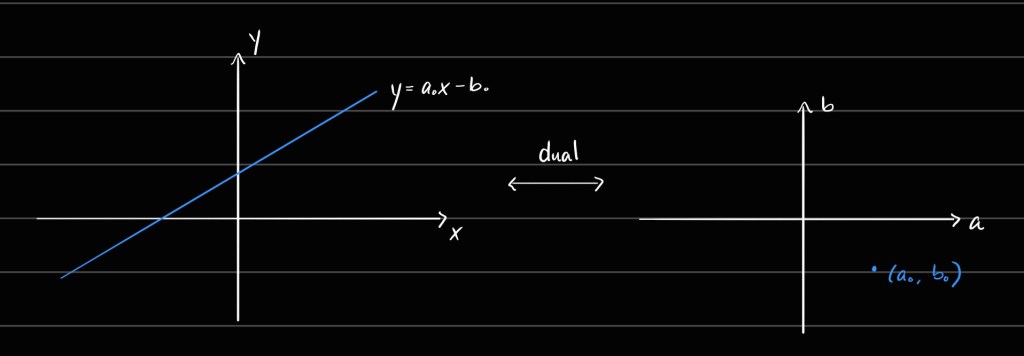
The problem with this is that vertical lines are associate with points at infinity. So the dual curve of a closed curve (for instance, a circle), will be quite bad.

What do we do? Consider things in homogeneous coordinates. We view a line as a plane passing through the origin of \mathbb{R}^3:

The dual will be the normal vector the plane:
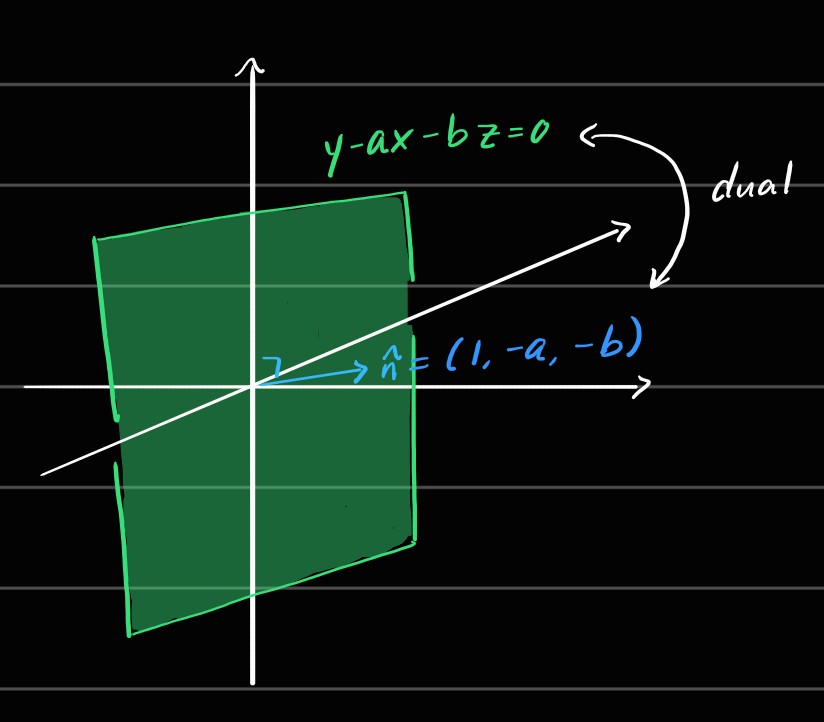
By looking at things in \mathbb{RP}^2, we have a much easier way of representing all lines.

Given the curve 2x^2 + 3y^2 = 1, to study its dual curve, we must first homogenize it so that it is in \mathbb{RP}^2 (every point on the curve corresponds to a line passing through the origin in \mathbb{R}^3):

2X^2 + 3Y^2 = Z^2. Let’s call the curve described by this equation C.

Key: C is a level curve of the function F(X, Y, Z) = 2X^2 + 3Y^2 - Z^2. The gradient of the function at each point on C will be normal to C. We use this to help us find the equation of the tangent line at each point.

Given (X_0, Y_0, Z_0) \in C, \nabla F(X, Y, Z)|_{(X_0, Y_0, Z_0) = (4X_0, 6Y_0, -2Z_0). Thus, the tangent line at (X_0, Y_0, Z_0) is given by:

(X, Y, Z) \cdot \nabla F(X, Y, Z)|_{(X_0, Y_0, Z_0) = 0

\Leftrightarrow 4X_0X + 6Y_0Y - 2Z_0Z = 0

The corresponding dual point is (\tilde{X}, \tilde{Y}, \tilde{Z}) = (2X_0, 3Y_0, -Z_0).

Since 2(\frac{X_0}{Z_0})^2 + 3(\frac{Y_0}{Z_0})^2 = 1, it follows that:

\frac{(\frac{\tilde{X}}{\tilde{Z}})^2}{2} + \frac{(\frac{\tilde{Y}}{\tilde{Z}})^2}{3} = 1.

Hence, the dual curve is given by \frac{x^2}{2} + \frac{y^2}{3} = 1.

Aside: given \frac{x^2}{a} + \frac{y^2}{b} = 1, where a, b \in \mathbb{R}, the two foci of the conic are: c, -c where |c| + |b| = |a|.

So, the family of conics described by \frac{x^2}{a - \lambda} + \frac{y^2}{b - \lambda} = 1 share the same two foci:

c = b - a or c = a - b.

Leave a Reply

Is this your new site? Log in to activate admin features and dismiss this message
Log In