This will be mainly based upon Section 6 of Chapter 2 of Arnold’s ODE.

Corollary 7 (taken from p. 100 of Arnold’s ODE): A solution with initial condition in a compact set K (note: this is different from saying “passing through a point in K”; we will discuss this in detail below) in the extended phase space can be extended forward and backward to the boundary of K. The extension is unique in the sense that any two solutions with the same initial condition coincide wherever they are both defined.
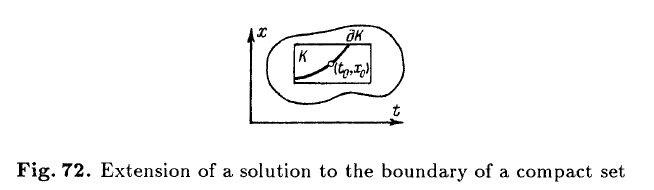
The goal of this post will be to try and understand Arnold’s proof of the uniqueness and existence of such extension and work through problem 2 on page 101.

But first, let’s examine why Corollary 7 used initial condition instead of merely a point in K.

Consider the direction field defined on the domain {x_1}^2 + {x_2}^2 > 0 (i.e. the plane with the origin removed) of the phase plane of the pendulum, i.e. \dot{x_1} = -x_2 and \dot{x_2} = x_1.

Why that specific domain of definition for the direction field? Let’s take a look at the velocity vector field on the phase plane to see why:
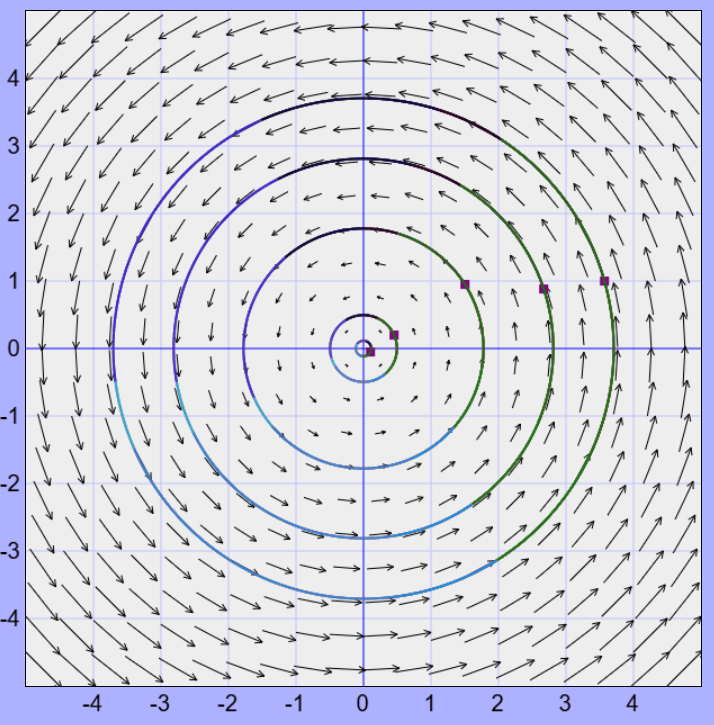
Figure obtained from: https://aeb019.hosted.uark.edu/pplane.html

The direction field is constructed from the velocity vector field by assigning the line defined by the velocity vector at each point to that point. This assignment is well-defined as long as the velocity vector at that point is non-zero. Notice that the origin is an equilibrium point of the phase space; the velocity vector is 0. This is why we need to remove the origin from our domain on which the direction field is defined.

Now, if we choose our compact set K to be 1 \leq x_1^2 + x_2^2 \leq 4, notice that the solution x_1^2 + x_2^2  = 2 lives inside set K but does not intersect with the boundary of K.

This does not contradict with Corollary 7, because this direction field does not have an axis of time; none of the points on an integral curve can be considered as an initial condition for that curve.

Notice that in order for there to be a notion of initial conditions, the direction field must be non-vertical.

________________________________________

Let’s now return back to the proof for Corollary 7.

We begin by showing the uniqueness of the extension (easier to show than existence):

Given initial condition (t_0, x_0) in K and its corresponding solution \phi(t), by the local uniqueness theorem (section 2 of chapter 2), there exists a small neighborhood in which any other integral curve passing through (t_0, x_0) coincide with \phi(t).

Let t_1 be the least upper bound of the time values at which uniqueness of \phi(t) holds. By definition, any solution \sigma(t) passing through (t_0, x_0) will coincide with \phi(t) to the right of t_1. Suppose they are both defined at t_1, by continuity, \sigma(t_1) = \phi(t_1). But then, by the local uniqueness theorem, \sigma(t) and \phi(t) must also coincide in some neighborhood to the right of t_1. Thus, t_1 must be the endpoint of an interval of definition for at least one of the two solutions. This concludes the proof for uniqueness.

Now, we prove the existence of such extension:

Notice that we have not used the fact that K is compact in the proof of uniqueness. The key behind the proof of existence is to use this fact. We want to show that we can extend a solution at an initial condition in K to the boundary of K within finite steps (i.e. within finite amount of time). So how do we choose such finite steps? We will have to find some kind of finite covering of K (this is where compactness comes in) and then select from this finite set.

By the local existence theorem, for each point (t, x) in K, we can find a neighborhood around (t, x) such that the solution with initial condition at any point in the neighborhood can be continued forward and backward to an interval of time in which all solutions with initial conditions in this neighborhood are defined.

The collection of all these neighborhoods form an open cover for K. Since K is compact, we can find a finite subcover. It follows that the set of intervals of time corresponding to this finite subcover is also finite. We can then choose the shortest interval of time from this set, denoting it to be \epsilon.

Let (t_0, x_0) be an arbitrary point in K. It is going to be covered by at least one of the neighborhoods of the finite subcover. Hence, the corresponding solution \phi(t) can be continued forward and backward by at least \epsilon in time. Let’s construct the forward extension of \phi(t) (the backward extension will follow by similar construction) and show that it will eventually reach the boundary.

Let’s move \frac{\epsilon}{2} forward in time and look at \phi(t_0 + \frac{\epsilon}{2}) (note: as long as we pick something smaller than \epsilon, then we are safe. The problem is that we cannot say for sure if \phi(t_0 + \epsilon) defined). If it is not in K, then we are done. If this value is still within K, then we can again extend \phi(t) by \epsilon. We move forward in time by another \frac{\epsilon}{2} and look at \phi(t_0 + \epsilon).

We repeat this process until we eventually reach some n \in N such that \phi(t_0 + n\frac{\epsilon}{2}) is no longer in K. Hence, we have shown the existence of such forward extension. The existence of the backward extension follows by similar proof.

________________________________________

Problem 2 of Arnold’s ODE p. 101

Claim: it suffices to consider initial condition (t_0, x_0) where |x_0| \geq r.

Proof of claim: Given initial condition (t_0, x_0) with |x_0| \leq r. Let \phi(t) be the corresponding solution. If |\phi(t)| \leq r for all t \geq t_0 (we are considering the forward extension), then take K_n = [t_0, t_0 + n] \times \overline{b_r(0)} to be a sequence of compact sets for n \in N. By the extension theorem, we can forward extend \phi(t) to the boundary of K_n. Since |\phi(t)| \leq r for all t \geq t_0, it follows that \phi(t) will always intersect (t_0 + n) \times \overline{b_r(0)} (i.e. the top of the cylinder K_n). By choosing arbitrarily large n, we can extend \phi(t) indefinitely.

If there exists some time t_1 > t_0 such that |\phi(t_1)| \geq r, then we can pick (t_1, \phi(t_1)) as our new initial condition and it suffices to examine if it is possible to extend our solution indefinitely from this point onwards. Hence, this verifies our claim.

Ok, so now let’s show that we can indeed extend any solution with initial condition (t_0, x_0) where |x_0| \geq r indefinitely.

Given such initial condition and corresponding solution \phi(t). Since |v(t, x)| \leq kx, it follows that |\phi(t)| \leq |\phi(t_0)|e^{k(t-t_0)} for all t \geq t_0.

Given x_1 > |\phi(t_0)|. Let t_1 be the first time such that |\phi(t_1)| = x_1. It follows that

t_1 \geq \frac{log(\frac{x_1}{|\phi(t_0)|})}{k} + |\phi(t_0)|

and so, as x_1 \rightarrow \infty, t_1 \rightarrow \infty. We choose the sequence of compact sets K_n = [t_0, t_n] \times \overline{b_n(0)} where n >> |\phi(t_0)| and n \in N and t_n is the first time \phi(t_n) = n. This induces an indefinite extension on \phi(t).

Suppose for some x_1 > |\phi(t_0)|, such t_1 does not exist, i.e. |\phi(t)| < x_1 for all time. Then we can reason similarly to our verification of the claim to show that \phi(t) can be extended indefinitely.

,

Leave a Reply

Is this your new site? Log in to activate admin features and dismiss this message
Log In