The post centers around the question taken from p. 91 of Arnold’s ODE:

A counterexample:

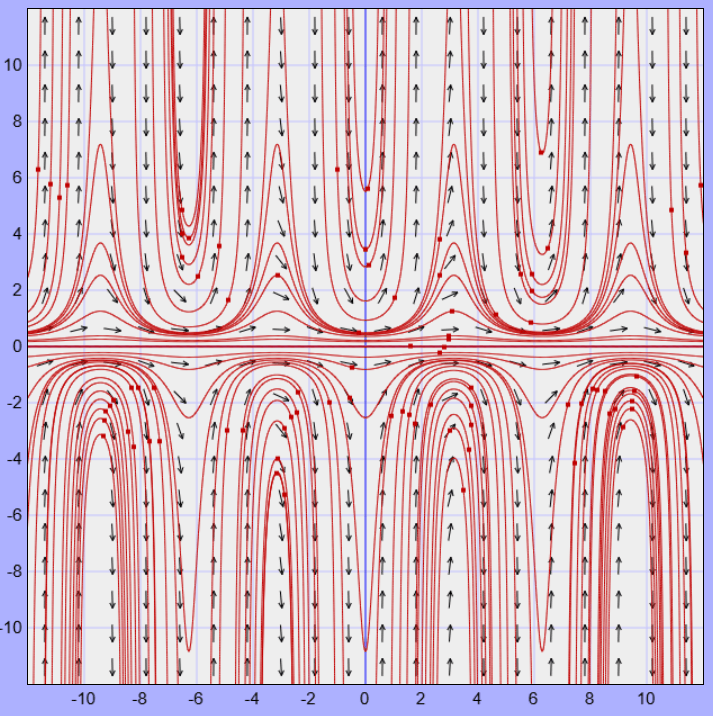
Suppose not. Then there exists such a diffeomorphism that transforms all integral curves of the direction field into parallel lines. It follows that in the rectified field, there exists a transversal intersecting all the parallel integral curves once.
We take the inverse diffeomorphism back. The image of the transversal is a smooth curve (because a diffeomorphism maps smooth curves to smooth curves) that intersects with each original integral curve once (because a diffeomorphism is injective).
It is not difficult to see that there does not exist a smooth curve that can intersect each integral curve once and only once.
It led me to think: given a family of smooth curves, how do we know if there exists a smooth curve that intersects each smooth curve of the family once and only once?


Leave a Reply