Definition: a contact manifold is a manifold equipped with a field of hyperplanes in its tangent spaces satisfying the condition of “maximal non-integrability”.
Example:
Recall the space of 1-jets of functions that we have seen when working with quasi-linear PDEs. Suppose the coordinates in this space to be 

Goal: In this post, we will understand what it means for a contact manifold to be non-integrable (and what it means for it to be maximal non-integrable) and we will see why the space of 1-jets with the field of planes is indeed a contact manifold.
Step 1: non-integrability
Unlike a field of one-dimensional directions, a field of planes may not have integral surfaces (i.e. surface whose tangent space is a subspace of the plane at each point) whose dimension is equal to the dimension of the planes.
How can we tell if a field of hyperplanes is not integrable?
Let 


Let 

The intersections of the field of planes with the lateral surfaces of the parallelepiped gives a direction field on the lateral surfaces. We can now lift the two paths so that they are integral curves of this direction field. Note: the projection of these two integral curves onto
The end points of these two integral curves are two points above the opposite vertex which are different in general. This difference is what prevents us from constructing integral surfaces.
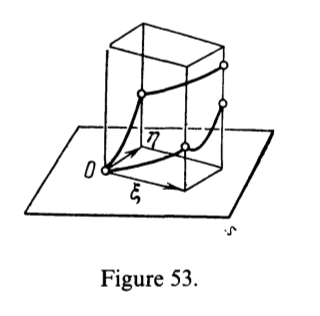
The principal bilinear part of this difference, with respect to 

The difference being non-zero is equivalent to saying the exterior derivative 
In fact, a 1-form 
If
In the example of the space of 1-jets,

The corresponding matrix has the form:

The determinant of this matrix is equal to 1. Hence,
Note: non-degenerate skew-symmetric bilinear forms can only be defined on even dimensional spaces. Why?
The corresponding matrix for the bilinear form is a skew-symmetric matrix, i.e. 


This implies n has to be even.
Thus, contact structures exist only on odd-dimensional manifolds.
Claim: the dimension of an integral manifold of a field of contact planes on a contact manifold of dimension 2n+1 does not exceed n.
Suppose 

Since the tangent plane of 

Thus, 
Hence, every two vectors in the tangent space of
The dimension of an isotropic subspace cannot exceed 


Leave a Reply