This post is based upon my understanding of what I am learning in my Riemann Surface class.
Intuition: Given a holomorphic function on an open neighborhood U of 0, if and , then f will locally behave like its linear term. if and (where is the smallest), then f will locally behave like its -term.
Lemma: f is holomorphic on an open neighborhood U of 0, and it is not a constant function. There is a unique integer such that on some smaller neighborhood of 0 , we can find a holomorphic function g with and
on .
Proof:
Key: we use the fact that f has a Taylor expansion at .
,
We can re-write the above as:
, where .
Define . This is a multi-valued function, but that’s okay. Let’s see why. Since is a finite value, there exists a small neighborhood, say of 0, such that for any , . Hence, is well-defined on .
Let .
Notice that , which is what we want.
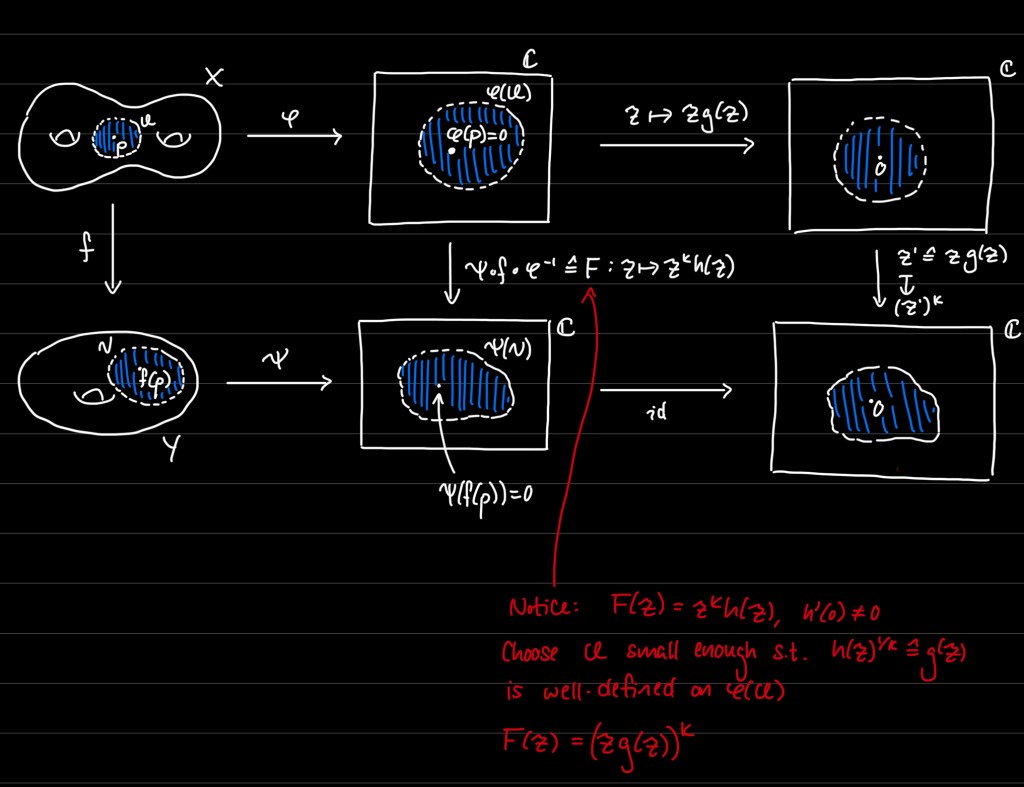
Corollary: Let X, Y be two Riemann surfaces and be non-constant and holomorphic. Then, for any point , there is a unique integer such that there exists charts and (with and ) such that , , and .
Picture proof:
Definition: The integer k given in the corollary above is the multiplicity of f at p, and is denoted by .
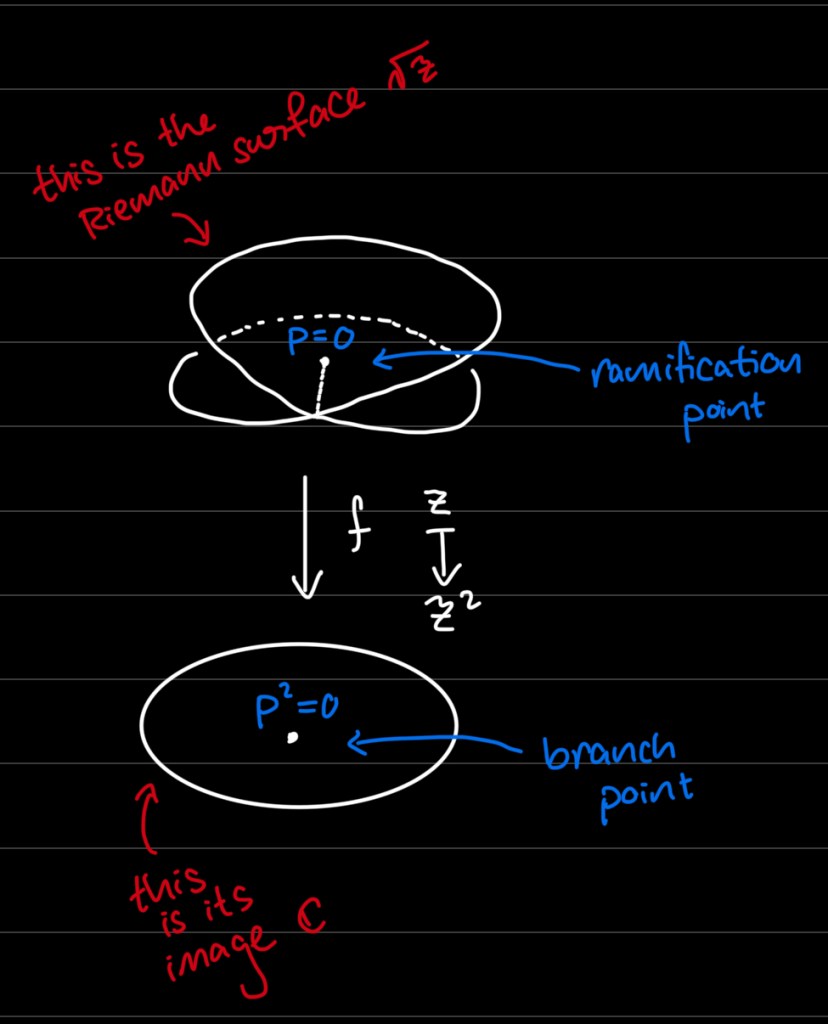
Definition: A point is called a ramification point for f if .
(note: ramify means to divide into 2 or more branches)
A point is a branch point of f if it is the image point of a ramification point for f.
Claim: the set of ramification points of f is discrete on X. (Recall: a subset S of X is discrete if each is contained in an open neighborhood U such that )
Key: A ramification point is a point where the derivative of the map is 0. Notice that in a neighborhood of a ramification point, the derivative of is non-zero. Then, we use the fact that transition maps are biholomorphic to show that no matter which charts we choose, the points in a neighborhood of the ramification point cannot be a ramification point.
Proof: Given X, Y are Riemann surfaces and is a non-constant holomorphic map. Let be a ramification point. Then, there exists a neighborhood of p along with the map and a neighborhood of (such that ) and a map such that:
is given by
(for some )
Claim: no points in is a ramification point.
Suppose for a contradiction there exists such that it is a ramification point. Then, we can find a neighborhood of and and a neighborhood of (with ) and such that:
is given by
for some
It follows that . We know that the transition maps and are biholomorphic.
Since and , it follows that:
This is equivalent to:
Since , it follows that .
But by (*), we have:
Expanding the above gives:
The LHS = 0.
Since is biholomorphic, its derivative does not vanish anywhere. We also know from above . Hence, RHS is non-zero, a contradiction.






Leave a Reply