The first part of the post is based upon my reading of Arnold’s ODE, the section: Differential Equations on Manifolds; the second part of the post is based upon my reading of Wald’s General Relativity / concepts from class. The motive of this post is to write out my own understanding of these concepts and to reconcile the different definitions that the 2 books give (I believe Arnold approaches it from a more geometric perspective whereas Wald approaches it from a more abstract point of view).
Part 1: Arnold’s ODE
Tangent Space
Let M be a smooth manifold.
Definition of a tangent vector to M at point p: it is an equivalence class of curves passing through p. We say that two curves are equivalence if their images on any chart are equivalent in 
Recall: the equivalence relation in 


Note: the equivalence relation on M is independent of charts because the transition maps are diffeomorphisms.
Tangent Bundle
We consider 
TM has a natural smooth manifold structure.
It makes sense for the dimension of TM to be 2n. A point in TM = ‘point of attachment on M’ + ‘direction vector of the tangent space of M at that point’. i.e. to determined a point, we need to know which tangent space it belongs to (the p in 
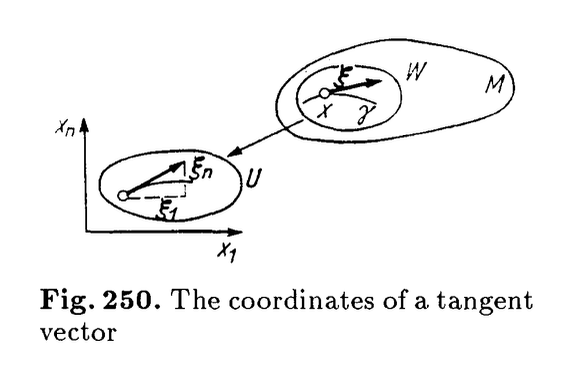
We construct a chart on TM from an existing chart on M.
Let 


Note: using 


Let 


Consistency of charts:
Suppose 


What about 
Let 


Let 


these are smooth functions of the 
Definition: the manifold TM is the tangent bundle of M.
We have 2 natural mappings between M and TM:
given by mapping each point
to the zero vector of
given by the projecting mapping which takes each
.
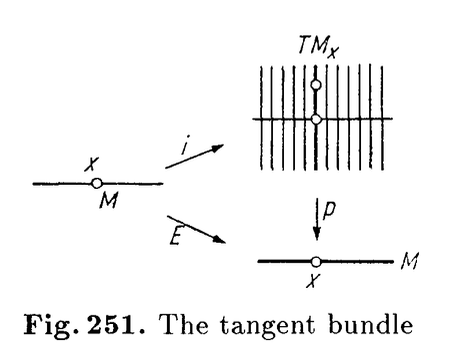
Definitions:
- Fibers: pre-images of points under the projection mapping p. Example:
- M is the base of TM.
Part 2
Tangent Space
In Wald’s General Relativity, he defines the tangent vector 
a linear map 


So how do we reconcile this definition with the one given by Arnold? How do we see the ‘vector’ hidden behind this definition?
Key: 

The equivalency of these two definitions come from the following bijective map:

Recall: this is essentially the one-to-one correspondence between a vector field, 

We are really seeing the tangent space as the space of first-order homogeneous linear differential operators!
In this case, the coordinate tangent vectors corresponding to 
Cotangent Space
Definition: 

This is the dual space of
But how do we see the duality?
Let 


Know: 
Hence, 


Leave a Reply