This post is based upon my reading of the section: Differential Equations on Manifolds (Arnold’s ODE).
Part 1: What is a differentiable manifold?
Goal: we first start by giving a few definitions; we then take a look at a few representative examples.
Definition of a differentiable manifold: it is a set M with a differentiable manifold structure on it. This structure is introduce on M if an atlas consisting of charts are consistently prescribed.
Definition of chart: let W be a subset of M and 

Definition of consistent charts: Let 


are open (they can be empty, i.e. when
) (
does this guarantee that. Note: right now, there is no notion of ‘open’ or ‘closed’ sets on M because we do not have any notion of ‘distance’ on M.)are homeomorphisms? In class, we required
are diffeomorphisms between
(these are called the transition maps).
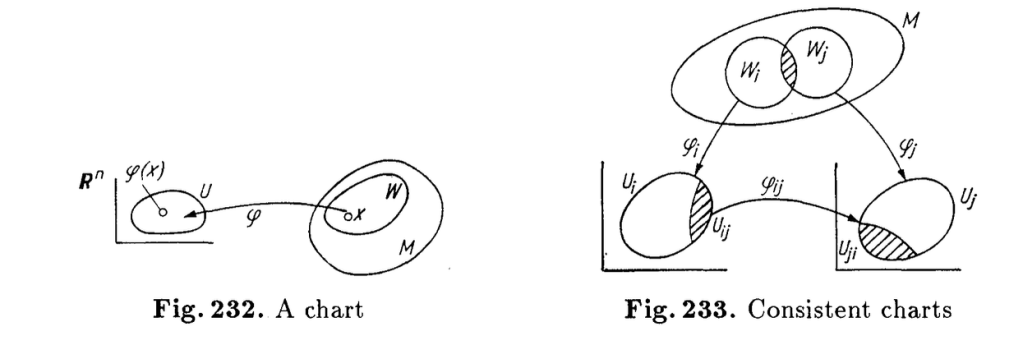
Interpretation: to study a manifold, we need to ‘pull’ it back to the vector space 

So now the question is what do we mean by a ‘differentiable’ manifold? Does it even make sense to say a ‘chart’ is differentiable? If not, what is the criterion that makes a manifold ‘differentiable’?
Turns out, the ‘differentiable’ comes from the transition map. The differentiable class of the transition map determines what type of manifold we are dealing with.
If the transition maps are smooth, then our manifold is smooth.
If the transition maps are 
Interpretation: the reason the smoothness of our manifold is uniquely determined by the smoothness of our transition maps is because the ‘differentiable structure’ that we have given to our manifold arises from the charts. So to study the structure, we study the relations between the charts. And it makes perfect sense to look at the differentiability of transition maps as they are maps from 

Definition of atlas: an atlas is a collection of charts on M that satisfies:
- any pair of charts are consistent
- any point
belongs to the domain of at least one chart (i.e. the set
covers the entire M)
Definition of equivalent atlases: 2 atlases on M are equivalent if their union is an atlas (really, this just means that any chart on the first atlas is consistent with any chart on the second).
We call an equivalence class of atlases a “differentiable manifold structure” on M.
Question/Investigation: It would be interesting to find a set M such that it can be endowed with more than one differentiable manifold structure. Also, how can we “count” the number of differentiable manifold structure that M has?
Important: we impose two conditions on our definition of a manifold to avoid pathological objects.
Condition 1: Hausdorff condition: any 2 points 


What happens if we do not require this condition?
We give an example in 
Condition 2: second-countability, i.e. there exists an atlas of M consisting of at most countably many charts.
So now, let’s look at some examples:
Example 1: 


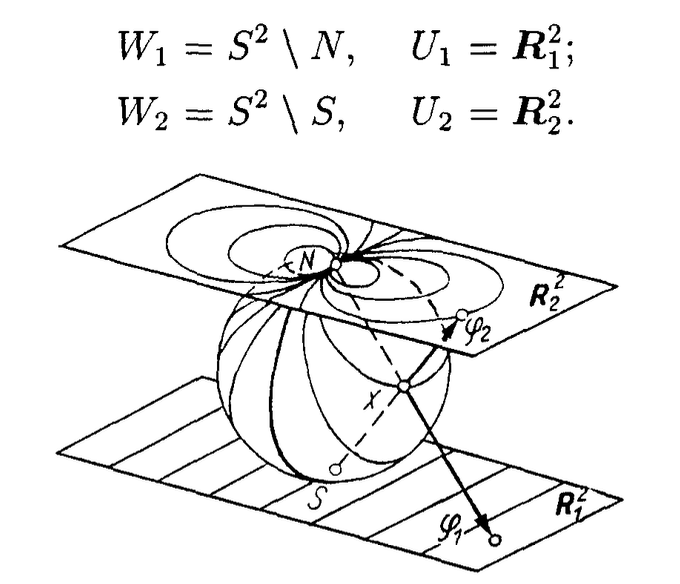
By stereographic projection, we see that this sphere can be covered with an atlas of 2 charts. Arnold also pointed out that a family of tangent circles on the sphere passing through the North Pole N gets mapped to a family of tangent circles on one chart and a family of parallel lines on the other.
The map for chart 1 is given by:

and its inverse is given by:

The map for chart 2 is given by:

and the inverse is given by:

The transition map from chart 1 to 2 is given by:


Example 2: a torus in
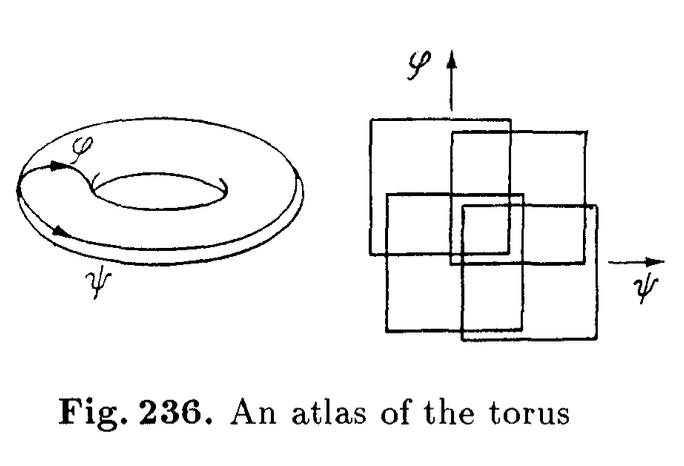
Without loss of generality, we fix an origin on the torus and set up angular coordinates. We can consider the atlas consisting of 4 charts (each chart’s mapping is the identity map) whose domains on the torus are (Note: each point on the torus can now be uniquely determined, relative to our ‘origin’, using the two angular components 


The figure above shows the 4 images of our domain on
Example 3:

I have attached screenshots of my notes showing the explicit formulas for the mappings corresponding to the 3 charts (each of whose domain is a copy of the affine plane,
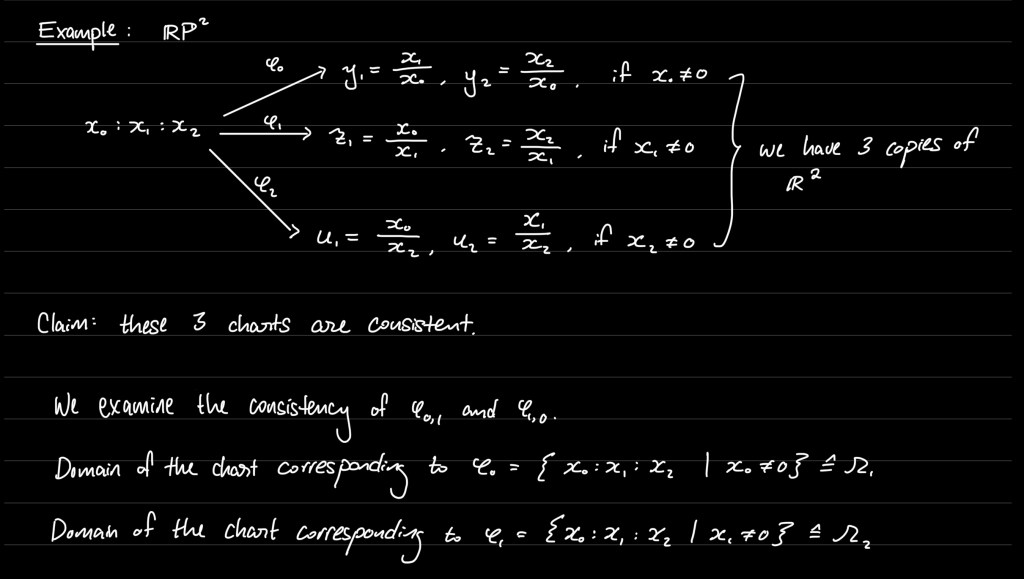
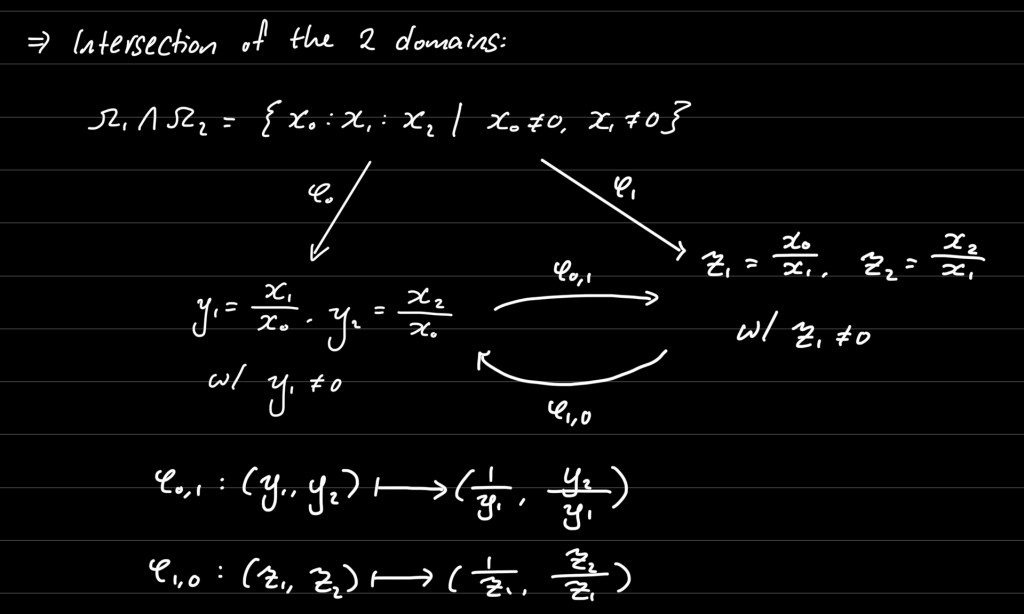
Since both 
An interesting picture from Arnold’s ODE shows how the diffeomorphism 
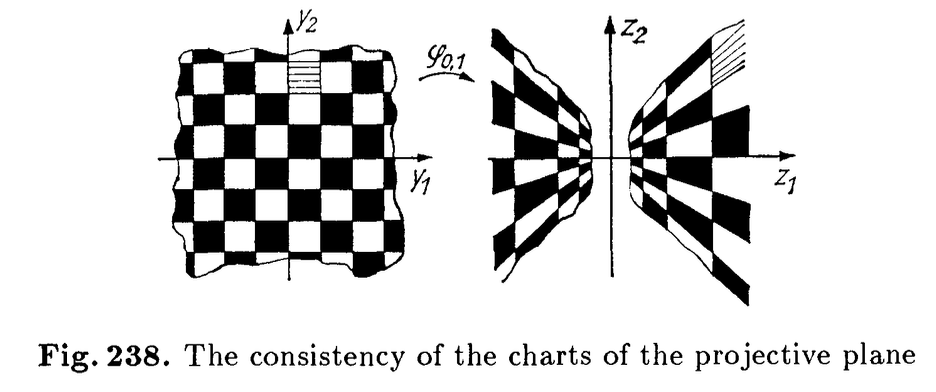
We start with a ‘square’ with the section of the 


Leave a Reply