Viète’s theorem tells us that , i.e. there is a diffeomorphism between the space of sets of unordered n lines passing through the origin of and the space of lines passing through the origin of .
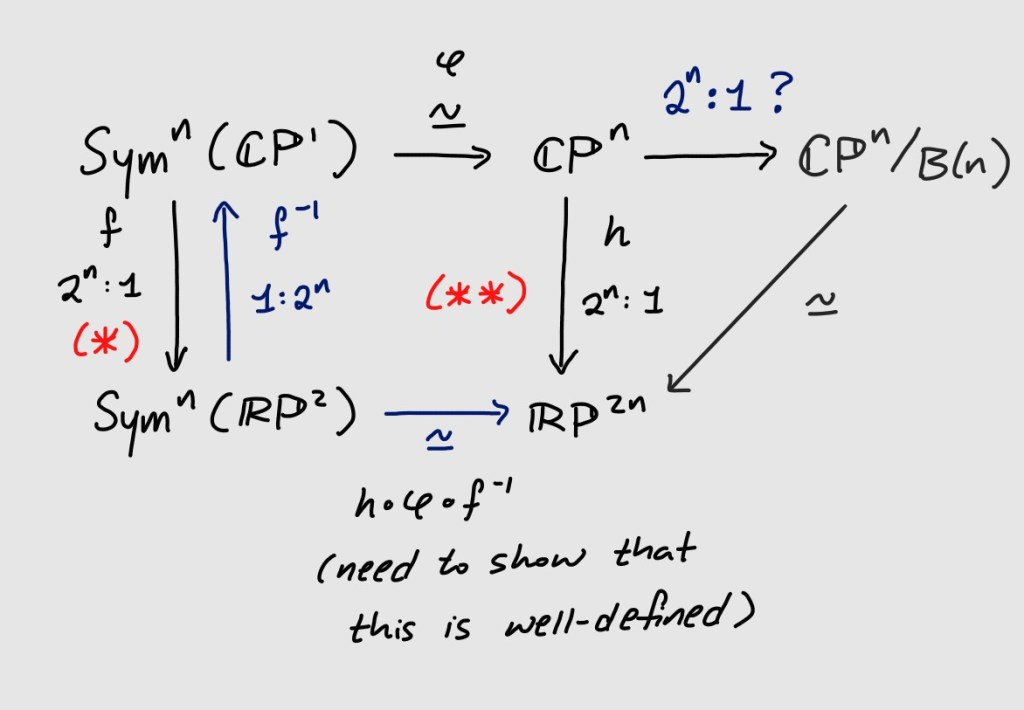
In his PDE book, Arnold claimed that and gave a proof based upon some corollaries and theorems obtained while proving Maxwell’s theorem. He also said that Viète’s theorem is the quaternion version of ; this will be the main focus of this post. The proof that Arnold gave tends more towards algebraic geometry (I will give a thorough examination of this later in this post). In the first part of this post, I will share a proof that I have in mind, which is really an extension of Viète’s theorem. By constructing multi-valued maps between and , and and , respectively, we will lift the diffeomorphism between and to one between and .
We start by constructing the -sheeted covering from to (**); we will also show that .
We first look at two examples: when n = 1 and n = 2.
The maps from are constructed from the elementary symmetric forms.
When n = 1, we construct in the following method:
Let be arbitrary. This corresponds to the line in . Its Hermitian-orthogonal is given by , and the corresponding point in is .
We look at .
Using the coefficients of the above polynomial, for each point , we obtain a unique ray (scaling by a positive constant) in :
.
Notice that the Hermitian-orthogonal does not get mapped to the same ray; it gets mapped to the antipodal ray in :
The space of rays in can be identified as in the obvious way (each ray corresponds to a point on the sphere).
Thus, the map (which is the antiholomorphic involution map on , discussed in a previous post) under this map gives rise to the antipodal map on .
It follows that by identifying and as one point (we are now looking at the space ), we have the following bijection induced from the above bijection (it can be shown that is a diffeomorphism) from :
.
This map can again be shown to be a diffeomorphism.
Thus, we have .
Now, let’s look at when n = 2. We will construct a -sheeted covering from .
Since , a point in can be identified as an unordered pair of points in , i.e. .
These two vectors together with their Hermitian-orthogonals give us:
.
Similar to the case of when n=1, the corresponding symmetric forms can be obtained as the coefficients of the following polynomial:
.
Expanding the LHS gives:
.
Notice .
And so we have a map from to :
.
Thus, we have a map from to .
This is a 2:1 map; let’s call it . Notice that gets mapped to the same ray, i.e. the antiholomorphic involution in under induces the identity map on .
In his book, Arnold claimed that this antiholomorphic involution under is the same as the complex conjugation map (in this case, they leave the resulting image unchanged in ); this is because each factor of this map is a symmetric form of degree n in terms of . Hence, each factor is invariant under permutations of and when n is even, the -1’s cancel out.
Hence, we have a bijection from (showing that this bijection is smooth tells us that .
Now, in , if we identify {{}}, {{}}, {{}}, {{}} as one point (i.e. we consider the space ), then we have a bijection to the space of lines in . This is because the points {{}}, {{}}, under the map , are both mapped to the antipodal ray corresponding to .
Thus, we have .
I will not show the general result for in this post.
From the construction we did for n = 2, the diffeomorphism is really between and .
We now focus on (*), i.e. finding a -sheeted covering from and .
Given a point {{}} , my thinking is that we can take the diffeomorphism we constructed for to map each for to a point in :
.
For each factor of , this map is a 2:1 cover (recall the above for n = 1), and so, putting this together as a map from , we have a cover.




![= z_1 \bar{w_1} z_2 \bar{w_2} x^4 + [z_1 \bar{w_1}(w_2 \bar{w_2} - z_2 \bar{z_2}) + z_2\bar{w_2}(-z_1\bar{z_1} + w_1\bar{w_1})]x^3y + [-z_1\bar{w_1}\bar{z_2}w_2 + (w_1\bar{w_1} - z_1\bar{z_1})(w_2\bar{w_2} - z_2\bar{z_2}) - \bar{z_1}w_1 z_2 \bar{w_2})x^2y^2 - \overline{[z_1 \bar{w_1}(w_2 \bar{w_2} - z_2 \bar{z_2}) + z_2\bar{w_2}(-z_1\bar{z_1} + w_1\bar{w_1})]}xy^3](https://s0.wp.com/latex.php?latex=%3D+z_1+%5Cbar%7Bw_1%7D+z_2+%5Cbar%7Bw_2%7D+x%5E4+%2B+%5Bz_1+%5Cbar%7Bw_1%7D%28w_2+%5Cbar%7Bw_2%7D+-+z_2+%5Cbar%7Bz_2%7D%29+%2B+z_2%5Cbar%7Bw_2%7D%28-z_1%5Cbar%7Bz_1%7D+%2B+w_1%5Cbar%7Bw_1%7D%29%5Dx%5E3y+%2B+%5B-z_1%5Cbar%7Bw_1%7D%5Cbar%7Bz_2%7Dw_2+%2B+%28w_1%5Cbar%7Bw_1%7D+-+z_1%5Cbar%7Bz_1%7D%29%28w_2%5Cbar%7Bw_2%7D+-+z_2%5Cbar%7Bz_2%7D%29+-+%5Cbar%7Bz_1%7Dw_1+z_2+%5Cbar%7Bw_2%7D%29x%5E2y%5E2+-+%5Coverline%7B%5Bz_1+%5Cbar%7Bw_1%7D%28w_2+%5Cbar%7Bw_2%7D+-+z_2+%5Cbar%7Bz_2%7D%29+%2B+z_2%5Cbar%7Bw_2%7D%28-z_1%5Cbar%7Bz_1%7D+%2B+w_1%5Cbar%7Bw_1%7D%29%5D%7Dxy%5E3&bg=ffffff&fg=000&s=0&c=20201002)


Leave a Reply