Goal: space of spherical harmonics of degree n is an irreducible representation of SO(3).

We know that the space of spherical harmonics of degree n has dimension 2n+1. The zonal function, say f_n(z), obtained by differentiating \frac{1}{r} by \frac{\partial^n}{\partial z^n}, is a spherical harmonic. We now show that \{ f_n(z), \frac{\partial^k f_n(z)}{\partial \alpha^k}, \frac{\partial^k f_n(z)}{\partial \beta^k} : 0 \leq k \leq n \} (where \alpha, \beta are rotations along the x-axis, y-axis by a small angle, respectively) span the space of spherical harmonics of degree n.

Let’s take a look at \frac{\partial f_n(z)}{\partial \alpha} (i.e. rotating along the y-axis by a small angle).

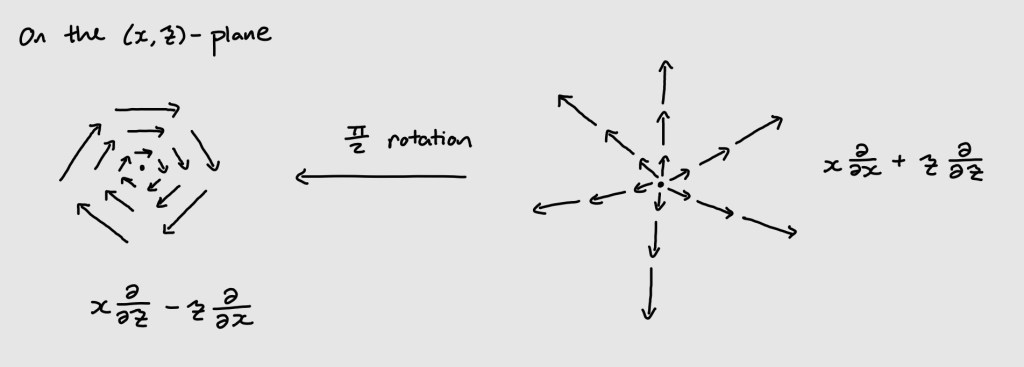
Claim: \frac{\partial}{\partial \alpha} = x \frac{\partial}{\partial z} - z \frac{\partial}{\partial x}.

Key: differentiating \frac{\partial}{\partial \alpha} is the same as differentiating along the following vector field on the (x, z)-plane:

Hence, it follows that

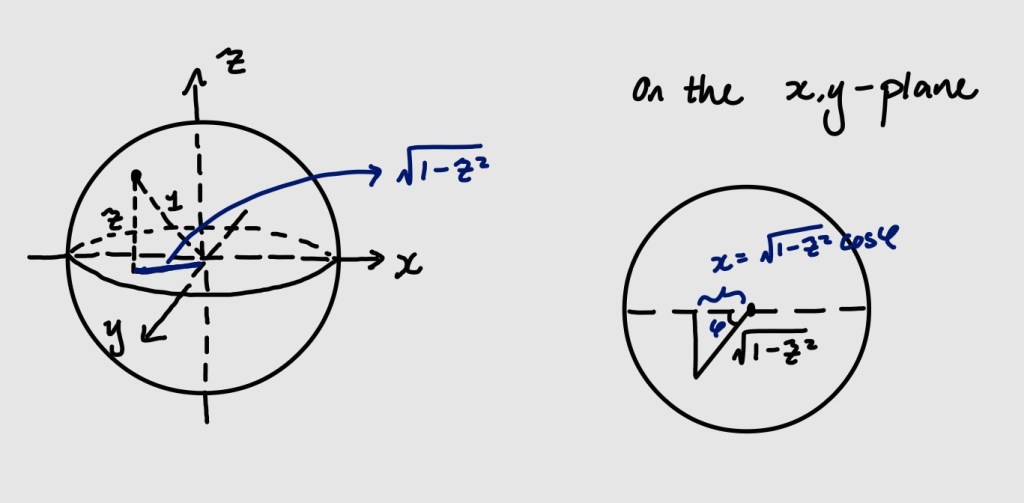
\frac{\partial f_n(z)}{\partial \alpha} = (x\frac{\partial}{\partial z} - z\frac{\partial}{\partial x})f_n(z) = xf'_n(z) (*)

Hence, (*) = \sqrt{1-z^2}cos(\phi)f'_n(z), where \phi is the angle of rotation along the z-axis.

Similarly, for the associated Legendre polynomial corresponding to a rotation along the x-axis:

\frac{\partial f_n(z)}{\partial \beta} = (y\frac{\partial}{\partial z} - z\frac{\partial}{\partial y})f_n(z) = y f'_n(z) = \sqrt{1-z^2}sin(\phi)f'_n(z).

Notice that differentiating by a small angle of rotation does not change the homogeneity of the polynomial. Since differentiating a harmonic function along a constant vector field still gives us a harmonic function, it follows that \frac{\partial^k f_n(z)}{\partial \alpha^k}, \frac{\partial^k f_n(z)}{\partial \beta^k} are both spherical harmonics of degree n.

Example: the zonal function of degree 1 is f_1(z) = z.

The associated functions are:

z, \sqrt{1-z^2}cos(\phi), \sqrt{1-z^2}sin(\phi).

Notice that they span the 3-dimensional subspace of spherical harmonics of degree 1.

For n = 2: the zonal function of degree 2 is f_2(z) = \frac{1}{2}(3z^2-1).

The associated functions are:

\frac{\partial f_2(z)}{\partial \alpha} = (x\frac{\partial}{\partial z} - z\frac{\partial}{\partial x})f_2(z) = x \frac{d \frac{1}{2}(3z^2-1)}{dz} = 3zx = 3z\sqrt{1-z^2}cos(\phi)

\frac{\partial f_2(z)}{\partial \beta} = 3z\sqrt{1-z^2}sin(\phi)

\frac{\partial^2 f_2(z)}{\partial \alpha^2} = (x\frac{\partial}{\partial z} - z\frac{\partial}{\partial x})(3zx) = 3x^2 - 3z^2 = 3(\sqrt{1-z^2} cos(\phi))^2 - 3z^2 (we obtain an expression that involves cos(2\phi)).

Similarly, \frac{\partial^2 f_2(z)}{\partial \beta^2} gives us an expression that involves sin(2\phi). The set of functions we generate via these differentiations give us a basis for the space of spherical harmonics of degree 3 (and in general, degree n).

Leave a Reply

Is this your new site? Log in to activate admin features and dismiss this message
Log In