Last time, we left off at the part discussing the space of spherical harmonics of degree k being generated by linear combinations of a spherical function and its rotations.
We take the generating spherical function to be the restriction of the Legendre polynomial on the unit sphere, say (Recall: the Legendre polynomials are mostly not harmonic functions in , but on the sphere, it coincides with a homogeneous harmonic polynomial).
How do we obtain a basis of spherical functions from the ?
I’m not exactly sure how Arnold obtained this answer, but the basis is: , where .
What is the angle ?
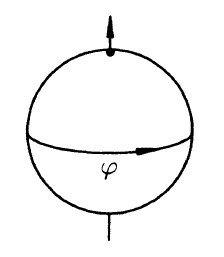
It is the angle at which we rotate around the z-axis on the (x,y)-plane. Essentially, we are looking at our space in terms of cylindrical coordinates. The functions and that we have created have two ‘separate’ components that depend independently on z and the angle on the (x,y)-plane. Something that we can ask ourselves is, why don’t we consider functions formed by multiplying with a function depending on , where is the magnitude of the distance of a point to the origin on the (x, y)-plane? We definitely can, but we would not be easily able to generate a basis of dimension (2k+1) in this way…
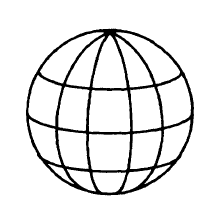
Arnold put this very nice picture to show the independent vibrating sections of the sphere corresponding to a function or . These are the sections formed by the zero set of such function on the sphere. I’m not sure why Arnold talked about them as ‘independent’, but it is clear that if this function describes the vibration of the surface of the sphere, then the curves of the zero set are regions of the surface that are not moving; the regions separated by these curves are ‘moving on their own’.
The longitudinal (i.e. the curves parallel to the equator of the sphere) curves are the zeros of the original and the latitudinal curves are the zeros of or . Isn’t this nice?
Also, Arnold called these the associated Legendre polynomials, and he said that the associated functions are a measurement of the difference between an original spherical function and the translated function. So what type of translation do we need to apply to the Legendre polynomial to obtain the associated Legendre polynomial?
It is not difficult to see that and are spherical functions. We apply the Laplacian in cylindrical coordinates to these functions, and we obtain:
(*)
Since and is a spherical function, it follows that (*) will indeed give us a multiple of the original function. Hence, is an eigenfunction of our spherical laplacian.






Leave a Reply