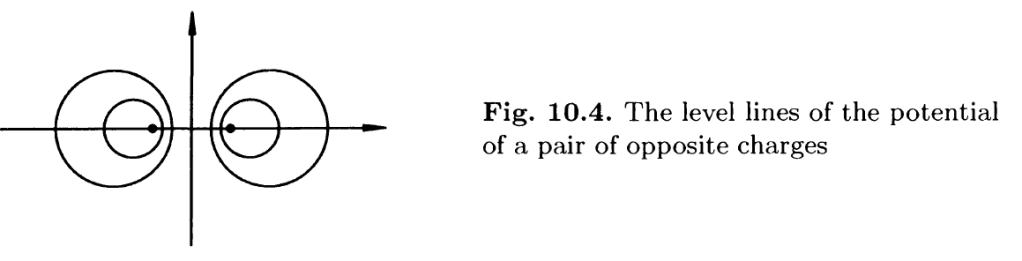
Potential of a pair of oppositely charged particles on the plane
WLOG, suppose the particles lie on the x-axis and their center of mass is on the origin. Let d be the distance from each particle to the origin and Q to be the magnitude of each of their charge.
Then, the potential at a point (x, y) is given by:

For a fixed 


Key: the points whose distances to 2 other points has a fixed logarithm ratio form a circle. I’ve given an algebraic proof above. Is there a more intuitive way to understand this?
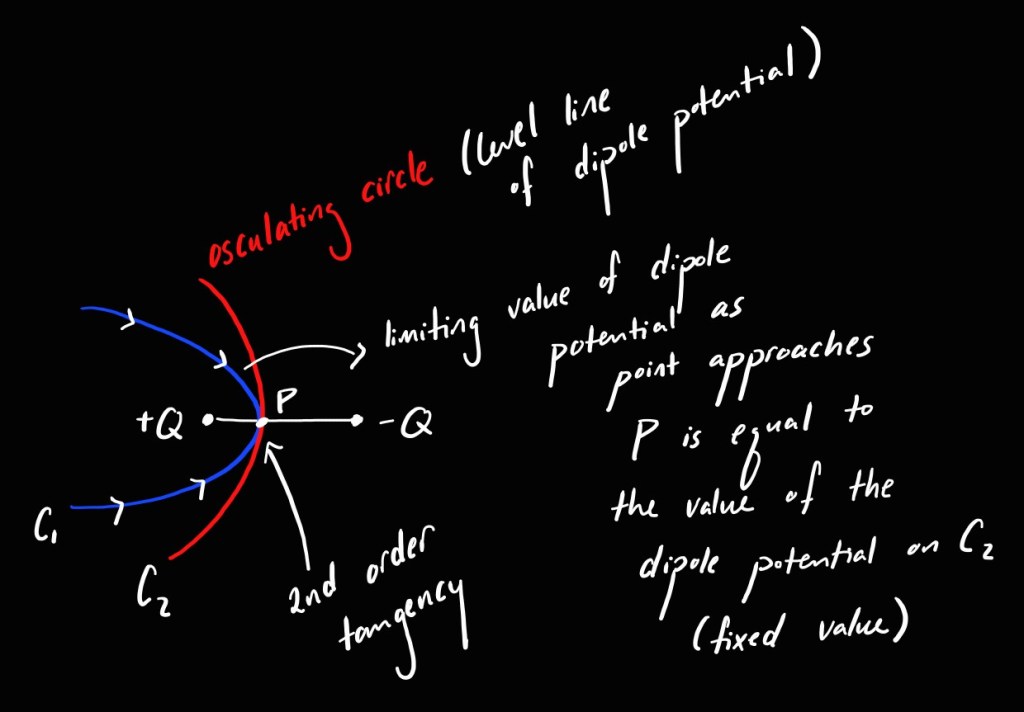
Geometric interpretation of potential of double layer:
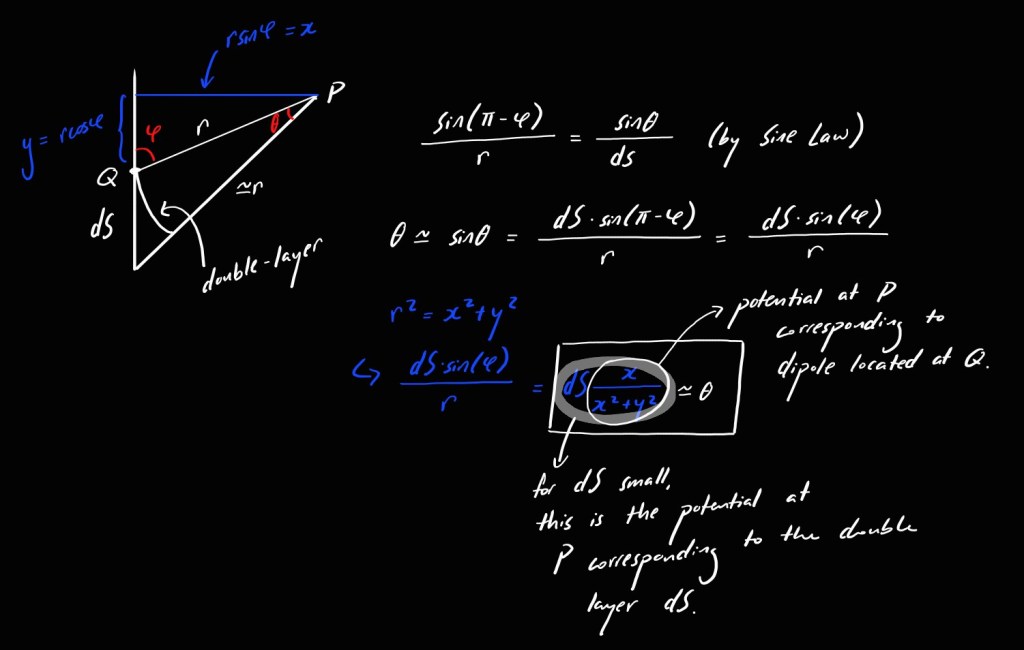
This means that the potential at P corresponding to the double layer dS is approximately the angle at P subtended by the curve dS.
Now, for a segment of the curve 

Hence, if we view the angle as a function with respect to the point P, it is harmonic (because x and y are the two components of the curve with respect to P).


Leave a Reply