Recall, given an elliptic curve , we can simplify it to:
.
The curve remains unchanged under the maps:
.
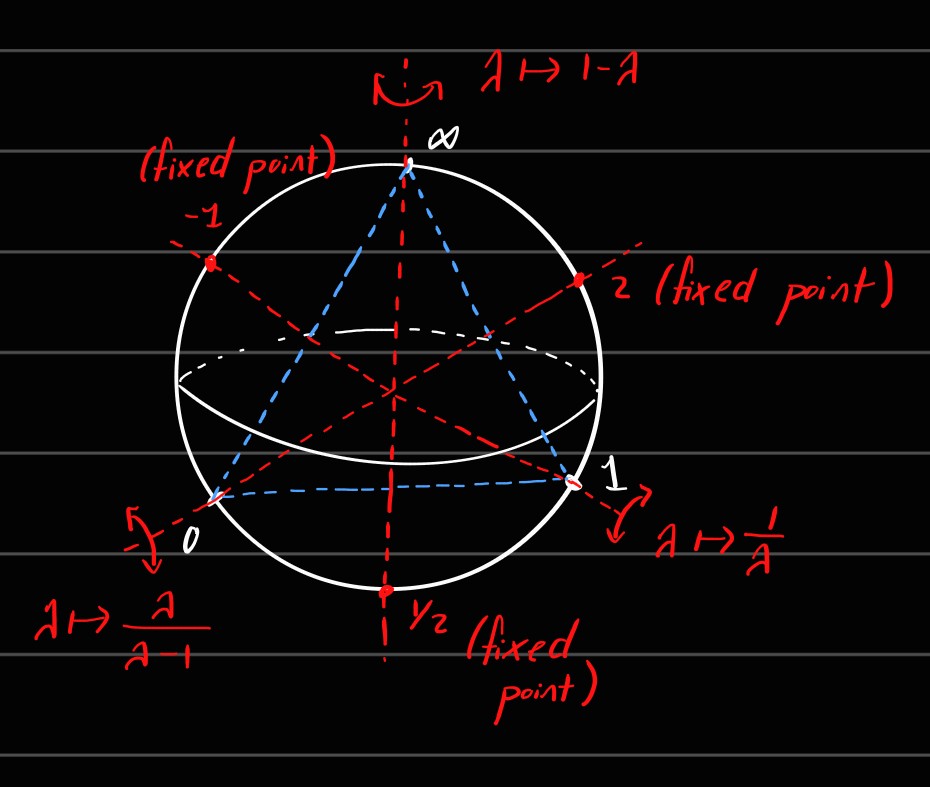
Notice that both have order 2; together, they generate . So now, the important question comes: where is the triangle?
The vertices of the triangle is given by . The group we have just described acts on this triangle. Not surprising, this is what we have seen in the cross ratios from complex analysis. The 6 values are obtained from the permutations of the 4 values in a cross-ratio .
A visualization of the action of the group on the ‘triangle’. Notice that -1, 1/2, 2 are fixed points of the 3 reflections, respectively.
Aside Observation: Notice that and are (when considered as function of ) Mobius transforms. Thus, the two transforms generates a linear transform group isomorphic to .
This explains why elliptic curves are not changed under any of the transformations of . Because the corresponding Mobius transform that takes to one of the 6 possible values act as a permutation on . Since Mobius transforms are symmetries of the complex plane, this does not change the elliptic curve (…?). To be honest, what is meant by an isomorphism class of elliptic curves? Are two curves ‘isomorphic’ if there exists a symmetry of the plane that takes one to the other?
So the symmetries of the complex plane can be extended to symmetries of elliptic curves?




Leave a Reply