We left off on the last post with the question: Why do harmonic functions on the plane whose growth is bounded by a logarithm must be a constant?

Let u(z) be the function such that it is both harmonic and |u(z)| \leq |log(z)| for z large (removed the constants for simplicity; could apply an easy transformation to get to this form if there were constants).

Let f(z) be the holomorphic function such that f(z) = u(z) + iv(z).

Key: we set up a new function g(z) = e^{f(z)}. For all |z| \leq 1, we have:

|g(z)| = |e^{f(z)}| = |e^{u(z)}||e^{iv(z)}| \leq |z|

\Leftrightarrow |\frac{g(z)}{z}| \leq 1.

Outside the disk of radius 1, we know that the function |\frac{g(z)}{z}| is bounded by 1. If we can show that inside the disk, the function must also be bounded (and can be extended to each point), then we have this function be bounded on the entire plane. This implies that the function must be constant (by Liouville’s Theorem).

Now, we return back to our discussion about potentials.

Last time, we talked about the potential corresponding to a region of charge. I offered a sketchy idea of what might be occurring in the region… No longer sure if that is actually correct. Will post an example computing the potential inside an insulating sphere.

Today, we are going to look at something more interesting:

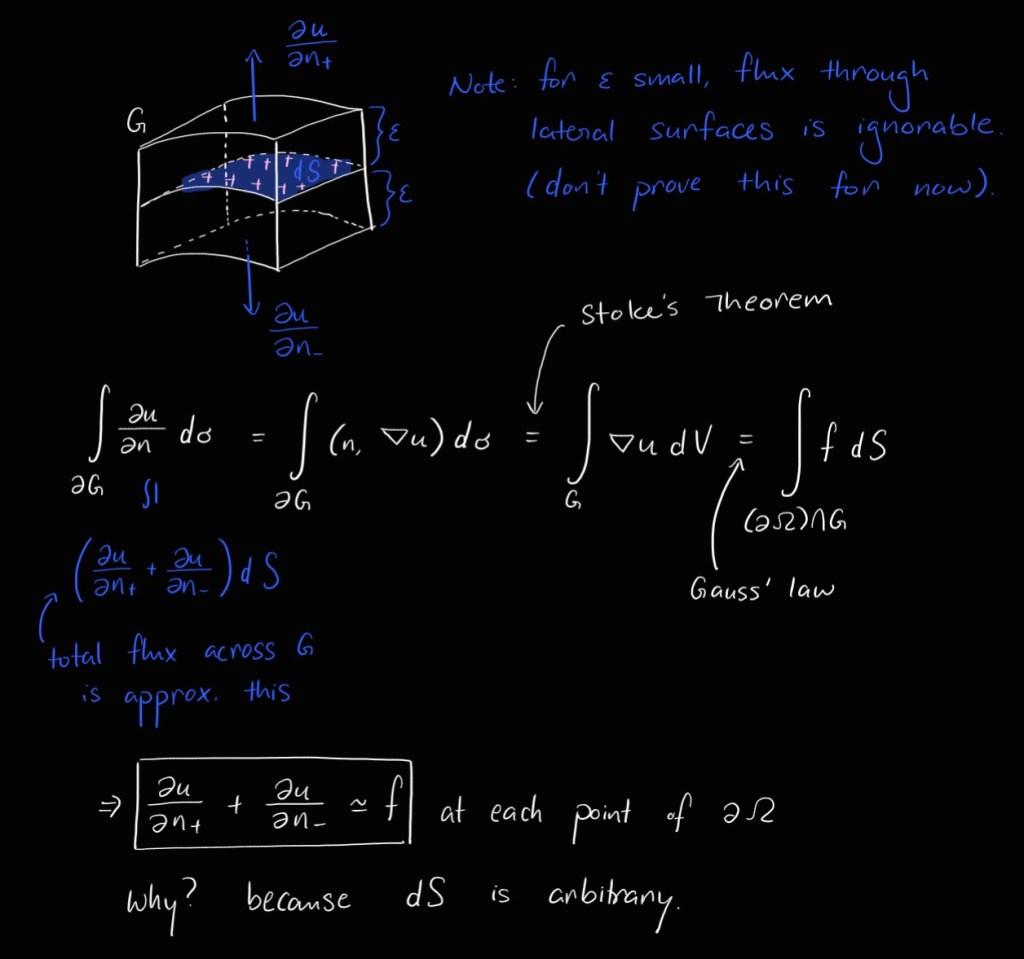
What happens when only the boundary of a closed region \Omega is charged? (Assume 3-dim. for simplicity)

The potential would be of the form: u(x) = \int_{\partial \Omega} f(y) u_0(x-y) dy.

Then, \Delta u = \int_{\partial \Omega} f(y) \delta(x-y) dy.

When x is not on \partial \Omega, \Delta u = 0. What happens when x is on the boundary?

Let’s see what is actually going on through an example. We will look at the potential corresponding to a conducting sphere; the charges would all be on the boundary of the sphere.
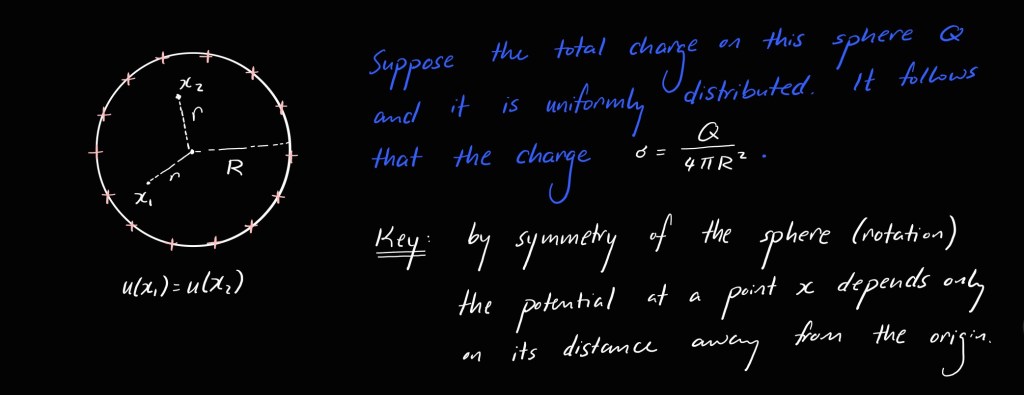
The function for our potential would thus be of the form u(r). Since this function is both harmonic inside and outside of the sphere and we have shown in a previous post that the only spherical harmonic function in 3-dim. is \frac{a}{r} + b, it follows that this must be the form for u(r) both inside and outside the sphere. Note: the coefficients and constants may differ. It suffices for us to find the values of these coefficients and constants.

We first consider the potential inside the sphere:

Since the potential exists and is harmonic at every point in the sphere, it follows that a = 0. Otherwise, the potential at the origin would not be well-defined. Hence, the potential inside the sphere is a constant.

We calculate the potential at the center of the sphere. Since it is of a distance R from any of the charge, the potential with respect to any charge is a multiple of \frac{1}{R}. Hence, the total potential at the center is (up to a constant multiple):

\int_{\partial S^{2}} \frac{1}{R} dS = \frac{4\pi R^2}{R} = 4\pi R.

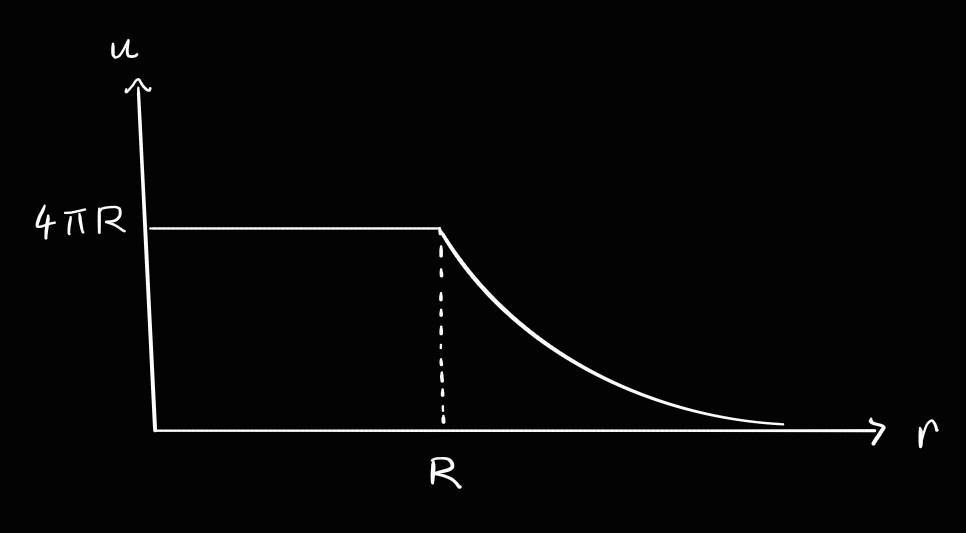
It follows that the potential at each point in the sphere is 4 \pi R.

What about the potential outside the sphere?

Since we want the potential at infinity to be 0, it follows that the constant is b = 0. What about the value for a? To preserve continuity of u, a = 4\pi R.

The graph for u is:

One response

Leave a Reply

Is this your new site? Log in to activate admin features and dismiss this message
Log In