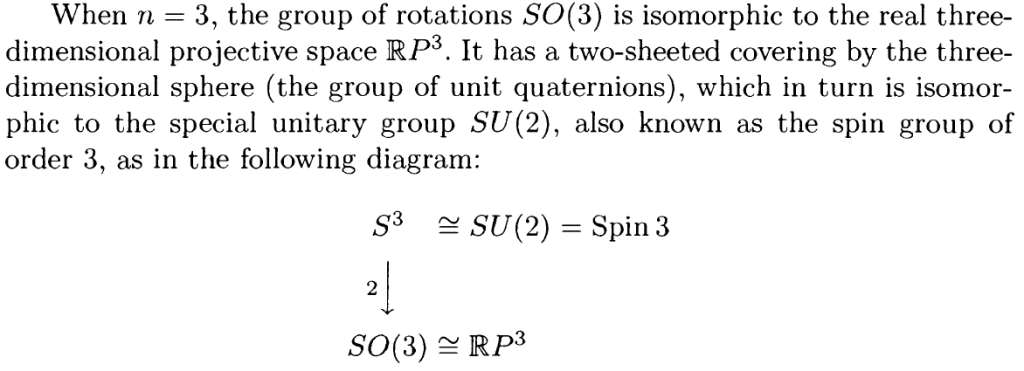
The motivation for this post comes from the example Arnold gave on p. 81 in his PDE book. My goal is to visualize the isomorphism between SO(3) and \mathbb{R}P^3 as well as the mapping from S^3 to SO(3).

The key is to find a common geometric object that is easy for us to see as isomorphic to SO(3) and \mathbb{R}P^3.

We can express SO(3) as:

SO(3) = {(\overrightarrow{v}, \alpha) : \overrightarrow{v} \in S^2, \alpha \in [0, \pi]}. Note: (\overrightarrow{v}, \pi) and (-\overrightarrow{v}, \pi) are the same and the identity map I can be identified as {(\overrightarrow{v}, 0): \overrightarrow{v} \in S^2}.

I will begin by defining a new geometric object, the solid ball in \mathbb{R}^3 with the antipodal points on its boundary identified as the same point. Let’s call this object with radius \pi \sim{B}.

Claim: We can find an isomorphism between \tilde{B} and SO(3) and \mathbb{R}P^3, respectively.

Isomorphism between SO(3) and \tilde{B}

We define \phi: SO(3) \rightarrow \tilde{B} as the following:

\phi((\overrightarrow{v}, \alpha)) = \overrightarrow{v} \cdot \alpha when \alpha \neq 0

and \phi(I) = (0, 0, 0).

This map is well-defined because \overrightarrow{v} \cdot \alpha and -\overrightarrow{v} \cdot \alpha are identified as the same just as (\overrightarrow{v}, \pi) and (-\overrightarrow{v}, \pi) are identified as the same. It is not difficult to see that \phi is a bijection between \tilde{B} and SO(3).

Isomorphism between \mathbb{R}P^3 and \tilde{B}

The map that I have found is a bijection, but am not uncertain if it shows the “isomorphism” between \mathbb{R}P^3 and \tilde{B} (because to be honest, what structure do the two share?).

Recall, {(x_1, x_2, x_3, x_4), (-x_1, -x_2, -x_3, -x_4)} = [(x_1, x_2, x_3, x_4)] \in \mathbb{R}P^3.

Define \phi : \mathbb{R}P^3 \rightarrow \tilde{B} by

\phi([(x_1, x_2, x_3, x_4)]) = (x_1 \cdot x_4, x_2 \cdot x_4, x_3 \cdot x_4) when x_4 \neq 0

and \phi([(x_1, x_2, x_3, x_4)]) = [(x_1, x_2, x_3)] when x_4 = 0 (this is because x_4 = 0, (x_1, x_2, x_3) \in \partial \tilde{B}).

It is not difficult to see that this map is a bijection.

A double-cover map from S^3 to \tilde{B}

Define \tau : S^3 \rightarrow \tilde{B} by:

\tau((x_1, x_2, x_3, x_4)) = (x_1, x_2, x_3). Note: when x_1^2 + x_2^2 + x_3^2 = \pi^2, \tau((x_1, x_2, x_3, 0)) = {(x_1, x_2, x_3), (-x_1, -x_2, -x_3)} = \tau((-x_1, -x_2, -x_3, 0)).

When x_1^2 + x_2^2 + x_3^2 < \pi^2, we have {(x_1, x_2, x_3)}^{-1} = { (x_1, x_2, x_3, \sqrt{\pi^2 - (x_1^2 + x_2^2 + x_3^2)}), (x_1, x_2, x_3, -\sqrt{\pi^2 - (x_1^2 + x_2^2 + x_3^2)})}.

This shows \tau is a well-defined double cover.

Leave a Reply

Is this your new site? Log in to activate admin features and dismiss this message
Log In