On page 93 of Arnold’s ODE:

The solution of an equation \dot x = v(t, x) with a smooth RHS depends smoothly on the initial condition.

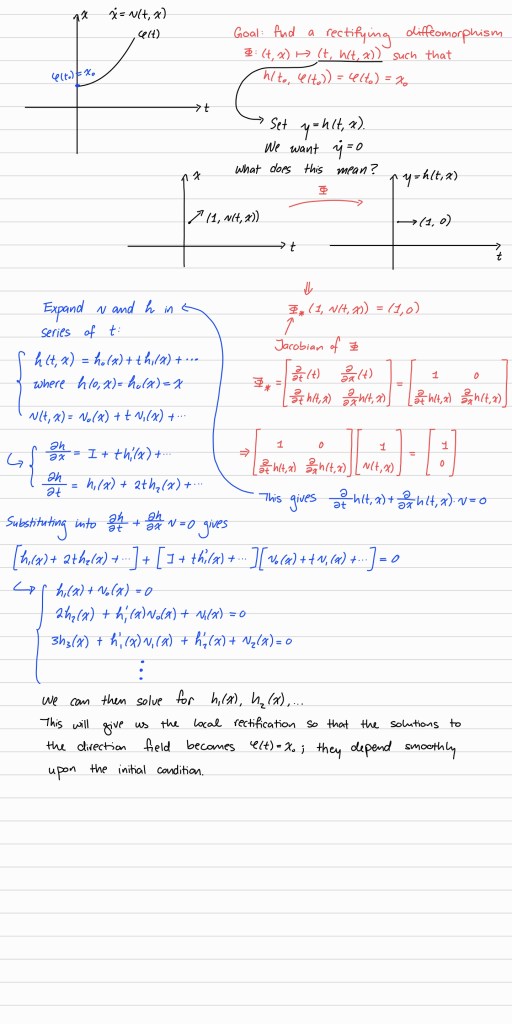
When v = 0, the solutions are of the form \phi(t) = x_0 where (t_0, x_0) is the initial condition. For the solutions to a general equation, we can apply a local diffeomorphism to rectify the solutions so that they become of the form \phi(t) = x_0.

The goal of this post is to find such diffeomorphism. And it will also give us the local Taylor expansion of the solutions.

The key idea is that we want to find a diffeomorphism taking us from (t, x) to (t, y = h(t, x)) such that h(t_0, \phi(t_0)) = \phi(t_0) (for any initial condition (t_0, \phi(t_0)).

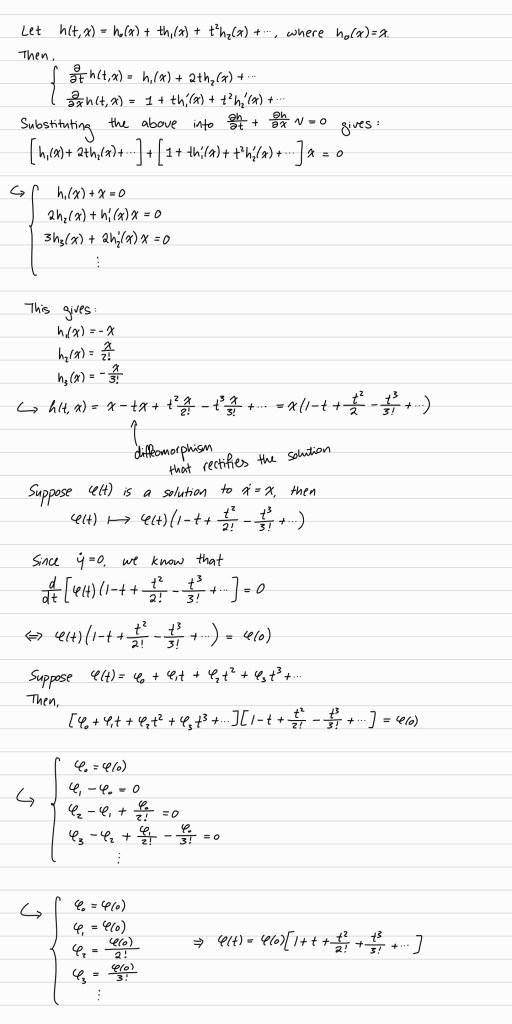
An Example: \dot x = x

We are going to find the local rectification (t, x) to (t, y = h(t, x)) such that the initial conditions (0, x_0) are preserved. Once we have found such diffeomorphism h(t, x) = h_0 + h_1(x)t + h_2(x)t^2 + ..., we can then use h(t, \phi(t)) = \phi(0) to find the taylor expansion of $\phi(t)$ near $t = 0$.

Aside: the easier way in this scenario would have been to directly substitute the taylor expansion of the solution into the equation, obtaining a sequence of recursive equations relating the coefficients of the taylor expansion and then solving for the coefficients.
One response

Leave a Reply

Is this your new site? Log in to activate admin features and dismiss this message
Log In