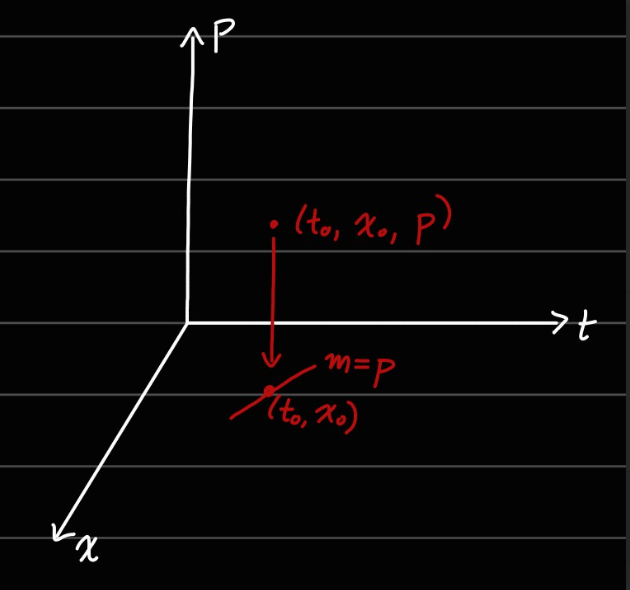
A point in this space tells us that the direction of the line at point on the (t, x)-plane is p.
Connection: the vertical line passing through in this space (including the point at infinity) represents the space of lines on the (t,x)-plane at the point .
The 1-form
Recall: 1-form is a linear function of vectors.
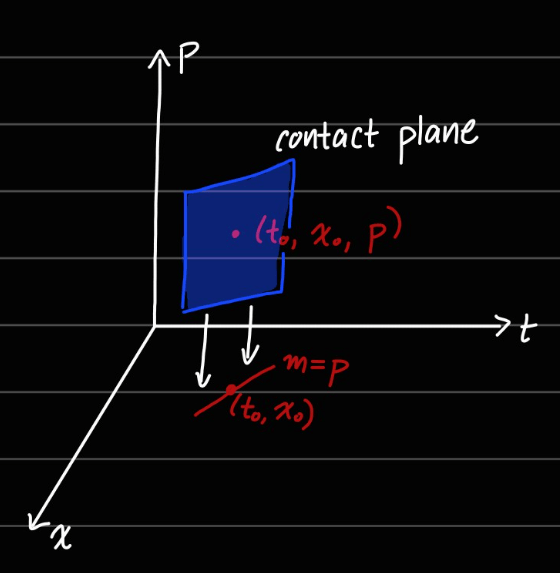
Given a point in this space. The vectors attached at the point such that form a plane (this is called the contact plane). Notice that the contact plane is always vertical, it contains the line parallel to the p-axis (this is when the vector A satisfies dx(A) = 0 = dt(A)).
Remark: The direction of the plane only depends on the value of p.
This is an exercise problem taken from p.15 of Arnold’s Geometrical Methods in the Theory of Ordinary Differential Equations:
Suppose such a surface exists. Say, . Since the tangent at each point on the surface exists, F is at least .
Then, we know that at each point, we have:
.
This would mean .
But however, we have:
, a contradiction.
Hence, it is not possible for such surface to exist.







Leave a Reply