11. Equations with a Multidimensional Phase Space
Given a vector field in a domain M, we can extend it to a direction field in the extended phase space. This direction field will be invariant along the t-axis because the vector field itself remains unchanged throughout time.
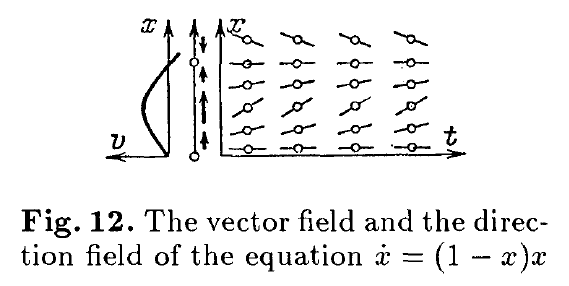
A direction field defined by 


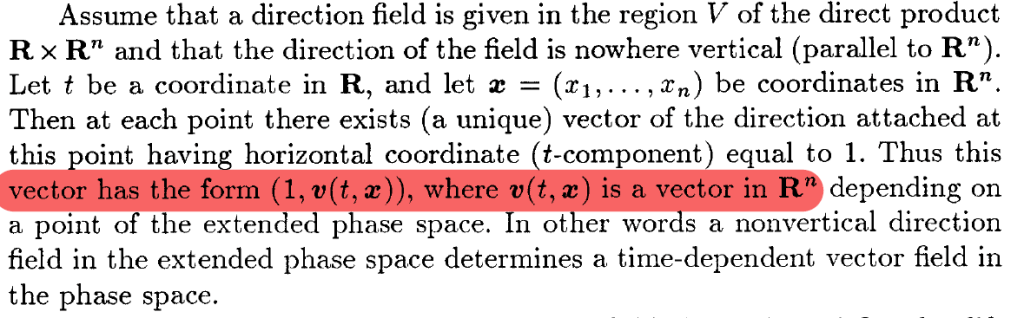
The above passage gives us a construction of the vector field at time t. At each point (t, x), there passes one line. We choose the vector A on that line such that dt(A) = 1; dx(A) (i.e. (dx1(A), dx2(A), …, dxn(A)) is the vector at point x on the vector field at time t.
In a sense, from a direction field, we can create a dynamical vector field
Section 4 – Phase Flows
New Understanding of Symmetry

Symmetries arise from the discrepancy between our visual perception of the physical world and our ability to endow further abstract meaning to the tangible.
A symmetry of an object is the object’s potential to be moved in a specific way such that after the movement, it does not appear any different in our eyes. The reason that we know that the object has undergone a certain movement is because we has put abstract labels on the points of a so-called orbit. Note that if we are to change the abstract labels to actual physical labels, the symmetry would once again be gone (because the resulting image would no longer be the same as the original object). Hence, a symmetry is the product of the collaboration between our imagination and our observation. It is our ability to move between the abstract and the tangible.
Section 5 – The Action of Diffeomorphisms on Vector Fields and Direction Fields
The first time I read Arnold’s definition of a tangent vector using equivalence class, I was very much confused and thought it was too abstract and quite useless. But when I revisited his earlier section discussing differential forms, I can understand why this definition is important (and quite geometric actually).
Differential forms are functions of vectors. The ‘dx’ and ‘dt’ that we encounter are not infinitesimal values; they are linear functions of vectors (in fact, given a vector A, we can see this as dx(A) and dt(A)). ‘dx’ tells us the rate of change of A in the direction of x (similarly for ‘dt’). When we express our vector A = (dx(A), dt(A)), it becomes obvious what the x- and t- values are. Applying a change of coordinates can reveal to us what the rate of change of A is in other directions.
And so now the question is: how can we understand vectors without using coordinates?
Enter:
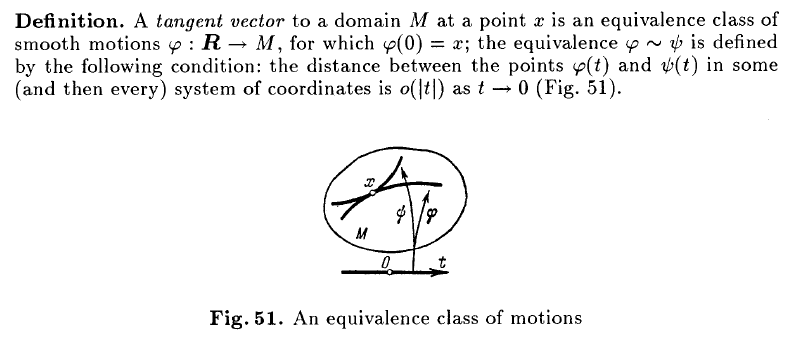
If we discard all coordinates, then the vectors that we have been referring to are really just the motions at a specific point. So, ultimately vectors are dynamical objects that arise from comparison. The coordinates allow us to more easily describe the vectors, that’s all.


Leave a Reply