When Arnold introduced the notion of differential 1-forms in Chapter 1, I had accepted it simply as linear functions of vectors. But there is more. Differential 1-forms has changed the way I understand lines and planes; it is also a powerful tool in creating new structures in space.
I will provide examples below:

Notice that by describing a line in the (t, x)-plane using the form 
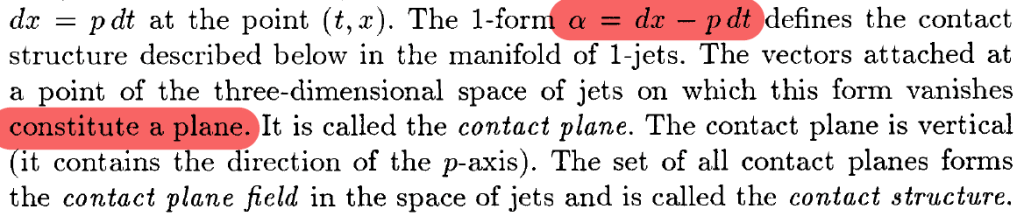
Similarly, a plane defined by 
And notice how this differential form defines not only one plane but a field of planes. It is essentially describing the relation between the velocity vectors and their point of departure at every single location in space.


Leave a Reply