This is a combination of the Section 5 of Chapter 2 of Arnold’s ODE and Section 3 of his Geometrical Methods in the Theory of Ordinary Differential Equations.
Currently working through examples of Clairaut’s equation.
Example 1:

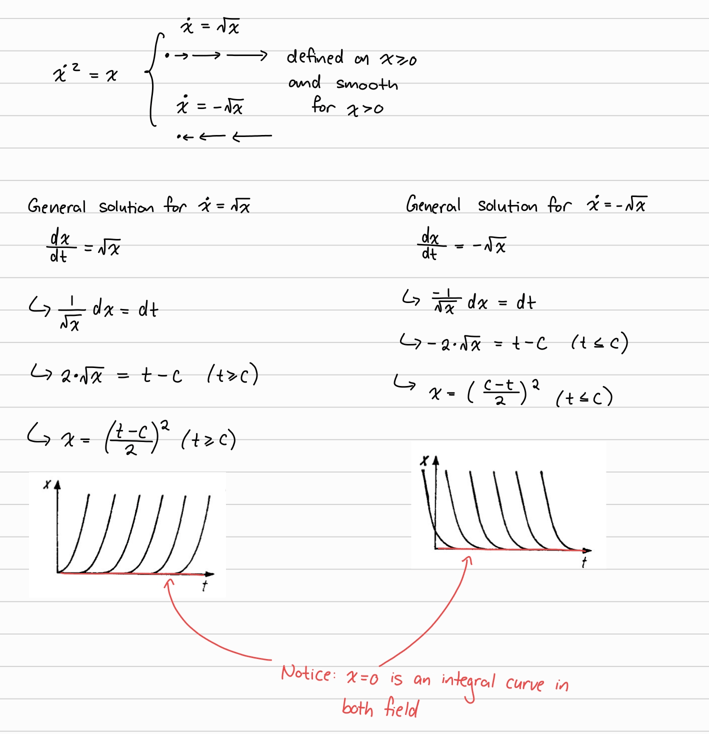
Example 2:

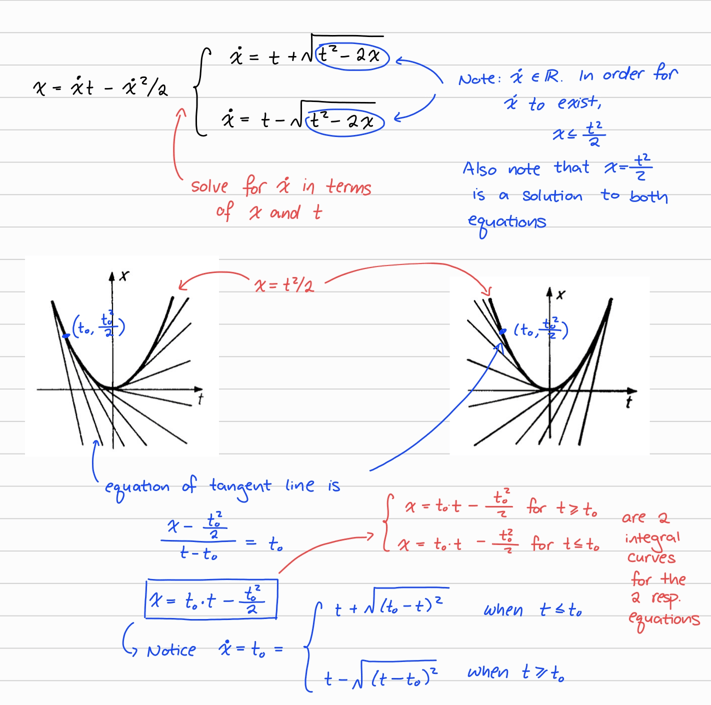
Understanding problem 2 (p. 115):
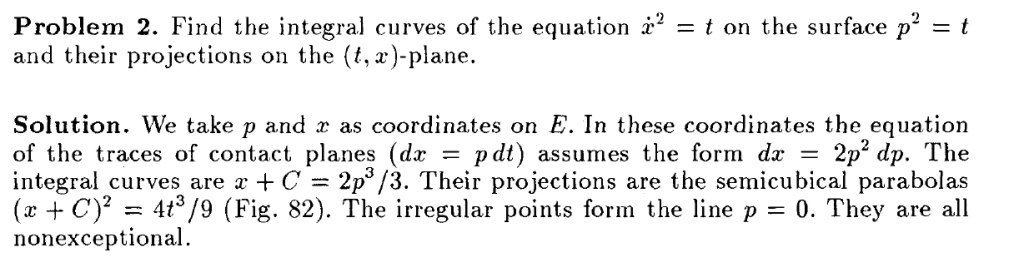
Question: What does it mean to take p and x as coordinates on E? Does it mean to project the surface E onto the (p, x) plane?
To find the trace of the contact plane (

The tangent plane is given by

which gives:

Hence, we have:

The trace of the contact plane is the intersection between the contact plane and the tangent plane. That is, we also have additional relation 


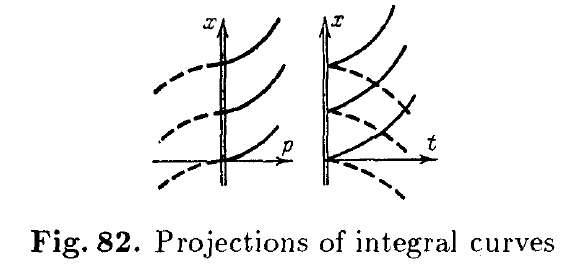
Projecting the integral curves back onto the surface E, we can express them using equations in terms of x and t (because E is described by 

which is equivalent to:

Problem 3 on p. 116:
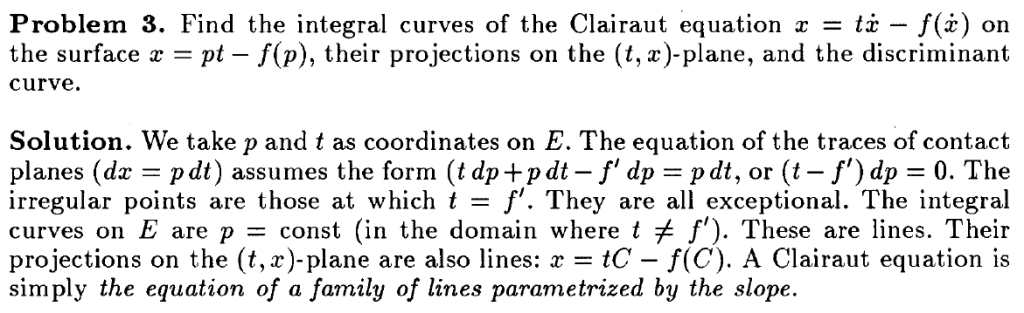
Question: Why did Arnold take p and x as coordinates on E in the previous question, but changed to take p and t as coordinates in this question?
Ans: This is due to the form obtained for the traces of the contact plane. In this question, the form 
Finding the traces of the contact plane follows similar procedure from previous question (being lazy, I am not going to type this out).
Unlike the previous problem,
The set of exceptional points form a curve. On the surface E, it is parameterized by (f'(C)C – f(C), f'(C), C). When projected onto the (t, x)-plane, the curve can be parameterized as stated in Arnold’s solution: t = f'(C) and x = Ct – f(C).
Now, let’s return back to finding the integral curves from the form


Leave a Reply