In the spirit of understanding complex and abstract concepts as simply as possible, I am going to attempt recreating/re-explaining Arnold’s proof of the uniqueness of the solution for 
We suppose 


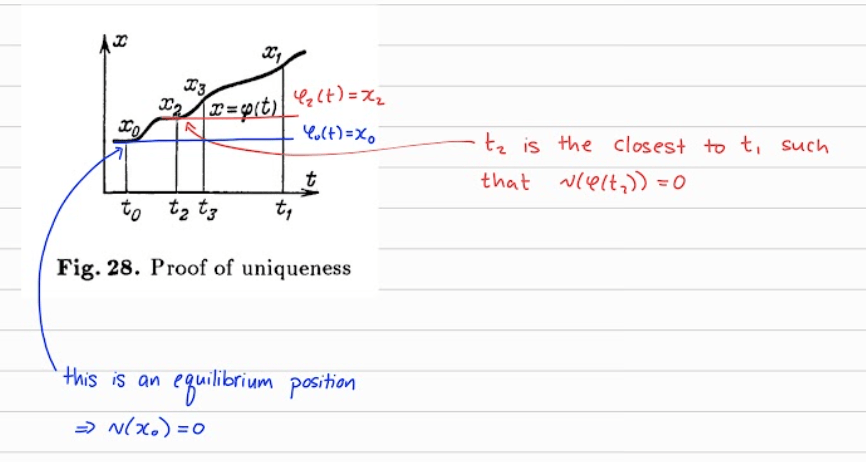
To start, we need to consider the equilibrium position that is closest to 


Why?
The key point is that the slope of each tangent line at each point of the integral represents the velocity of the particle. So, as the particle gets closer to
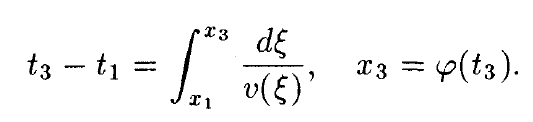
The difference in time comes from Barrow’s formula:
Now, since $\latex v(x)$ is smooth, within a neighbourhood of $\latex x_2$, its slope is bounded:
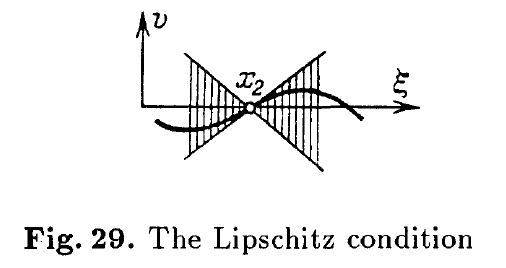
i.e. there exists k such that 
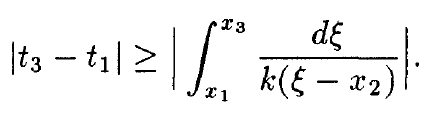
We can always compare this motion with a faster linear motion. But since the linear motion is going to take infinite time, this motion will also take infinite time.


First, we need to ask what does it mean for something to converge faster than exponentially?
Given two integral curves 


When one of the curves is an equilibrium position, like Arnold had said previously, the motion of the a particle described by the second integral curve can be compared to a suitable and more rapid motion in a linear field, and we know that the motion in the linear field converges exponentially.
But now, if both integral curves are not equilibrium positions, in what situation will they converge to each other faster than exponentially? Note that the RHS of
I had originally came up with this field of integral curves:
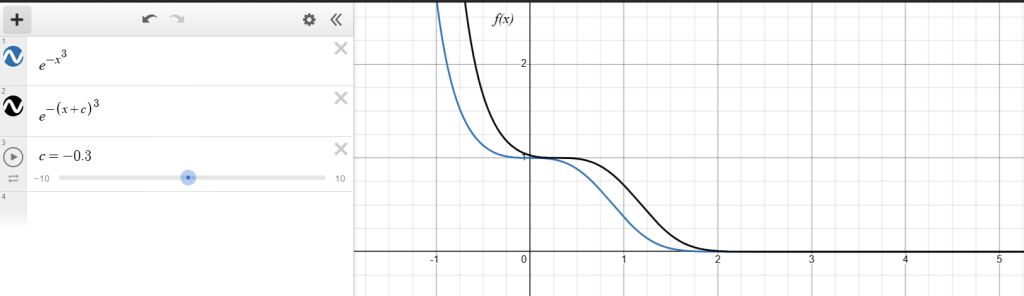
Here, the curves get mapped to each other under translation along the t-axis and they converge to each other faster than exponentially. However, if we are to express this field using an autonomous equation, the RHS will not be smooth due to the degree 3. And this will be true as long as we try to decide to have a polynomial in the exponent.
But, what if we are to do something like the one below?
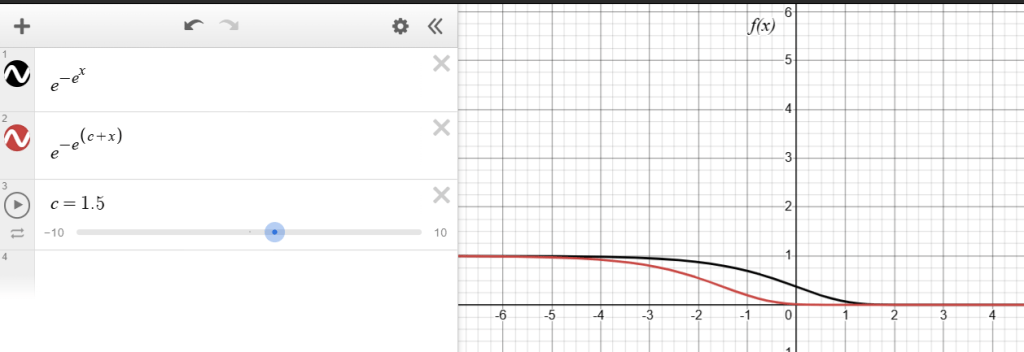
If we are to restrict our equation to x > 0, then we would have 
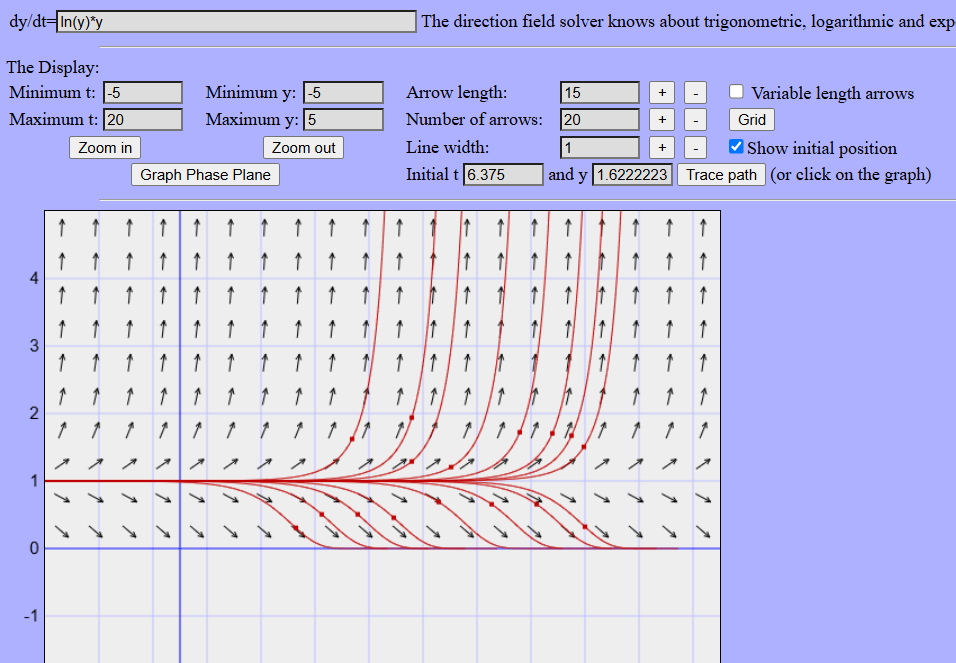

Key point: as long as we can compare the motion to a suitable motion in a more rapid linear field, then we’re good.
Since the derivative of v exists on the interval of definition, then in the neighborhood of x2, there exists k>0 such that 


By Barrow’s formula,

Suppose

Suppose v(x0) = 0, then for any 

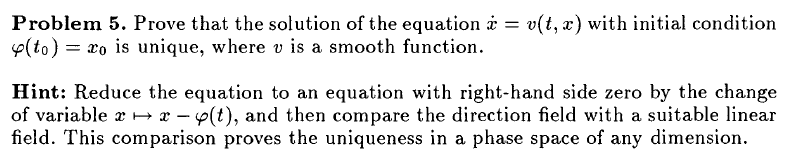
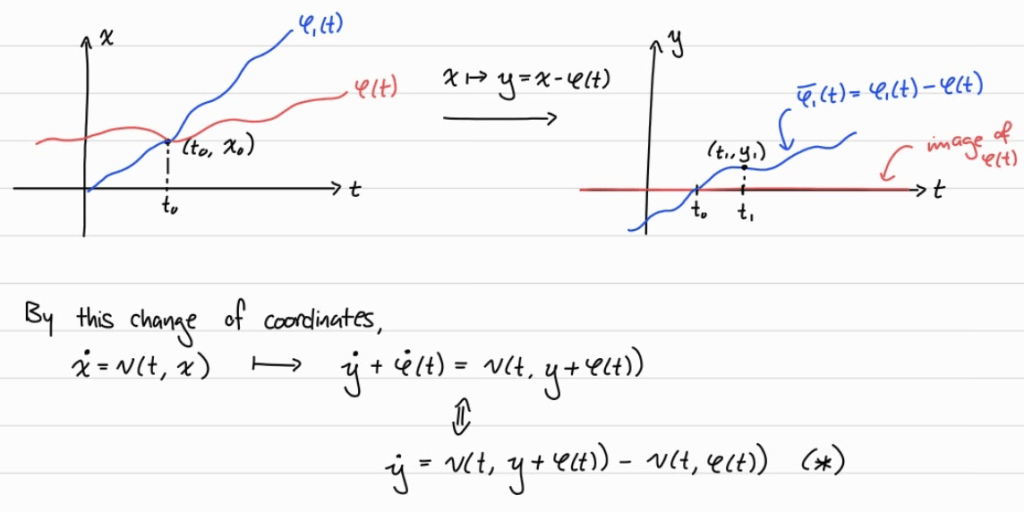
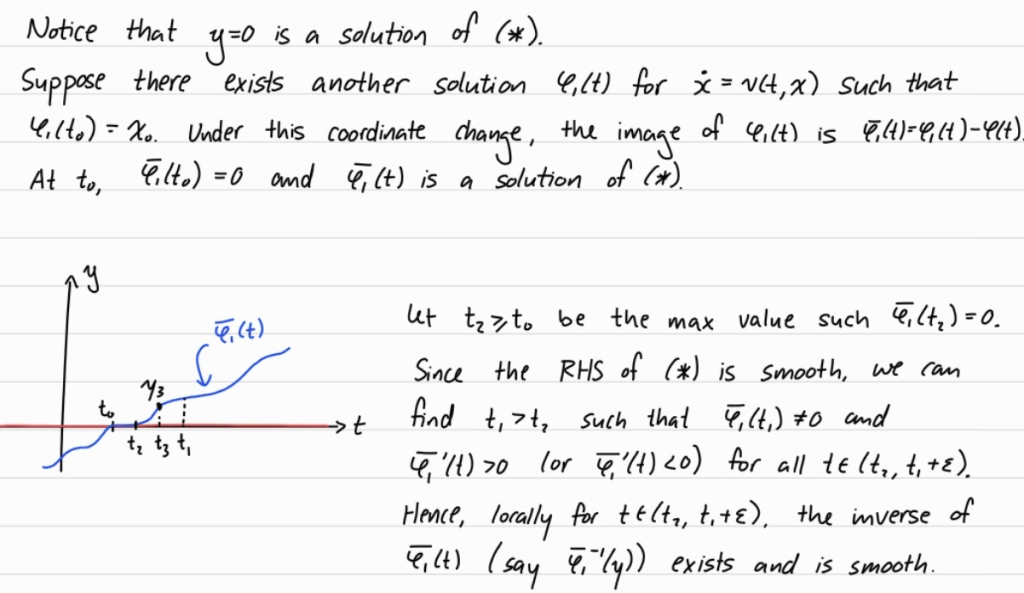
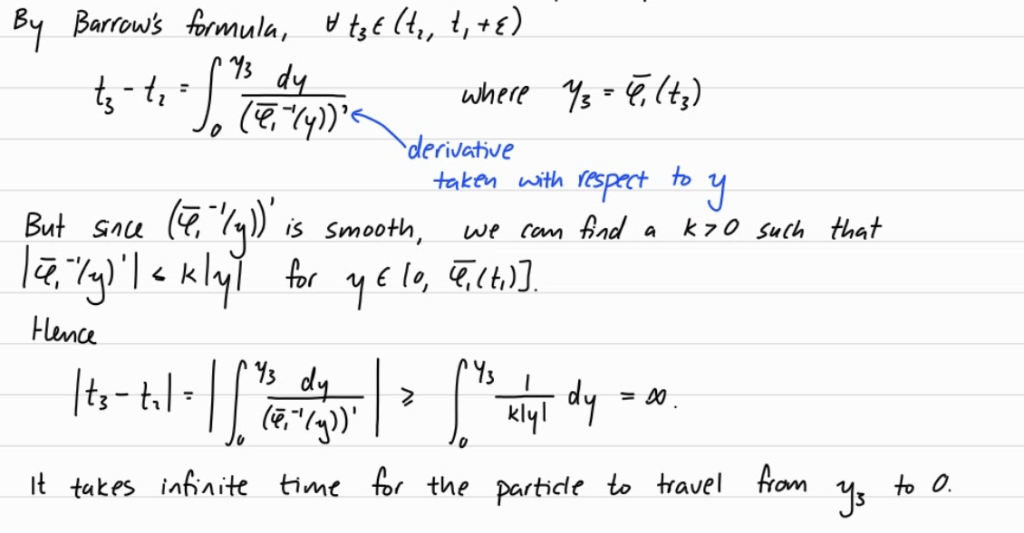
The underlying concept is that because of smoothness, we can locally see 


Leave a Reply