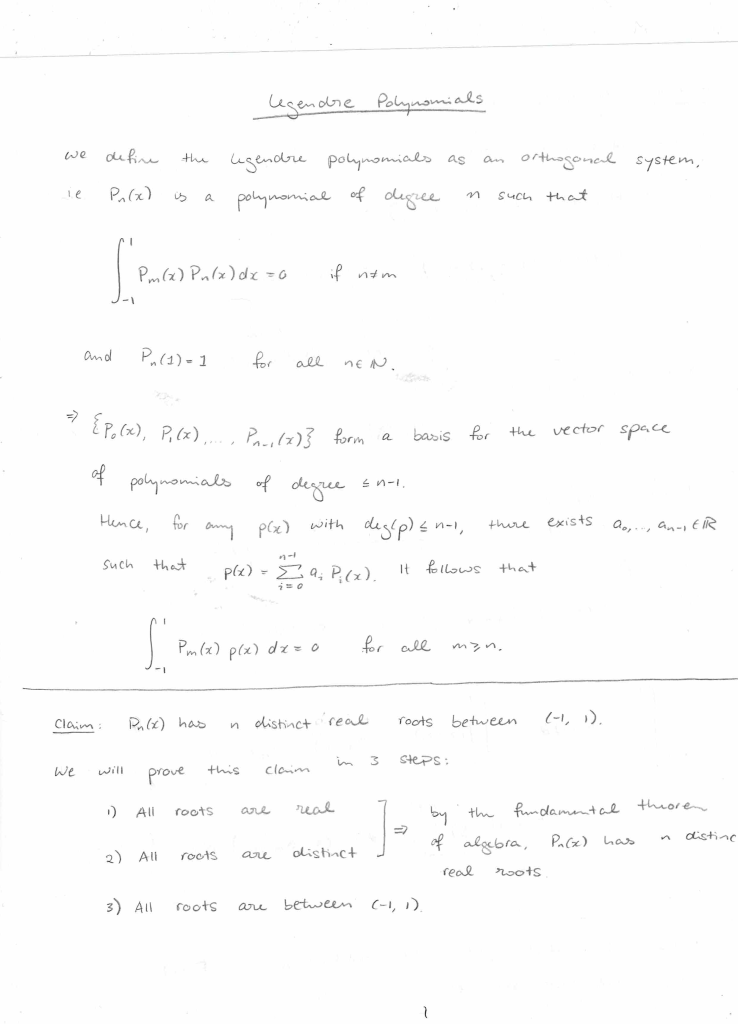
I admit, this is definitely not the conventional way to define Legendre polynomials. But, it isn’t difficult to derive this orthogonality property even if we were to define it as solutions to a set of ODE.
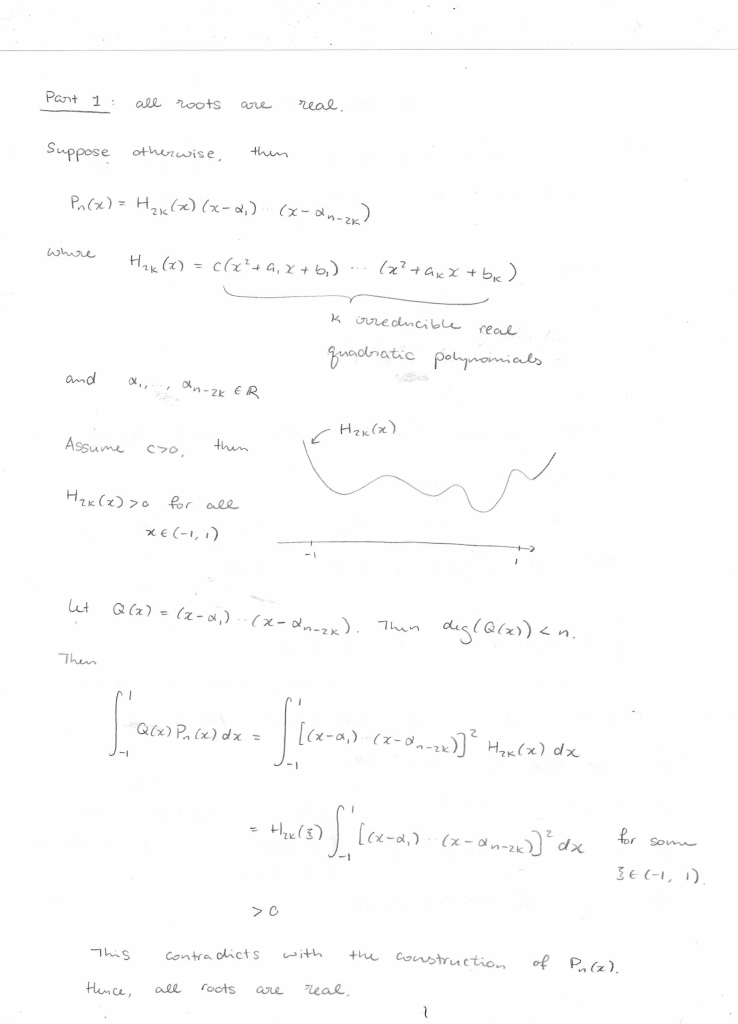
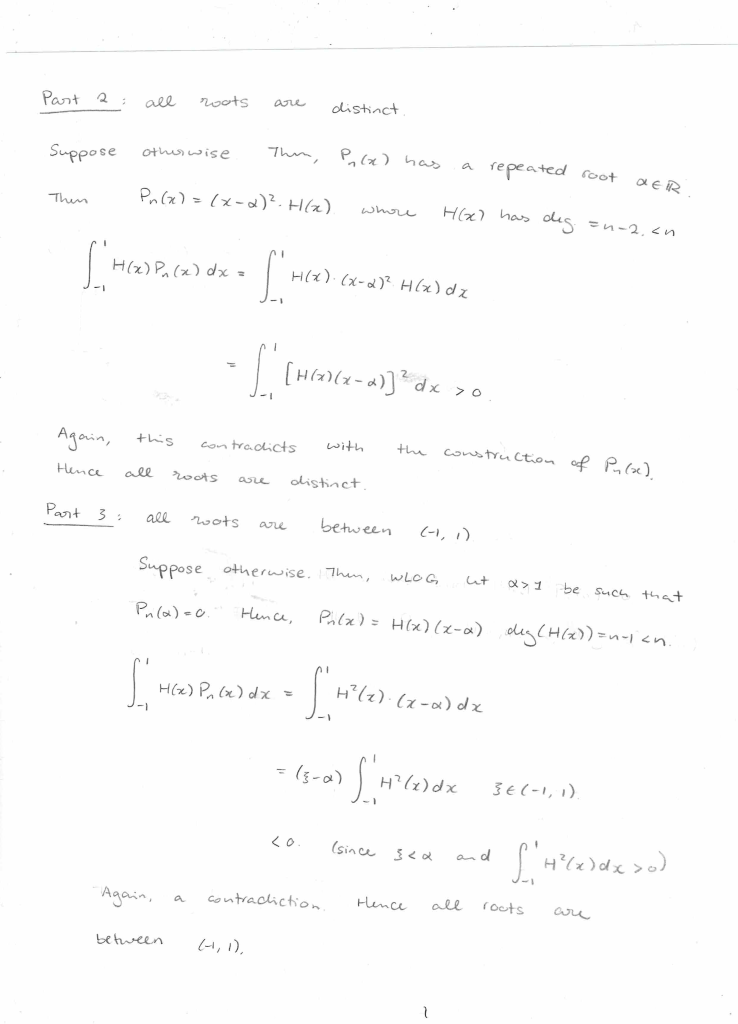
Below, I introduce my own way of proving the the n real distinct roots of the Legendre polynomial of degree n that exist between -1 and 1 (exclusive). In the proof, I used the fact that the integral of strictly positive (or negative) continuous functions over an interval must be non-zero. And also, a little spoiler alert: this proof heavily revolves around the weight mean value theorem (is it just me or do I find this theorem awfully useful?). Feel free to comment below if you have any suggestions, questions, or ideas.


Leave a Reply