When I first pictured what it was like to travel inside the space of lines (centered at the origin, for simplicity), I thought it was quite straightforward: say I am currently at a point A (not the origin) on line a and wish to reach a point (not the origin) B on line b, wouldn’t the obvious choice be to rotate the point along the lines (traveling an arc-like path) until we have reached line b and then shifting along line b to reach point B? Rotate and then slide?

There seemed nothing wrong with this method of moving until I started trying to find the non-orientability inside this space. It simply wasn’t there if I were to move in this particular method. In his video on blow up points, Borcherd mentioned that assigning a local coordinate to one side of a line and then taking it through the origin to and reaching the other side of the line would result in a change in orientation.
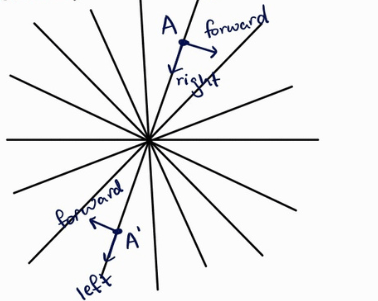
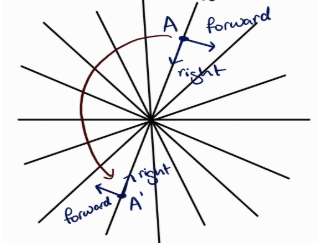
And then it occurred to me that inside a space of lines, maybe it wouldn’t be physically possible to leap from line to line. It would take infinite time because no matter how close line a and b may appear to us (observers on Earth), they are separated by an infinite number of lines. And so for a person moving in that space — standing at a point A not at the origin on line a — any point B that is not the origin on line b would be infinitely far away. The only movement for the person would be forward and backward along line a. Hence, my previous interpretation of the orientation that Borcherd has assigned to point A and A’ had been wrong. Forward could only be a direction parallel to line a.

For a person to travel from A to B, it needs to first move from A to the origin O (the direction of such movement would be the forward direction of that person at point A):

Once it has reached O, it is going to rotate by angle equal to that of ∠AOB (counterclockwise). This will get it to line b:

Then, it moves along line b to reach point B. We define the direction in which the person has been moving the instant it reach B to be the forward direction of the person at B:

Returning back to what we were previously talking about, the orientation change that would occur when we take the local coordinate defined at A through the origin to get to A’ would indeed be true. Note that the ‘right’ is defined in the point of view of the person and not the ‘right’ of the forward direction.

This is not the same as simply moving along line a and passing through the origin O without a rotation by 180°:

Rotating by 180° does not send us back to the original line because our orientation has changed. It takes another rotation by 180° to return us back to our original orientation, just like the Mobius band.


Leave a Reply