This is based upon my reading of the paper Complexification of Tetrahedron and Pseudo-Projective Transformations written by Arnold.

The objective of this paper is proving the claim: the octahedron is the complexification of the tetrahedron.

In this post, we will try to figure out what this claim actually means.

Remark: The cube and the octahedron are duals, they share the same symmetry group (as can be seen in the picture below).
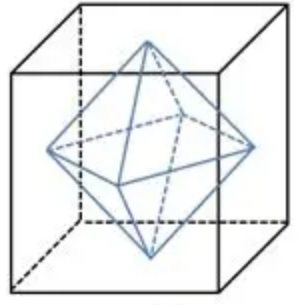
The full symmetry group of the cube, B_3, consists of 48 symmetries. We define the central symmetry to be the symmetry that interchanges each vertex with its diagonal opposite. Notice that the central symmetry commutes with any other symmetry and fixes the 4 diagonals; this symmetry is of order two. The resulting quotient group (obtained by quotienting the symmetry group of the cube by the group generated by the central symmetry) permutes the four diagonals (this is easy to see since the only symmetries that fix the four diagonals are the identity and the central symmetry). No two elements in the quotient group gives the same permutation of the four diagonals.

Geometric interpretation of above: the quotient group no longer describes the symmetries of the cube, rather, it is the group of symmetries that arise when we identify each vertex and its antipodal point as 1 point. Alternatively, we can think of this as putting our cube into \mathbb{RP}^2 (i.e. space of lines passing through the origin of \mathbb{R}^3) and the quotient group is the group of symmetries of this cube in \mathbb{RP}^2.

Each permutation of the 4 diagonals can be realized by one of the 24 rotations of the cube. Thus, we have:

\text{quotient group} \cong \text{rotation group of cube} \cong \text{permutation group of the 4 diagonals} = S_4

and B_3/\mathbb{Z}_2 \cong S_4.

Can every symmetry of the cube be realized as a rotational symmetry or the composition of a rotational symmetry with central symmetry?

Answer: Yes. But how do we see this geometrically?

Lemma: rotation group of the cube is isomorphic to the full symmetry group of the tetrahedron.

Proof: Any rotation of the cube corresponds to a rotation of an inscribed tetrahedron to itself or to its dual inscribed tetrahedron in the cube. We can realize the latter case as a symmetry of the initial tetrahedron by applying central symmetry after the rotation. The tetrahedron goes back to itself, but its orientation has changed. Both cases give us a symmetry of the tetrahedron. We thus obtain the 24 symmetries of the tetrahedron from the rotation group via this mapping.
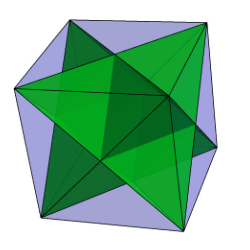
The mapping, which we denote by \Phi, above is a group isomorphism. Group homomorphism follows from the fact that central symmetry commutes with the rotational symmetries.

Example: Let the central symmetry be denoted by C and let R_1, R_2 be two arbitrary rotational symmetries of the cube. Suppose \Phi(R_1) = C \circ R_1 and \Phi(R_2) = R_2, then

\Phi(R_2 \circ R_1) = C \circ (R_2 \circ R_1) = R_2 \circ (C \circ R_1) = \Phi(R_2) \circ \Phi(R_1).

Bijectivity is trivial since the full symmetry group of the tetrahedron has 24 elements and the kernel of \Phi is trivial. This follows from the fact that if \Phi(R) (where R is a rotational symmetry of the cube) is the identity element, then R fixes all 4 diagonals of the cube. The only rotation that this could be is the identity.

Thus, the rotation group of the cube is isomorphic to the full symmetry group of the tetrahedron. It follows that the full symmetry group of the tetrahedron is isomorphic to S_4. \square

Back to the initial question: how do we visualize each symmetry of the cube as either a rotational symmetry or the composition of a rotational symmetry with central symmetry?

Key: Notice that each symmetry of the cube takes an inscribed tetrahedron to itself or to its dual inscribed tetrahedron.

Let T be a symmetry of the cube. Suppose T takes the inscribed tetrahedron to itself. Then by the above lemma, we know that there exists a rotational symmetry, R, of the cube such that either T = R or T = C \circ R.

Suppose T takes the inscribed tetrahedron to its dual. Then, C \circ T takes the inscribed tetrahedron back to itself. Again, by the above lemma, we know that there exists a rotational symmetry, R, of the cube such that either C \circ T = R or C \circ T = C \circ R.

Since C \circ R = R \circ C and C^{-1} = C, it follows that T can always be expressed as a rotational symmetry or the composition of a rotational symmetry with central symmetry. \square

Our argument shows that symmetry group of the cube B_3 is isomorphic to S_4 \times \mathbb{Z}_2.

How does this help us understand the claim: the octahedron is the complexification of the tetrahedron?

Instead of considering the tetrahedron in \mathbb{R}^3, let’s place it inside \mathbb{RP}^2, i.e. the space of lines passing through the origin in \mathbb{R}^3. In this space, replace the tetrahedron with 4 points; in \mathbb{R}^3, these will be the lines passing through the 4 vertices of the tetrahedron. We complexify the real projective plane to the complex projective plane \mathbb{CP}^2, still endowed with the 4 points.

Step 1: We show that the group of complex projective transformations on \mathbb{CP}^2 preserving the set of 4 points is isomorphic to S_4, i.e. the full symmetry group of the tetrahedron.

Step 2: We show that the group of pseudo-projective transformations (transformations on \mathbb{CP}^2 that maps complex projective subspace to complex projective subspace) preserving the set of 4 points is isomorphic to S_4 \times \mathbb{Z}_2, which in turn is isomorphic to B_3.

This is what Arnold means by the octahedron being the complexification of the tetrahedron.

One response

Leave a Reply

Is this your new site? Log in to activate admin features and dismiss this message
Log In