This is based upon my reading of the first chapter of Arnold’s PDE.
Key takeaway: in the space of 1-jets, we can view first order PDE’s as algebraic equations, i.e. a first order PDE describes a hypersurface living in this space.
By definition, the space of k-jets of functions of is the space of Taylor polynomials of degree k.
For example, a point in the space of 1-jets is given by . The first n components gives us the point in the domain . The (n+1)-th component is the value of the function. The last n components gives us the derivative of the function in the direction of , where i = 1, 2, …, n. Each point in the space of 1-jets gives us the first degree Taylor expansion of a function.
In the space of 1-jets, we have an invariantly defined field of 2n-dimensional hyperplanes given by, . (Note: since this field is a geometric object, it is invariant under change of coordinates, but why does Arnold also say that under a change of coordinates , this field of planes is still given by ?)
Important geometric property of this field of planes in: All tangent planes of all 1-graphs at a given point in lie in the same hyperplane, .
Proof: At the point , any tangent vector of the 1-graph of a function must satisfy (*).
(*) can be explained in the following way:
Let be a tangent vector of the 1-graph and be a curve on the 1-graph such that . Since is a curve on the graph, .
Using the chain rule, we have: . By definition of the space of 1-jets, .
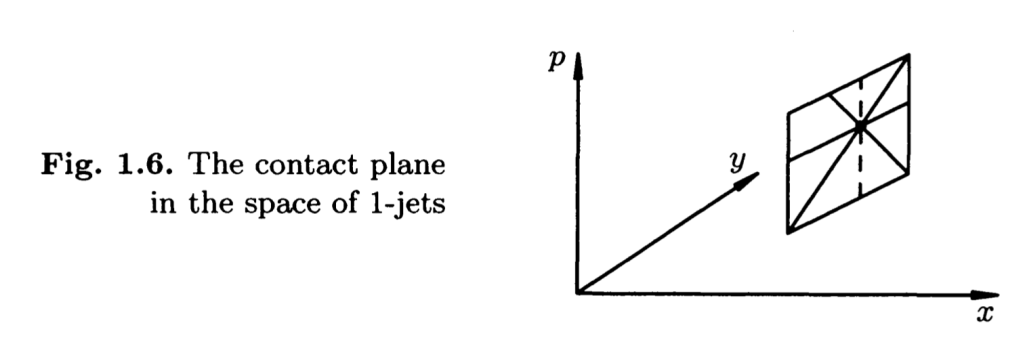
Think about: In , what are the n-planes in the hyperplanes (dim. 2n) of the contact structure that cannot be tangent planes of a 1-graph?
For n = 1, at the point , this would be the line given by and . Notice the projection of all other lines into the (x, y)-plane gives us the line (i.e. the tangent line of all functions that satisfy ). The projection of the line given by and into the (x, y)-plane gives us the point . If a 1-graph were to be tangent to this line at , then the corresponding function would have a singularity at .
What about when n = 2 or greater?
Think about: What are the dimensions of the integral manifolds (manifolds such that the tangent plane at each of its points is a subspace of the contact plane) for the field of contact planes?
Answer (we take for granted for now): the dimension cannot be greater than half the dimension of the contact plane.
Definition (Legendre manifold): integral sub manifold of a field of contact planes whose dimension is maximal (from above, we know that this would be half the dimension of the contact plane).
Example of Legendre manifold: 1-graphs
Converse is not true: not all Legendre manifolds are 1-graphs.
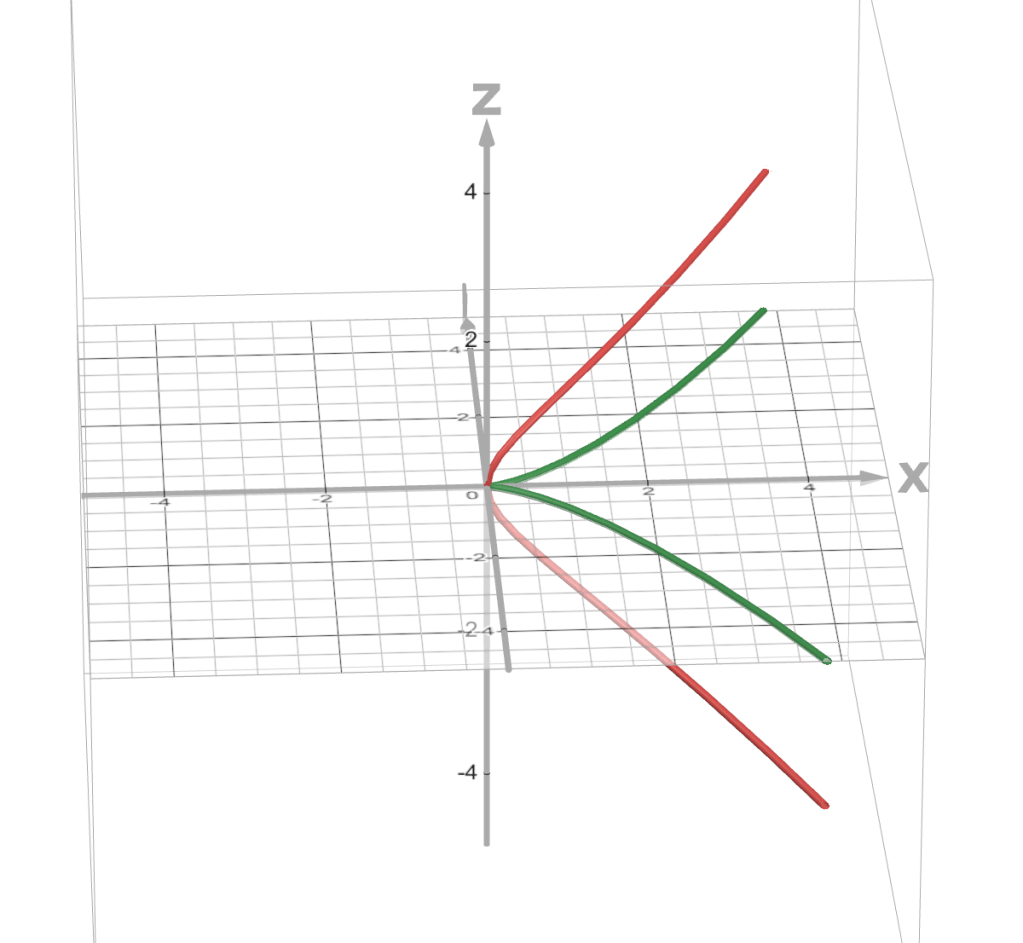
Example of a Legendre manifold that is not a 1-graph: consider the smooth curve parameterized by . It is easy to check that it satisfies , i.e. this curve is a Legendre manifold. The projection of this curve into the (x,y)-plane is not smooth; we have a cusp singularity at the origin. Hence, this curve is not a 1-graph.
First order PDE’s in
Such an equation describes a 2n-dimensional submanifold in .
Our goal: at each point in , we want to distinguish a characteristic direction determined by the tangent space of and the contact structure.
At a point , we consider the intersection of the tangent space (dim. 2n) and the contact plane (dim. 2n). Since has dimension 2n+1, it follows that these two spaces either coincide ( is singular) or we have a (2n-1)-dimension intersection ($latex p) is regular).
Claim: for a surface in general position, the singular points are isolated.
Proof: In a small neighbourhood, we can describe as the zero-set of a function, i.e. . Let be a point in this neighbourhood. Every vector tangent to at is orthogonal to the gradient direction of , i.e. (or $df_p(v) = 0$ for any ).
If coincides with the contact plane, then vanishes on . Hence, we have for some .
In local coordinates, , and so, if we express , we have:
…
(where are all functions of )
We have 2n equations in a 2n-dim. manifold. The solution set is 0-dim. Thus, the singular points are isolated.






Leave a Reply