The first part of the post is a continuation of the previous post Arnold’s Mathematical Methods of Classical Mechanics: Exterior Differentiation. The second part is based upon my reading of Lecture 1 of Arnold’s PDE.
We left off with the computation of the principal linear part of the integral of the differential 1-form 


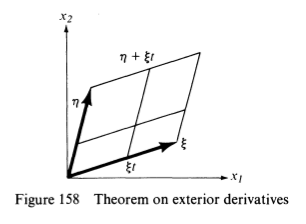
After some parameterization, we arrived at the step:

Claim:

Why is this true? This is just the first-order Taylor expansion of 
Notice: the linear part 


Algebraically, we have:

which is what we want.
Return to Arnold’s PDE
Recall the differential 1-form we were interested comes from the contact structure in 

We now look at the 2-form 

Example: in
The exterior differentiation would give us:

This 2-form gives the negative of the oriented area of the projection of a parallelogram in 
For general 
Suppose the coordinates on 
The exterior differentiation would give us:

This 2-form gives the sum of the oriented area of the projection of a parallelogram in 
Thinking about: Given two vectors 

Claim: The 2-form 
Proof: Let 

Then, 
The RHS is equal to:


Hence, when restricted to the field of contact planes, i.e. 

which is the same as

What does this mean geometrically?


Leave a Reply