Definition of Riemann surface: a complex manifold of dimension 1.
What is a complex manifold?
It is a Hausdorff and 2nd countable topological space X (this is the same as when we discussed differentiable manifolds from before) and the coordinate charts need to not only satisfy the usual consistency condition, but the transition maps must also be holomorphic (i.e. the map preserves angles and orientations).
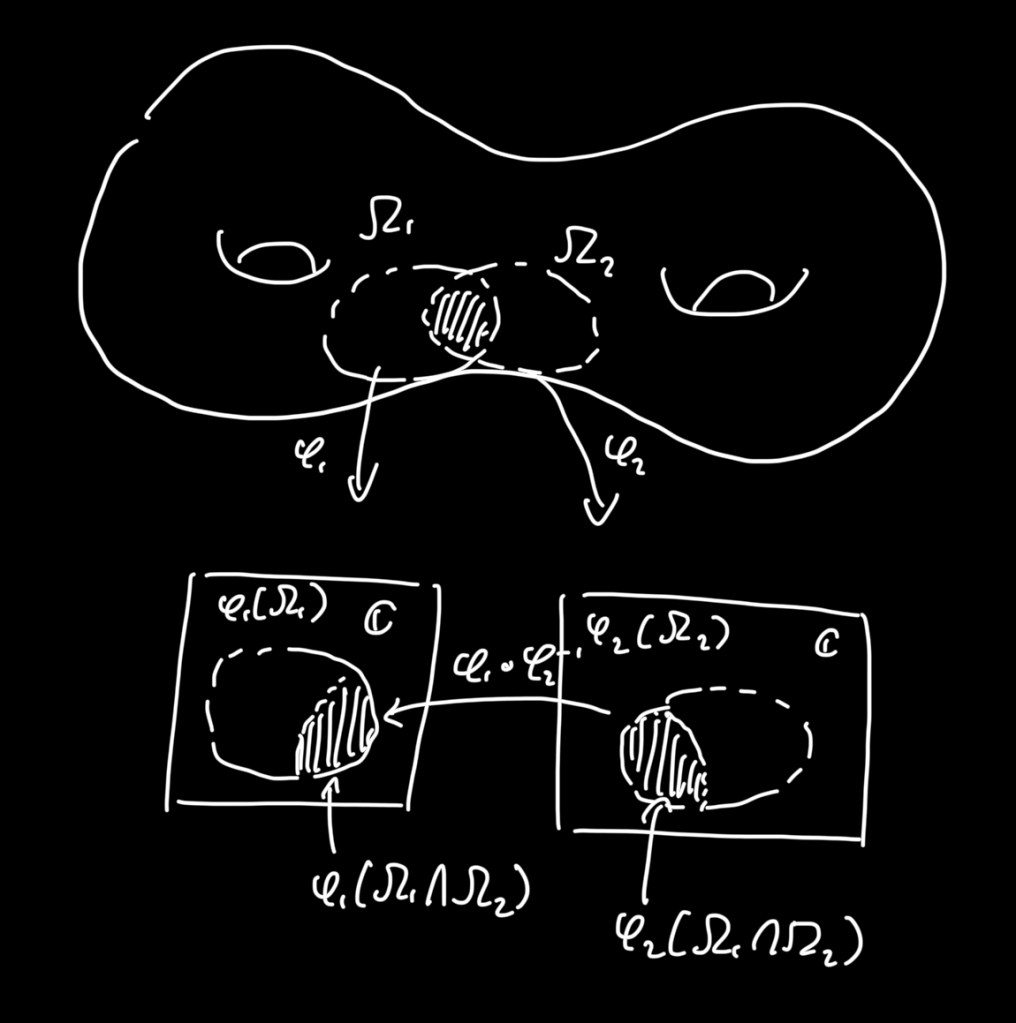
Let’s look at some examples.
Example 1 (an easy one): the Riemann sphere or 

Aside: how can we visualize a line, set of points 

The holomorphic structure on the Riemann sphere is given by the following charts:


The transition map is 


How do we know that there does not exist other non-equivalent atlases on the Riemann sphere?
Example 2 (an important one): this example will be the first Riemann surface we look at which is constructed as the quotient of another simpler Riemann surface under the action of a group.
Aside: there are 2 ways of constructing Riemann surfaces.
- As quotients of other Riemann surfaces under the action of a group
- As complex algebraic curves (will prove in a later post that Riemann surfaces are in fact the same thing as complex algebraic curves)
Consider 


Let’s define a Riemann structure on this surface by defining the following charts:
Let z \in \mathbb{C}$. Consider the disk 


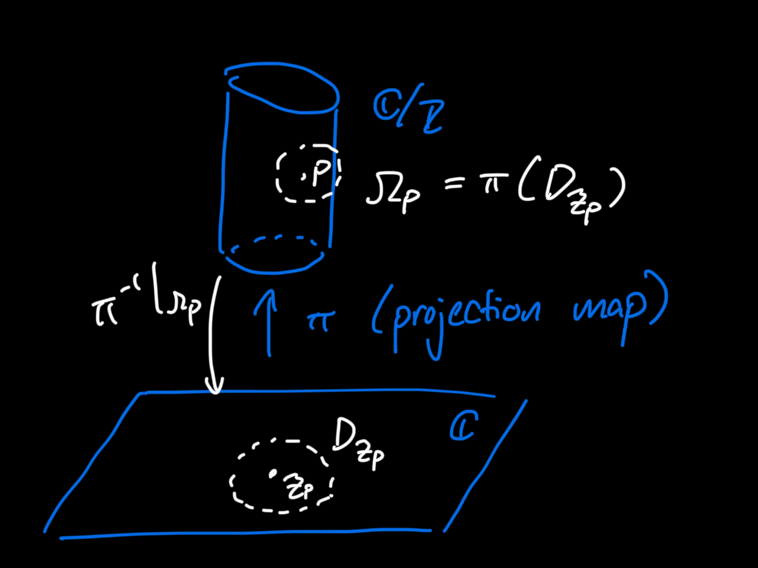
Then, 


We can cover
Claim: the transition maps are either identity or translation by an integer.
This can be shown in the diagram I have attached below:
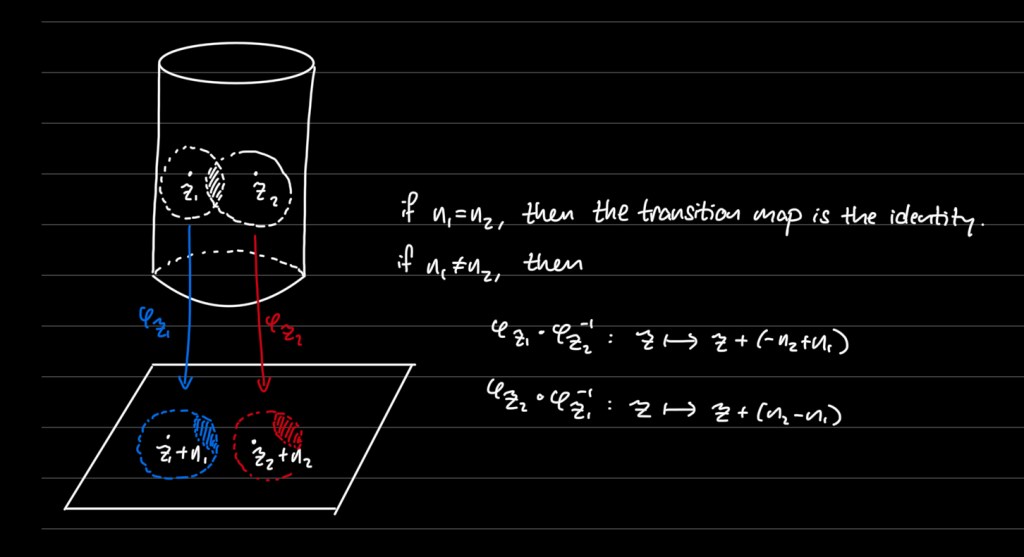
The coordinate map corresponding to a chart depends on our choice of
Prove: the Riemann surface 
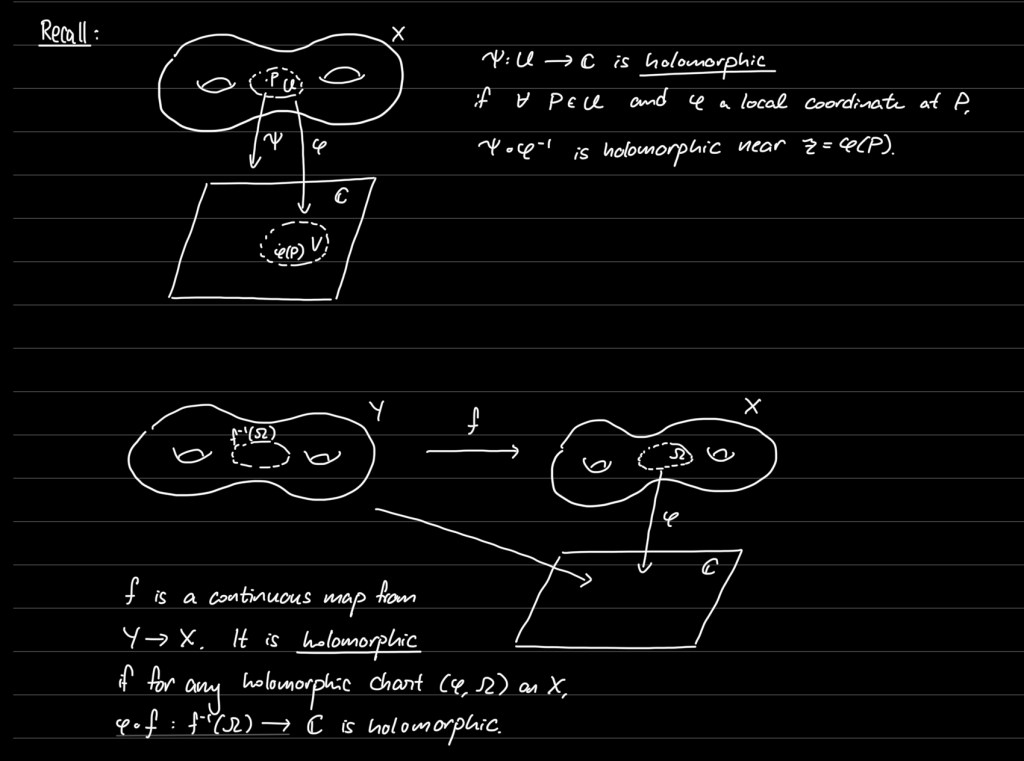
Step 1: Find the continuous map from 
A point in 

We take the exponential map given by:

(it maps the vertical strip 
The inverse map is given by:

Since


is a well-defined and unique point, it follows that the inverse map is well-defined and is injective.
Step 2: Show that this map is holomorphic.
On 


It suffices to show that 
Let 


To show 


Step 3: Show that the inverse map is also holomorphic.
Here, we consider the map 

Since 
Hence, it follows that:


Leave a Reply