This is a discussion of A.4 (Explicit Formula) of the appendix of Arnold’s PDE.
Goal: Show 
In Arnold’s proof, he split the proof into two parts.
First, he showed using the real algebraic theorem to show the existence of a homeomorphism between 

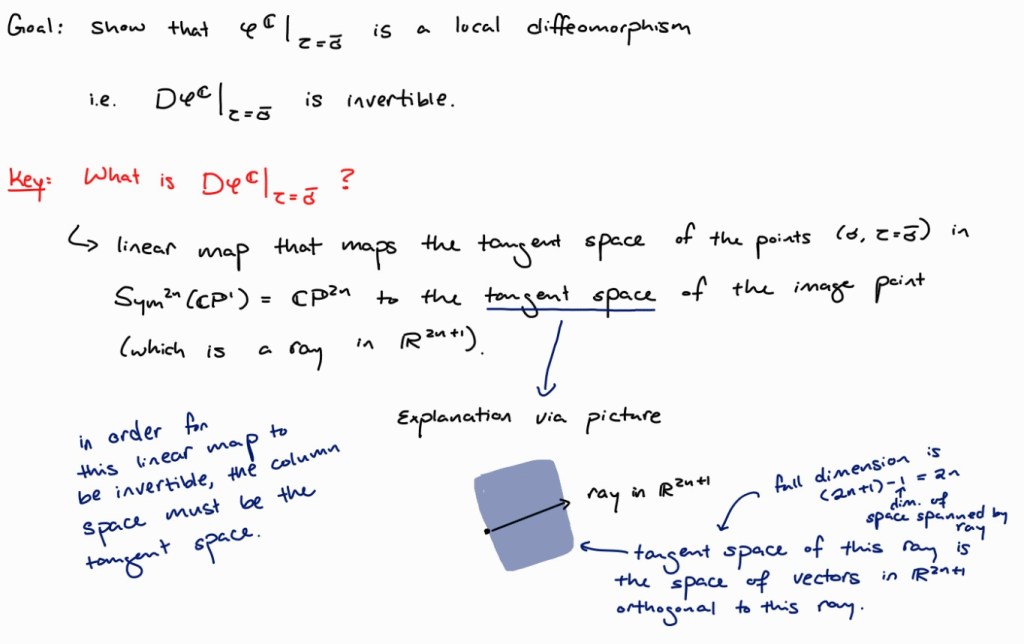
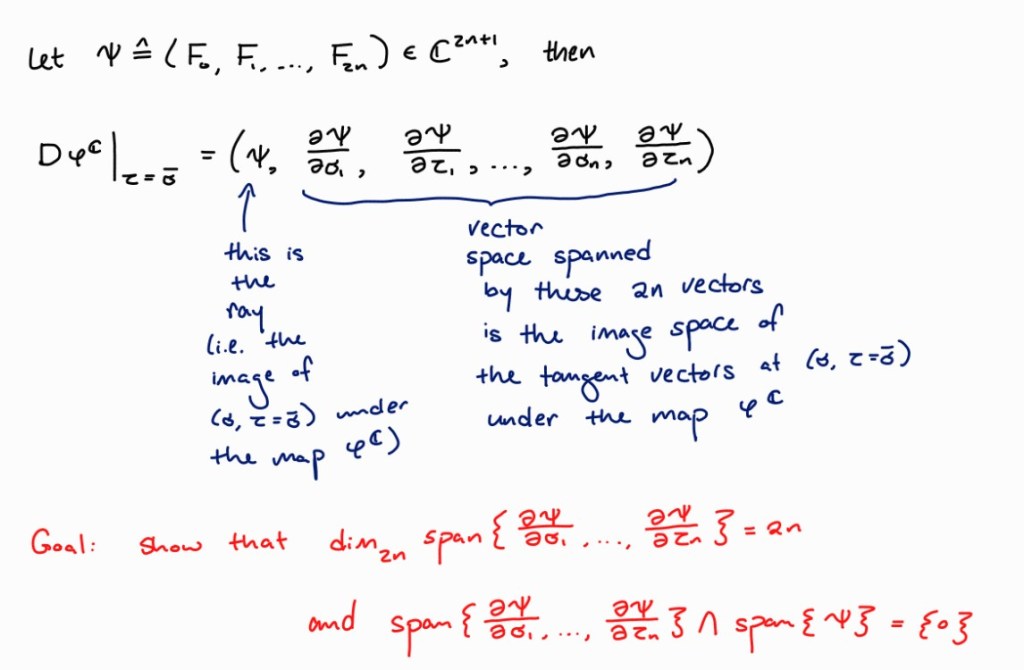
Then, we must show this homeomorphism is a diffeomorphism (it suffices to show that it is a local diffeomorphism).
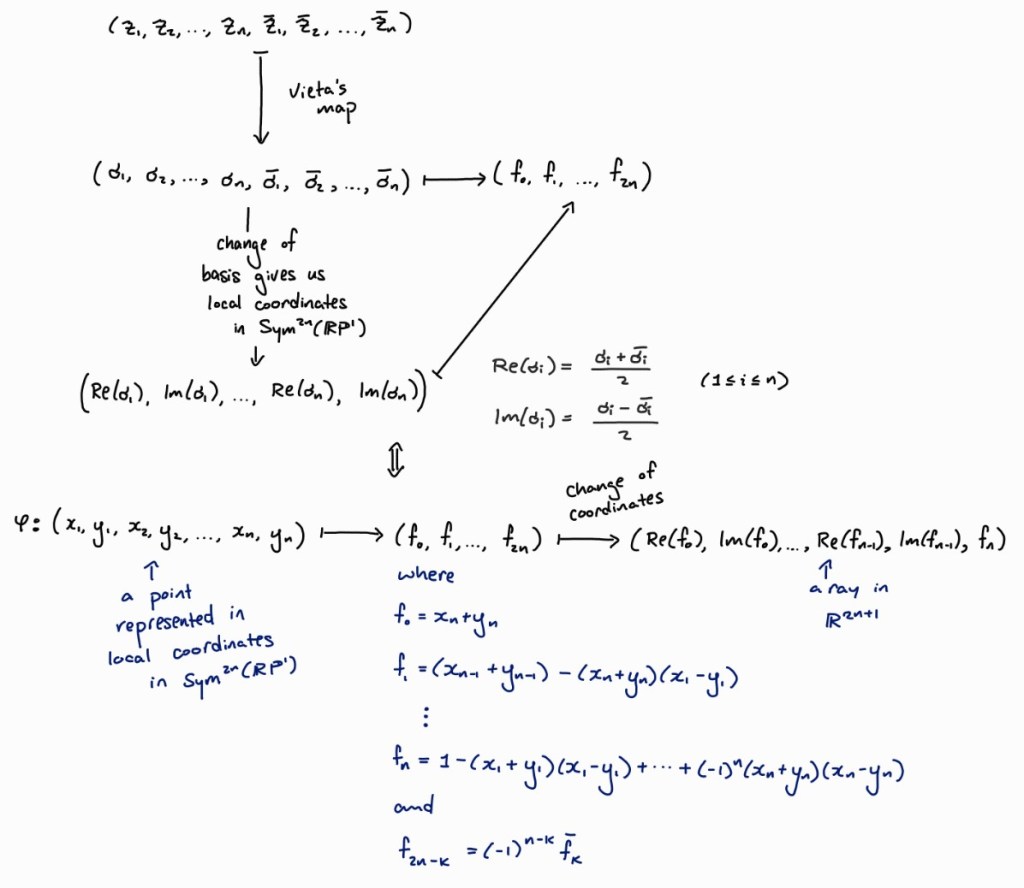
The map we construct is the following:
Given n lines and their Hermitian-orthogonal passing through 0 in 

From each pair, we can choose a representation with a non-zero 


Key: Arnold said that given repeating pairs, we must choose the same representative. This is essential later to showing the Jacobian of our map is non-vanishing. Why?
Consider the following form:

Expanding (*) gives:

where (taken from Arnold’s PDE), the particular expressions are given by:


…

and $latex f_{2n-k} = (-1)^{n-k} \overline{f_k}
Claim: the map 

Proof via an example (can be generalized):
When n = 1, consider:

From the above form, we obtain the map:

this is because 

By a change of coordinate, we have:

which is a ray passing through the origin in 
The ray corresponding to 

i.e. the antipodal ray.
Suppose WLOG 


this point corresponds uniquely to the ray we obtained before and this map (up to ordering of the coordinates) is the one that Arnold had described.
The coefficients of the polynomial 

For a polynomial 

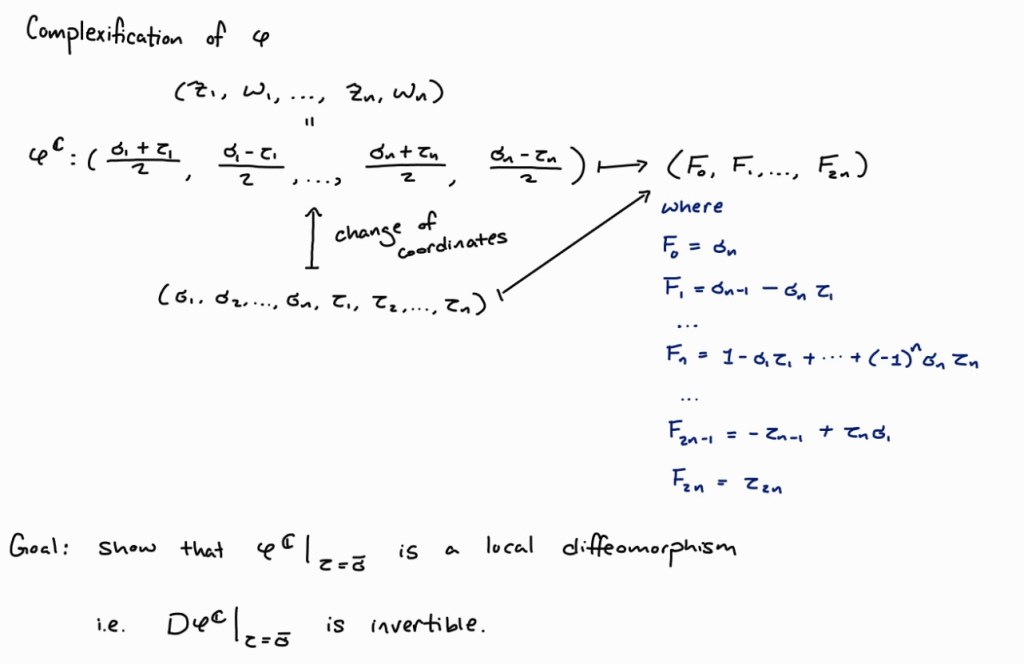
In our case of P(z), the determinant of the Jacobian is:

where 

But what would this determinant be if instead of the map 

We must account for the change of variable:
The determinant of the Jacobian of this transformation is:


Thus, by the chain rule, the determinant of the Jacobian of our map from 


Notice that the determinant vanishes if and only if two roots 
By our choice (no 


This shows that our map is a local diffeomorphism.


Leave a Reply