In his PDE, Arnold says that the Coxeter group B(n) acts on the factors of 
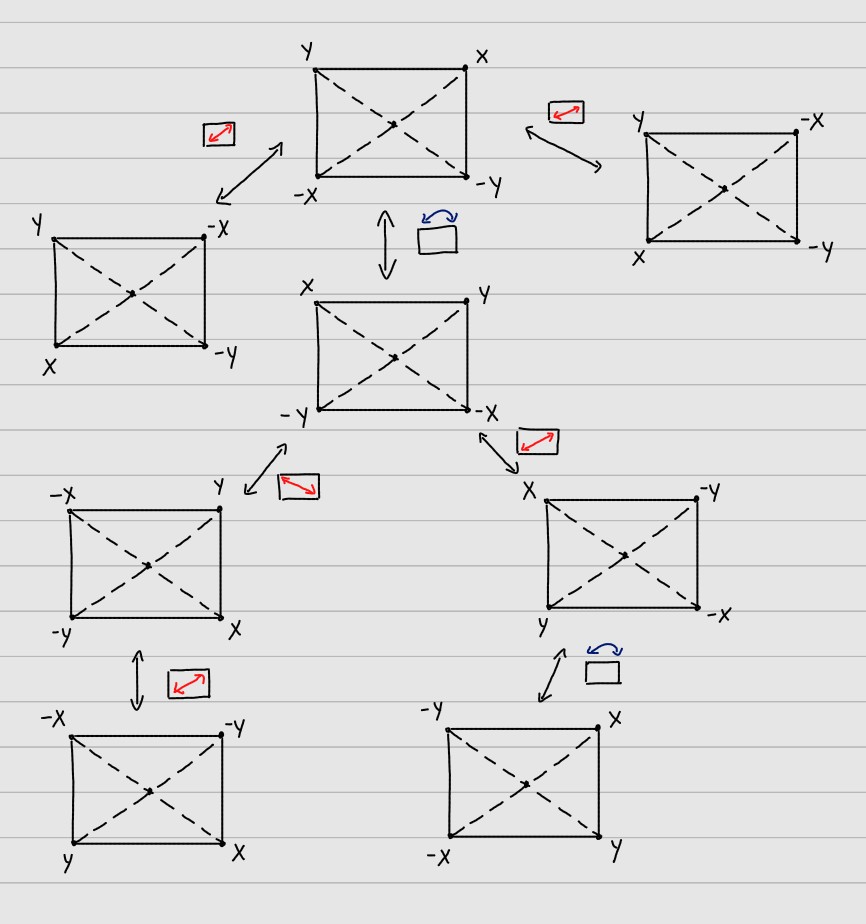
For an example, let’s take B(2) acting on 


Claim: B(2) is 
Intuitively, when we write out the orbit, it definitely seems like this group would be a subgroup of the symmetries of a square. I give a visual proof below:
An interesting theorem (A.2 of Arnold’s PDE)
A real homogeneous polynomial f of degree n has a unique representation as the sum of two polynomials; one of which is the product of n linear real factors, and the other is divisible by 
What is more interesting is a remark that Arnold made afterwards: any real algebraic curve of degree n defined in a projective space determines n real “principal axes”. How does this connect to the theorem above? It is clear that the polynomial f contains a product of n linear real factors, which determine n lines. Are these n lines the principal axes that Arnold is referring to?
The proof of the theorem really uses the idea of quotient to the space of algebraic curves; the ideal is the one generated by 
S does not have any real solution in
Since S is a degree 2 curve (and is irreducible) and f is degree n, it follows by Bézout’s theorem that either S is a component of (f=0), which means that f is a multiple of
Since both (f=0) and S are real algebraic curves, the 2n intersection points consist of n conjugate pairs (and no pairs are real).
These n conjugate pairs give n lines; each pair of points define a line. It follows that these n lines are real, i.e. can be defined by ax + by + cz = 0. We can define g to be the product of these n lines. We now show that 

Key: we parameterize S by setting 

Then, 


Thus, f – cg = 0 on S. Hence, 
Now, the question is: where did we use Maxwell’s theorem in our proof?


Leave a Reply