This post is about something from my algebraic geometry class that has helped me to better understand Riemann surface and the ‘structure’ that we can define on a surface.
Given 4 distinct points on the complex plane, why is the Riemann surface structure that we obtain independent of the cutting (i.e. we assume our cutting to be smooth and non-intersecting)?
Let the 4 points be 

Different cuttings correspond to different choices of branch cuts, but topologically, they are all the graphs of the same function.
Now, we need to show that these different cuttings still give us the same Riemann surface structure. Key: what is the structure that we put on the surface?
The structure is given by a holomorphic function that we define on the surface. But how do we such function?
In neighbourhoods away from the branch points, we can take the function to be 

The following pictures is the graph of 
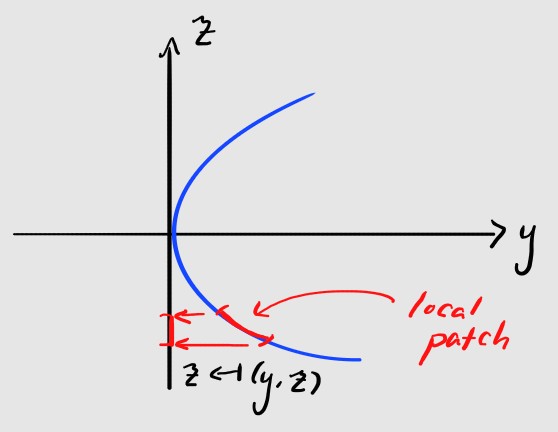
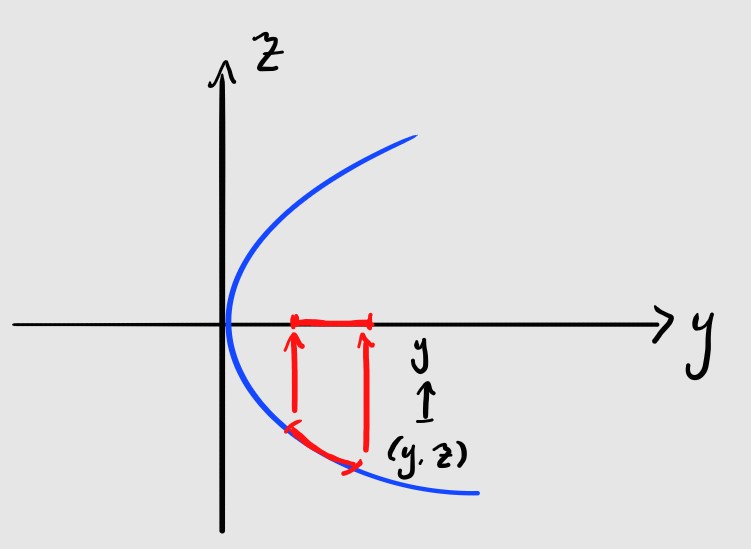
My question: would the space of holomorphic functions defined on this patch be the ring of functions generated by 

Notice at the branch point, we have only ONE choice for our holomorphic function:
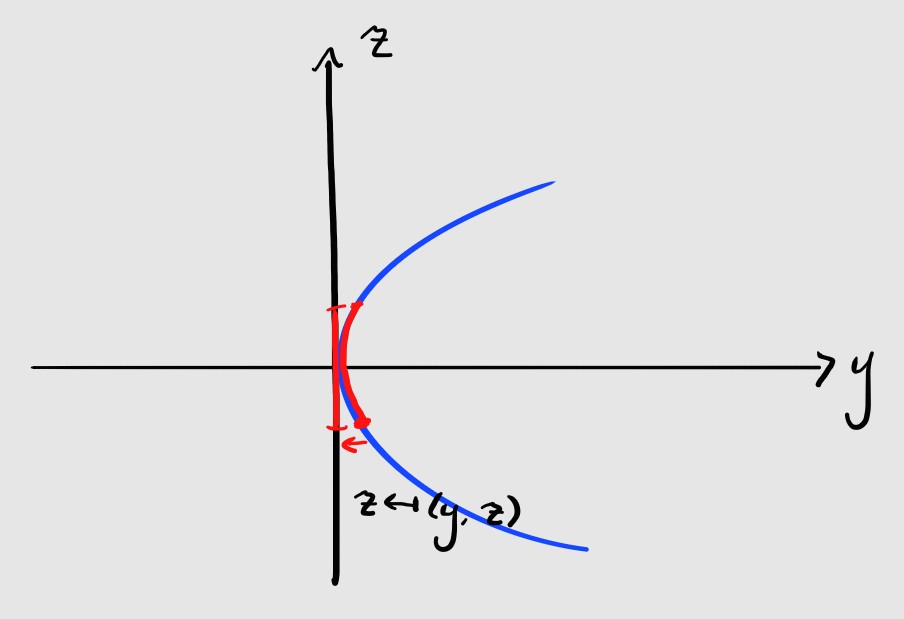
Now, returning back to our original question with the 4 distinct points. What happens near a branch point, say 


The isomorphism between the surfaces arises from the fact that the holomorphic functions that we can define on each of the surface are the same (i.e. away from the branch points and in neighbourhoods of branch points). Note: these are not just holomorphic functions that we have found, they are also bijective. Hence, at each patch, we have found ourselves a local isomorphism between the surfaces. We can extend this isomorphism from patch to patch to obtain a global isomorphism.
Something that I’m still thinking about: the isomorphism between Riemann surfaces defined as graphs of multivalued functions is really only dependent of the monodromy group of our graph (removing bad points). It makes sense because from the above, we see that the only parts where the structure really gets interesting is at the branch points. But why the monodromy group though? Why cannot we simply identify using branch points?


Leave a Reply