We will study equations of the form 
In the (t, x, p)-space, equation (1) defines a surface M. Note that intersection of M with the planes p = C (where C is a constant). are straight lines: 
Similar to what we have done in: https://menagerieofmathematics.wordpress.com/2025/01/13/clairauts-equation-space-of-1-jets/
we will find the integral curves on M (and then, find the integral curves on the (t, x)-plane).
First, we find the direction field (i.e. the field of traces of the contact planes) on M through the relations:


We obtain the 1-form 
Why does this occur? Looking back at the relations, we see that when t = -f’, the tangent plane coincides exactly with the contact plane. These points are exceptional and the set of these points is the discriminant curve t = -f'(p).
On the surface M, the discriminant curve is described by the relation t = – f'(p) and x = pt + f(p). On the (t, x)-plane, this curve can be described by the parameterization 
On the (x, p)-plane, the integral curves are given by p = C (where C is constant). On the surface M, the integral curves are given by (t, Ct + f(C), C). Projecting the curves onto the (t, x)-plane gives us the integral curves
So, what is the relation between the discriminant curve and the integral curves on the (t, x)-plane?
Claim: the integral curves 

The velocity vector at each point on
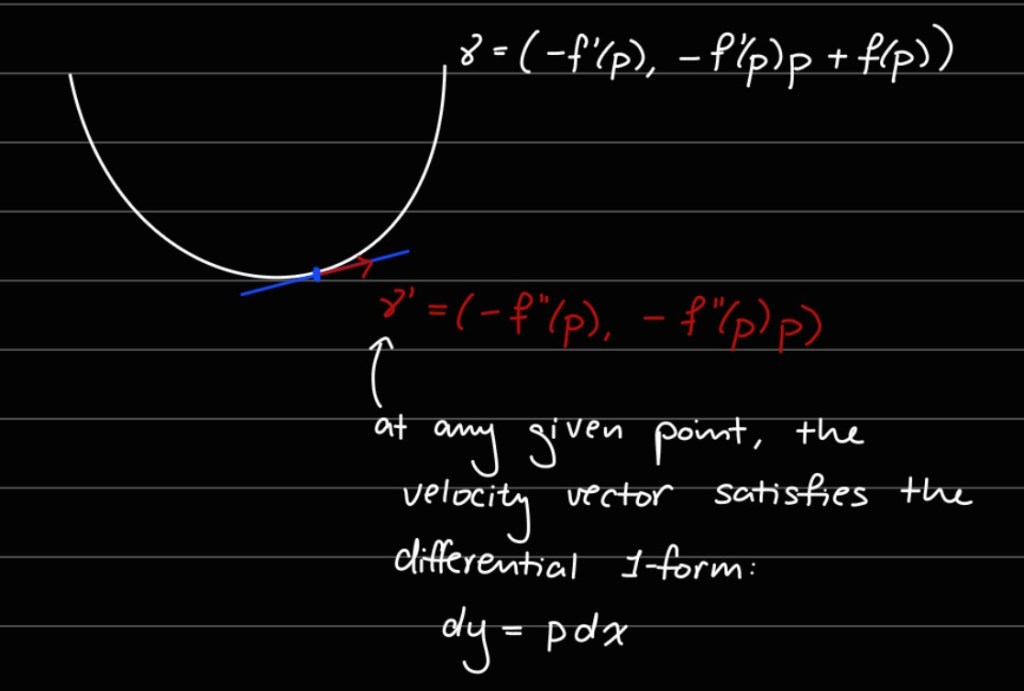

Note that the 1-form 
A Curve and its Family of Tangent Lines
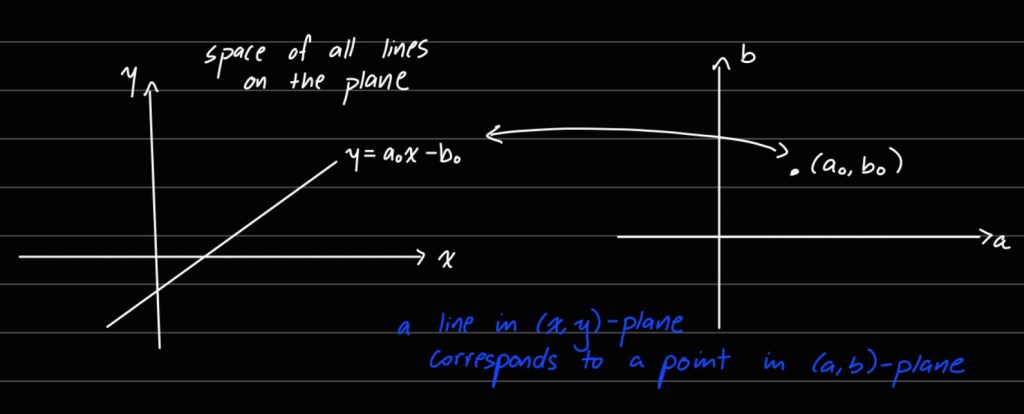
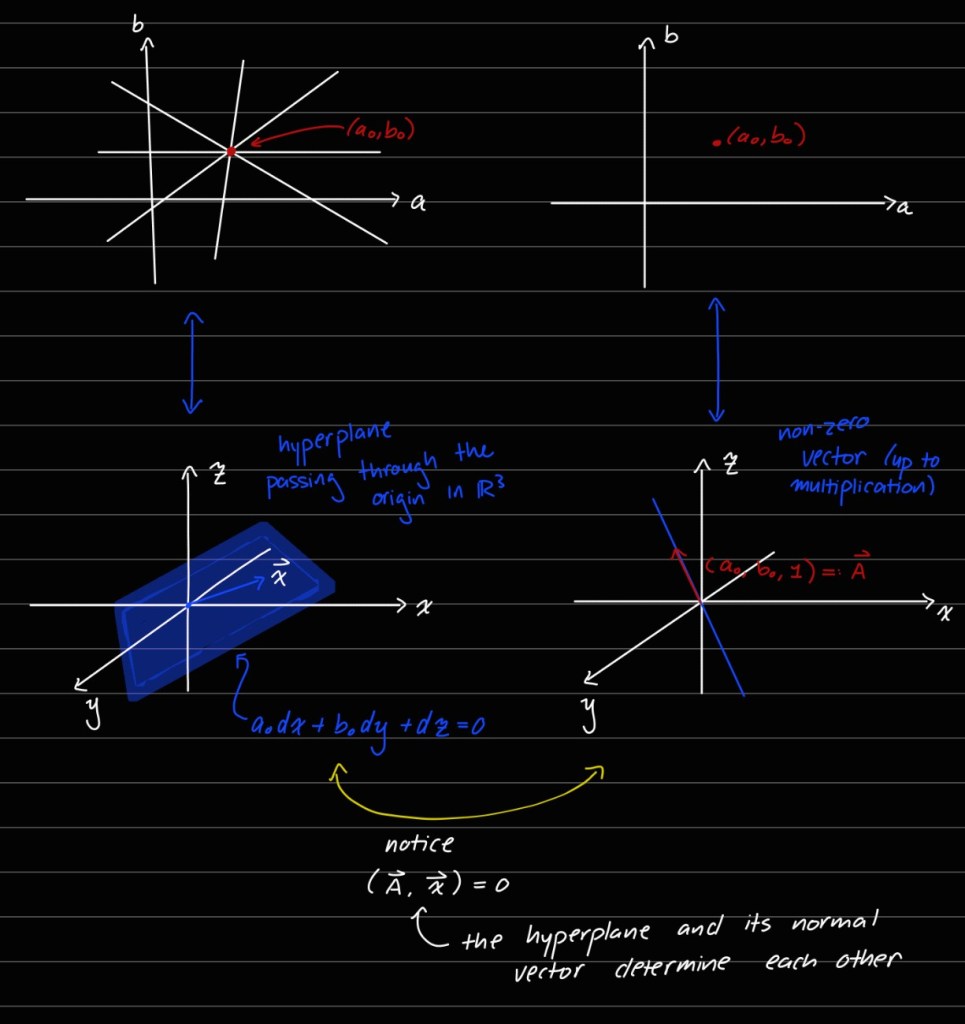
Identifying the plane as the space of all lines (except for the vertical lines) and the dual plane of points:
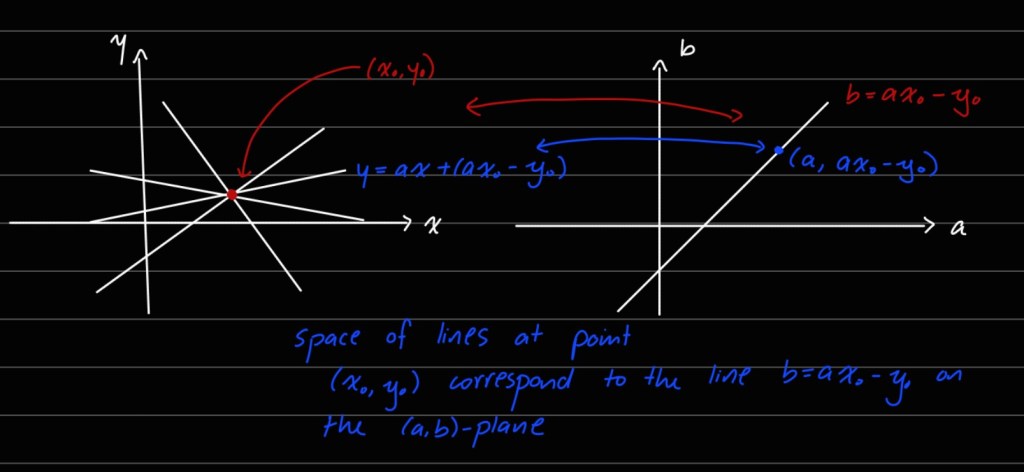
And also
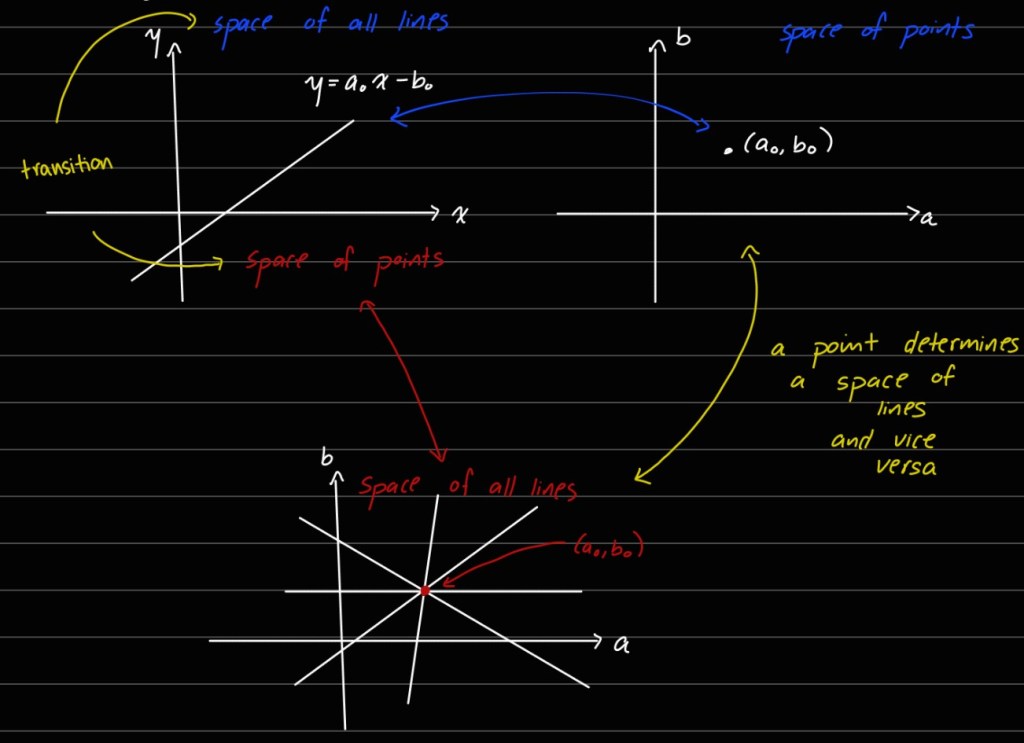
A shift in perspective – how they all connect together.
The duality between a point and the space of lines centered at the point:
Taking this to the 3-dim. space. Duality between a hyperplane (passing through the origin) and its normal vector (up to multiplication by a non-zero constant):


Leave a Reply