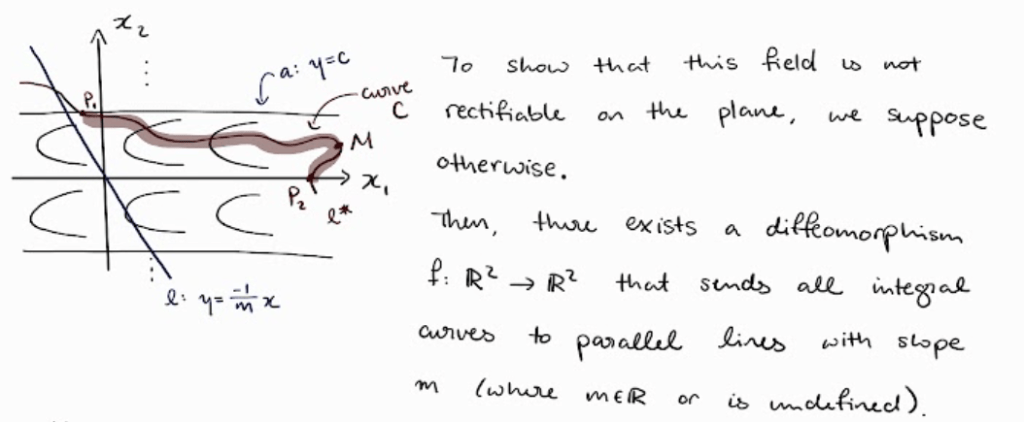
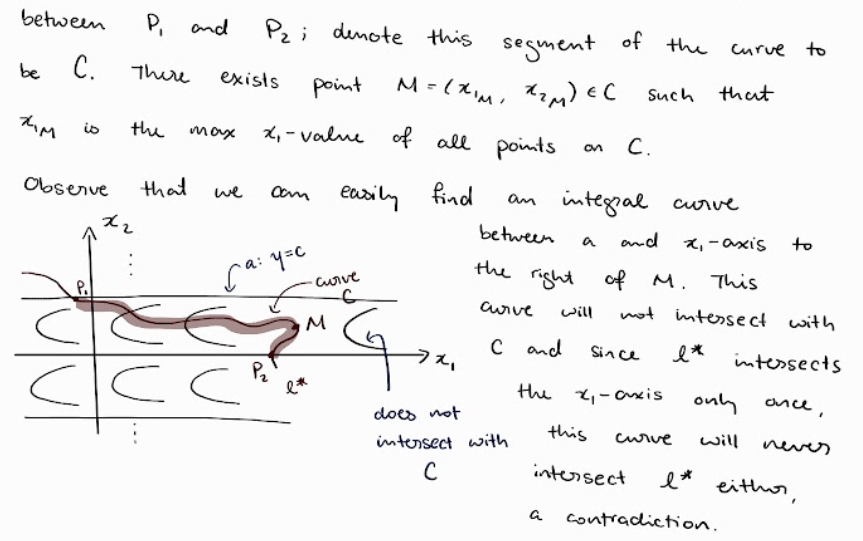
First, we are going to investigate into why the smooth direction field below is non-rectifiable:

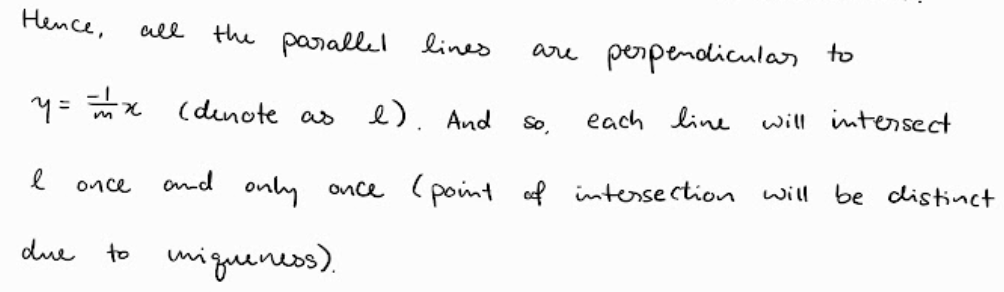
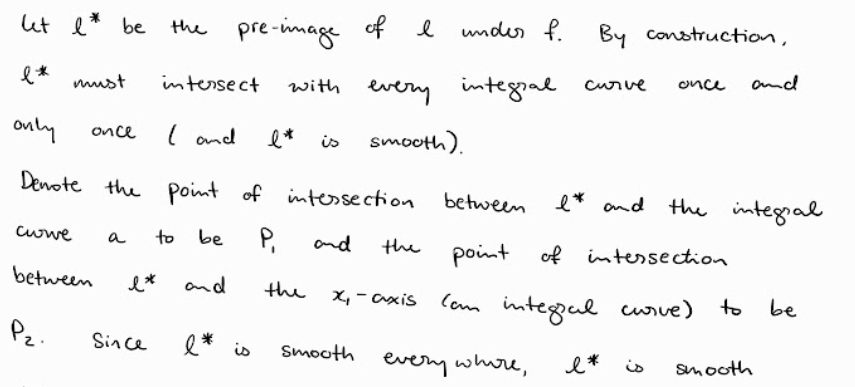
Key idea: diffeomorphism preserves the number of intersections between two curves. So, if the integral curves can all be rectified into parallel lines, then there must exist a line (the image of which is a line perpendicular to the parallel lines on the plane) that intersects with each integral curve once and only once. We are going to show that this is not possible using the Extreme Value Theorem.
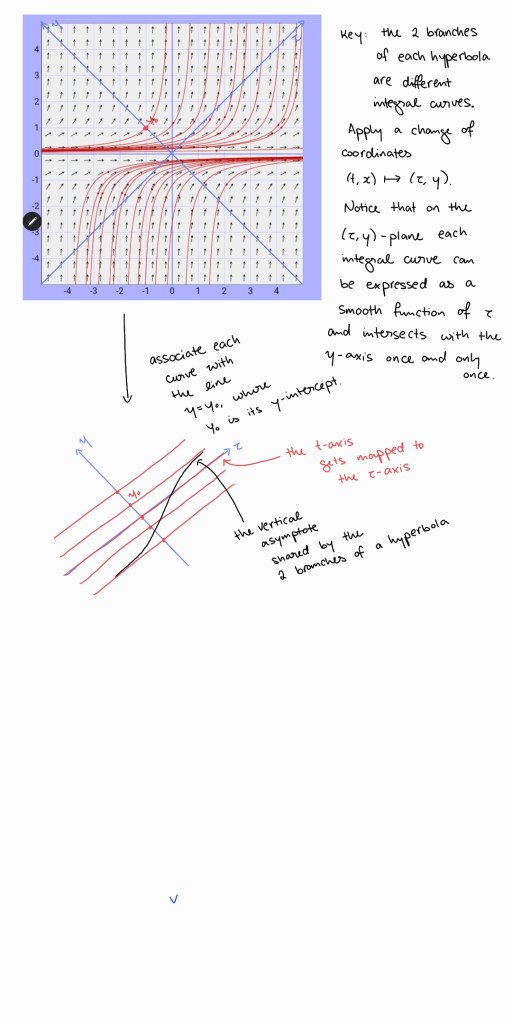
Problem 5. Can a diffeomorphism of the plane map the direction field of the differential equation 
Answer. It is possible, though an explicit formula is difficult to write out.
To be honest, I had not thought it was possible the first time. That was because I thought of the 2 branches of the hyperbola as the SAME integral curve. And so I kept on trying to find a diffeomorphism from a hyperbola to a real line even though I knew it was not possible. I also persisted for a while that finding an explicit formula was more important than potentially just seeing how the diffeomorphism might be.
Anyways, while I was re-reading “Example: The Explosion Equation” that I was once again reminded that on the real plane, the two branches of the hyperbola are 2 integral curves. I think the reason that I forgot this earlier was that I kept on confusing integral curves with phase flows… (now, I know better).
Once that made sense, looking at these curves from a coordinate system completely resolved the singularities:


Leave a Reply